Does Assembling An Aquarium Floating Fish Feed Extruder Machine Require Specialized Skills?
Leave a message
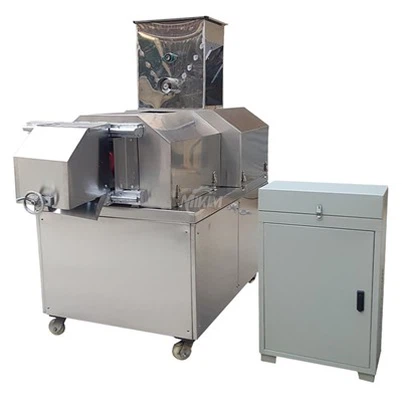
Human-centered design is key to reducing assembly difficulty. Small and medium-sized fish feed making machines often employ a modular structure, integrating core components such as the motor, reducer, and barrel into relatively independent modules. Assembly eliminates the need for complex wiring connections and mechanical adjustments. The manufacturer's instruction manual is richly illustrated, with high-definition images and QR codes for operation videos accompanying key steps. Scanning these codes allows access to detailed demonstrations, and warnings such as "Important Notes" and "Do Not Operate" are clearly marked to effectively prevent incorrect operation.
The assembly process is clear and can be completed in three steps. The first step is to secure the machine base. Small and medium-sized fish feed extruder machines are lightweight (typically 50-100kg), allowing two people to move them. Secure the machine to a flat surface using expansion bolts. No professional leveling tools are needed; simply use a standard spirit level to center the bubble. The second step is to install the core working module. Connect the barrel and screw module to the base. The module interface uses a locating pin design; align them and gently push them in to complete the positioning, then secure with bolts. The operation is simple and precise. The third step is to connect the electrical system. The motor and control panel use a plug-in connection, with color-coded interfaces (red for live wire, blue for neutral wire). After connecting, tighten the fixing nuts.
The debugging process after assembly is simple and easy to operate. After connecting the power, perform a no-load test by pressing the start button and observing whether the equipment runs smoothly and without abnormal noise. After running for 5 minutes, touch the motor casing; if the temperature does not exceed 40℃, it is normal. Next, perform a load test by adding a small amount of the mixed raw materials and observing the pellet formation. If the pellets are loose, the pressure of the pressure rollers can be adjusted using the knobs on the control panel. The operation is intuitive and convenient. Overall, the low assembly difficulty of small and medium-sized floating fish feed machines is one of the important reasons for their widespread use, and users do not need to worry excessively.
Why choose us?
The MIKIM's floating fish feed extruder machine is constructed entirely of food-grade 304 stainless steel, fully complying with food processing hygiene standards. It is corrosion-resistant, easy to clean, and eliminates potential contamination at the source. The core screw is made of high-quality alloy steel through special heat treatment, offering outstanding wear resistance and corrosion resistance. Combined with its integrated structural design, this significantly extends its service life. The entire machine has passed CE and ISO international authoritative certifications, aligning with global quality standards and ensuring safer and more reliable processing.
Our equipment



Our Services
We offer:
One-Year Whole Machine Warranty Service
On-site Installation, Commissioning, and Technical Guidance
24/7 Online Technical Support
Qualifications and Honors

Customer visit

FAQ
1. What is the price of the fish feed processing machine?
The price ranges from approximately $1,500-$50,000
2. How do you deliver to customers?
MIKIM Machinery's machinery delivery follows a complete process of "customized preparation - safe and fast delivery - precise handover - after-sales extension", with 3-day fast delivery, multi-layer protective packaging, global logistics tracking and 1-year warranty + on-site technical service to ensure that the equipment is delivered efficiently and in good condition and put into use smoothly.