How To Fix The Clicking Noise in A Small Cat Food Making Machine?
Leave a message
content
The core cause of the abnormal noise: Motor failure + abnormal transmission components, resulting in unbalanced power transmission
The clicking noise caused by a faulty motor and transmission system in a small cat feed extruder machine is fundamentally due to an unbalanced power transmission. This leads to unstable screw operation and subsequent collisions. Specifically, there are two scenarios: First, motor failure. Small extruders often use small asynchronous motors (1.5-5kW). If the motor bearings are worn or the rotor is eccentric, the motor will vibrate during operation. This vibration is transmitted to the linkage shaft and screw, causing the screw to rotate eccentrically and collide with the barrel and die, producing a clicking noise. This is accompanied by increased motor heat and noise. Second, abnormal transmission system. A loose or worn drive belt will slip and wobble during operation, resulting in unstable power transmission and fluctuating screw speed, causing collision noises. Worn or loose gears will result in poor gear meshing, producing a clicking noise. Simultaneously, interrupted or unstable power transmission causes the screw to rotate unevenly, leading to subsequent collision noises.
Troubleshooting Methods: Differentiating Between Motor and Transmission System Faults to Avoid Misdiagnosis
Accurately identifying the fault type is key to quickly resolving abnormal noises. Based on the structural characteristics of the small cat food maker machine, three signals can be used for differentiation:
1. Location of the noise: If the noise originates from the motor and is accompanied by motor heating and vibration, and appears immediately after startup, unrelated to material feeding, it is most likely a motor fault. If the noise originates from the connection between the motor and screw, or the drive belt, and is accompanied by screw speed fluctuations and uneven material output, it is most likely a transmission system fault.
2. Operational test: Run the equipment idle (without feeding). If a clicking noise persists, and the noise is related to the speed (more pronounced at higher speeds), it indicates a motor or transmission system fault, unrelated to materials or foreign objects. If there is no noise during idle operation but it appears after feeding, it indicates a material or foreign object problem.
3. Component inspection: Check for loose or worn drive belts, worn or poorly meshed gears, and loose or jammed motor bearings to further confirm the fault location.
Troubleshooting Techniques and Maintenance Points: Targeted Repairs to Ensure Stable Power
For clicking noises caused by motor and transmission system malfunctions, the principle of "targeted repairs and regular maintenance" is adopted to ensure stable power transmission and prevent recurrence of the noise. First, for motor malfunctions: worn motor bearings require replacement with specialized bearings and the addition of high-temperature resistant lubricating oil; rotor eccentricity requires contacting a professional repair technician to calibrate the rotor to prevent motor vibration; motor overheating requires checking the motor cooling fan, cleaning the cooling channels, and preventing motor overload operation. Second, for transmission system malfunctions: loose drive belts require adjusting the tensioning device and tightening the belt; severely worn belts require direct replacement with a suitable drive belt; worn gears or poor meshing require grinding and repairing the gears or direct replacement, and tightening the gear connecting bolts to ensure smooth meshing. Thirdly, key points for daily maintenance: check the motor's operating status monthly, clean the heat dissipation channels, and replenish lubricating oil; check the connection of the transmission belt, gears, and linkage shaft weekly, tighten loose parts, and replace worn parts; avoid long-term high-intensity operation of the equipment, and regularly stop the machine to cool it down, extend the service life of the motor and transmission system, while ensuring smooth screw operation and reducing the occurrence of clicking noises in the small cat food extruder machine.
Our equipment


Why choose us?
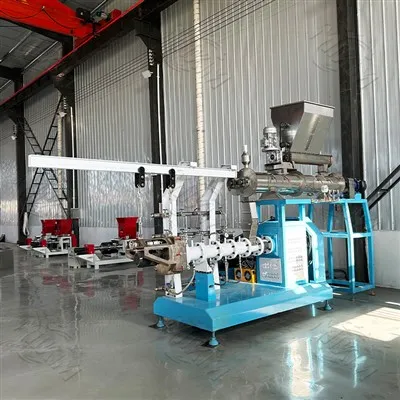
The MIKIM's floating fish feed extruder machine is constructed entirely of food-grade 304 stainless steel, fully complying with food processing hygiene standards. It is corrosion-resistant, easy to clean, and eliminates potential contamination at the source. The core screw is made of high-quality alloy steel through special heat treatment, offering outstanding wear resistance and corrosion resistance. Combined with its integrated structural design, this significantly extends its service life. The entire machine has passed CE and ISO international authoritative certifications, aligning with global quality standards and ensuring safer and more reliable processing.
Our Services
We offer:
One-Year Whole Machine Warranty Service
On-site Installation, Commissioning, and Technical Guidance
24/7 Online Technical Support
Qualifications and Honors

Customer visit

FAQ
1. What is the price of the small cat food pellet machine?
The price ranges from approximately $1,500-$50,000
2. How do you deliver to customers?
MIKIM Machinery's machinery delivery follows a complete process of "customized preparation - safe and fast delivery - precise handover - after-sales extension", with 3-day fast delivery, multi-layer protective packaging, global logistics tracking and 1-year warranty + on-site technical service to ensure that the equipment is delivered efficiently and in good condition and put into use smoothly.