


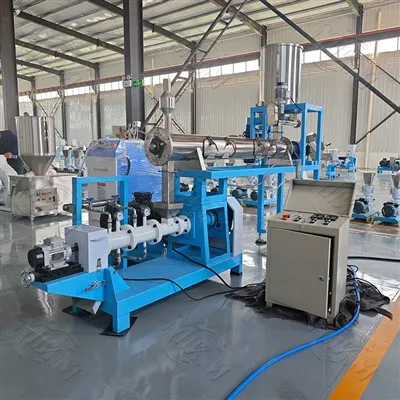
What Is The Core Content Of The Animal Floating Food Extruder Line?
Leave a message
content
1. Production line composition for making fish meals: Primarily made of wear-resistant materials, with grading components ensuring uniformity. The system mainly consists of a "wear-resistant storage silo," an "alloy spiral auger," a "grading mixer," and a "pressure sensor." The inner wall of the wear-resistant storage silo has an anti-scratch coating; the alloy spiral auger is made of high-strength wear-resistant alloy; the grading mixer has multi-layered blades; and the pressure sensor is installed at the auger outlet to monitor the feeding pressure.
2. Working principle of the floating fish food making production line: Pre-grinding followed by uniform mixing, preventing calcium powder accumulation. Raw materials such as shell powder and fish meal first enter the wear-resistant storage silo to prevent hard particles from scratching the silo wall. Then, the alloy spiral auger feeds the raw materials forward. The wear-resistant material of the auger can withstand the wear of shell powder, and its service life is 3 times longer than that of ordinary augers. After the raw materials enter the grading mixer, the multi-layered blades rotate, thoroughly mixing the coarse shell powder and fine fish meal, ensuring that every scoop of raw materials contains calcium powder. If the pressure sensor detects that the feeding pressure is too high (indicating raw material accumulation), it will automatically slow down the auger speed; if the pressure is too low, it will speed up to ensure stable feeding.
3. Core Advantages of the Floating Fish Meal Making Production Line: Wear-resistant and durable, ensuring high-quality shrimp feed: The alloy auger solves the problem of calcium powder wear on equipment, eliminating the need for frequent auger replacements and reducing maintenance costs. Graded mixing improves the uniformity of calcium powder mixing by 50%, ensuring each shrimp pellet contains sufficient calcium, resulting in hard shells, thick flesh, less vulnerability to attack from other shrimp, and a 25% increase in survival rate. Furthermore, feeding is stable, with consistent pellet size and hardness, allowing even juvenile shrimp to easily peck at the feed and preventing slow growth due to overly hard feed. The system has an exceptionally low failure rate; wear-resistant components reduce maintenance frequency, making it suitable for 24-hour continuous production to meet peak shrimp feed demand.


about Us
Qualifications and Honors

Customer visit

FAQ
1. What is the price of the floating shimp feed extruder production line?
The price ranges from approximately $10,000-$44,000
2. Do you provide maintenance services for your customers?
Yes, we offer comprehensive after-sales maintenance services to our customers.


