Dry Pet Food Manufacturing Process: Step-by-Step Extrusion Guide
Leave a message
Stage 1: Raw Material Pretreatment and Grinding
Pretreatment is the foundation of a uniform finished product. Core ingredients such as corn, soybean meal and meat meal are screened to remove impurities and spoiled particles before grinding. The screened material is then pulverised to a fine flour, typically in the range of 80 to 120 mesh. Moisture of the ground meal is controlled between about 10 and 15 percent, which is a core requirement of the dry route: a wetter meal sticks and blocks the extruder, while a drier meal generates too little frictional heat and cooks incompletely. A magnetic separator is fitted in the transfer line to pull out metal fragments before they reach the screw and die, since tramp metal is a common cause of screw scoring and die damage.
Stage 2: Batching, Mixing and Transfer
Ground grain flour, meat meal, vegetable powder and the vitamin and mineral premix are weighed to formula and charged into a twin-shaft paddle mixer, where they are blended for about 5 to 10 minutes to reach a mixing uniformity better than about 95 percent. Mixing time is not a free variable: too short a cycle leaves nutrient pockets in the batch, and too long a cycle separates components of different bulk density. After mixing, the material is transferred to the extruder feed inlet through a sealed pipe so that it cannot pick up moisture or contamination on the way.
Stage 3: Extrusion and Cooking
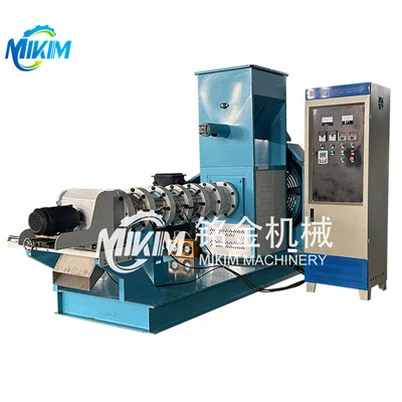
Extrusion is the core of the dry route. The dry extruder adds no water and no steam; heat and pressure come entirely from the rotation of the screw, typically running at 300 to 600 rpm, and from friction against the extrusion chamber wall. Inside the barrel the material is cooked at roughly 120 to 160 degrees Celsius and 3 to 8 MPa. The temperature and residence time are set to eliminate vegetative pathogens such as Salmonella, while the pressure and shear gelatinise the starch and partially denature the protein, which is what raises digestibility. At the die, the pressure drops instantly and the material expands into a porous, crisp granule. Die hole diameter is selected against the target animal size and can be changed to produce kibble from about 2 to 8 mm.
Stage 4: Drying and Cooling
Kibble leaving the die carries roughly 20 to 25 percent moisture, and it must be dried before it can be stored. A mesh belt dryer operating with hot air at about 80 to 100 degrees Celsius for 15 to 20 minutes brings the moisture below about 12 percent, which is the band that gives a stable shelf life. Dried kibble leaves the dryer above about 60 degrees Celsius and goes straight into a cooler, where forced air circulation brings it to ambient temperature. This step is not cosmetic: residual heat in the core of a bagged kibble condenses moisture and starts mould growth, so cooling is a preservation step as much as a handling step.
Stage 5: Screening, Grading and Packing
After cooling, the product is screened to remove broken and oversized granules, and only kernels inside the target size band go forward. The screened product is packed into sealed bags to protect against moisture regain and oxidation. Rejected material is returned upstream rather than blended into the finished product, because mixing off-size kernels back into the stream is what makes bag-to-bag consistency drift.
Process Settings Summary
| Parameter | Typical setting | What it controls |
|---|---|---|
| Grind fineness | 80-120 mesh | Mixing uniformity, cooking rate |
| Meal moisture before extrusion | 10-15 % | Frictional heat, blockage risk |
| Mixing time | 5-10 min | Nutrient distribution |
| Screw speed | 300-600 rpm | Shear, temperature rise, output |
| Barrel conditions | 120-160 C, 3-8 MPa | Starch gelatinisation, pathogen control |
| Die hole diameter | 2-8 mm | Kibble size |
| Dryer setpoint | 80-100 C, 15-20 min | Final moisture, shelf life |
Standards Applied to Dry Pet Food
Process control at the plant level follows EN ISO 12100 and EN 60204-1 for machinery, while product testing uses ISO 6496 for moisture, ISO 5983-2 or ISO 16634-1 for crude protein, ISO 6492 for fat, ISO 6865 for crude fibre and ISO 6579-1 for Salmonella detection. Hygiene obligations for the producing plant sit under Regulation (EC) No 183/2005, with additives governed by Regulation (EC) No 1831/2003 and undesirable substances limited by Directive 2002/32/EC. Complete dog food for the Chinese market is checked against GB/T 31216 and complete cat food against GB/T 31217.
Frequently Asked Questions
Q: Why must the ground meal moisture be kept between 10 and 15 percent?
A: That band gives enough moisture for starch gelatinisation and enough friction for the dry extruder to cook the material. Outside it, the meal either blocks the barrel or cooks incompletely.
Q: How long should the mixer run to reach acceptable uniformity?
A: About 5 to 10 minutes in a twin-shaft paddle mixer, which normally brings mixing uniformity above about 95 percent. Longer cycles risk separating components of different bulk density.
Q: What temperature and pressure does a dry extruder reach?
A: Roughly 120 to 160 degrees Celsius and 3 to 8 MPa at screw speeds of 300 to 600 rpm. Heat comes from friction, not from an external steam supply.
Q: What moisture should kibble have after drying?
A: Below about 12 percent, starting from roughly 20 to 25 percent at the die. The dryer runs at about 80 to 100 degrees Celsius for 15 to 20 minutes to reach that level.
Q: Which standards are used to test the finished kibble?
A: Moisture to ISO 6496, crude protein to ISO 5983-2 or ISO 16634-1, fat to ISO 6492, crude fibre to ISO 6865 and Salmonella to ISO 6579-1, with GB/T 31216 or GB/T 31217 applying to complete dog and cat food in China.