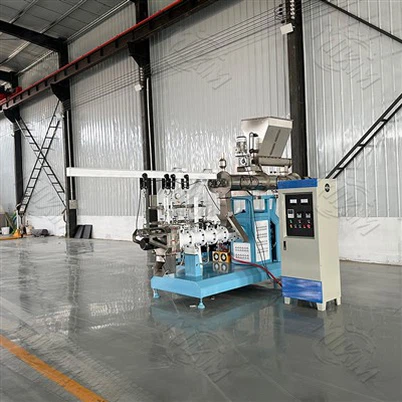
Low-Price Slow Sinking Fish Feed Machine
The slow sinking fish feed machine is a small aquafeed extruder for producing dense and gradually sinking fish feed pellets on farms and small aquaculture businesses. Available in DGP and LX models with capacities from 40-350 kg/h, it can process corn, soybean meal, fish meal, rice bran, and other local ingredients into customized fish feed.
Description
A slow-sinking fish feed machine is the cheapest legitimate way to start making your own dense, gradually-sinking aquafeed at home. If you run a backyard pond or a small tilapia-and-catfish setup, buying bagged feed already eats 50-70% of your production cost (De Heus). A small DGP or LX single-screw extruder flips that math by turning local ingredients into sinking feed at 30-40% lower cost.
Picture this: every morning you scoop imported pellets from a sack that cost more than the fish are worth this week. Now picture a small machine in your shed turning corn, soy, and fish trim into pellets your catfish actually reach. That second picture is why a Slow-sinking fish food pellet making machine has become the practical starting point for smallholders across Asia, Africa, and Latin America.
You care about one number - payback. We'll show you what "slow sinking" really means, which small DGP and LX models fit a backyard budget, and exactly how self-production cuts feed cost by 30-40%. You'll also see that one machine can make both sinking and slow-sinking feed, and that beginners can run it without an engineering degree.

Key Takeaways
- A Slow-sinking fish feed pellet mill (small DGP-40/60/70 or LX-45/65/75/85) outputs 40-350 kg/h of dense, gradually sinking pellets.
- Self-producing feed cuts purchased-feed cost by 30-40% - the single largest farm expense.
- One machine makes both sinking and slow-sinking feed by adjusting moisture, die hole, and screw speed.
- LX models add reinforced screws and larger conditioners for steadier output at the same low price point.
- MIKIM ships these CE/ISO-certified mini extruders with on-site or remote training, spare parts, and a 1-year warranty.
1. What Is a Slow-Sinking Fish Feed Machine?
A Slow-sinking fish food extruder machine is a compact single-screw extruder tuned to produce pellets with density just above water. Instead of plummeting to the bottom like a hard pellet, or floating like expanded feed, the pellet drifts down through the water column over several seconds to a minute. That "slow sink" delivers feed to mid-water and bottom feeders at the same time.
The term comes from extrusion science: by holding the mash at near-neutral density - extruded but barely expanded - you create a pellet that hangs in the column (slow-sink feeds are extruded to near-neutral density, which is vital for mid-water feeders). For a small mixed pond, one slow-sinking ration can feed tilapia near the surface and catfish on the bottom without waste.
Unlike the larger sinking fish feed pellet machine line or a fast-sinking hard pellet mill, the small DGP and LX extruders deliver extruded quality with a gentle sink at a cottage-scale price.


2. Slow Sinking Fish Feed Machine vs. Sinking Feed: Which Fish Needs Which?
| Feed type | Density | Sink behavior | Best for |
|---|---|---|---|
| Fast sinking (hard/dense extruded) | >1 g/cm3 | Drops at once | Catfish, shrimp, carp, eel |
| Slow sinking (near-neutral extruded) | ≈1 g/cm3 | Drifts down gradually | Tilapia, crucian carp, mixed/ juvenile stock |
| Floating | <1 g/cm3 | Stays on surface | Surface feeders, easy waste monitoring |
Strict bottom dwellers - catfish, shrimp, carp, eel - need feed that reaches the floor. Mid-water and mixed-stock ponds benefit from slow sinking feed that spreads through the column so weaker fish aren't crowded out at the surface. A Slow-sinking fish feed machine lets a small farmer cover both zones with one recipe, adjusting sink speed as the school grows.

3. Slow Sinking Fish Feed Machine Model Specs (DGP & LX 40-350 kg/h)
The mini range shares mechanical DNA with the DGP sinking fish feed pellet machine line but is priced and sized for startups. LX models use a reinforced screw and a slightly larger conditioner for steadier low-volume output.
| Model | Capacity (kg/h) | Power (kW) | Screw Dia. (mm) |
|---|---|---|---|
| DGP-40 | 40-50 | 5.5 | Φ40 |
| DGP-60 | 120-150 | 15 | Φ60 |
| DGP-70 | 200-250 | 18.5 | Φ70 |
| LX-45 | 40-50 | 5.5 | Φ40 |
| LX-65 | 120-150 | 15 | Φ60 |
| LX-75 | 200-250 | 18.5 | Φ70 |
| LX-85 | 300-350 | 22 | Φ80 |
For most backyard operations, the DGP-60 or LX-65 at 120-150 kg/h is the sweet spot: enough for a 0.5-2 ha pond, yet small enough to run on a single-phase supply in many regions. The LX-85 pushes to 350 kg/h for a small commercial sideline.
Buyer's Checklist: 5 Things to Verify Before Buying a Low-Price Slow-Sinking Fish Feed Machine
A low sticker price means little if the machine cannot actually deliver dense, slowly-sinking pellets day after day. Before you commit, verify these five points so your Slow-sinking fish feed processing machine earns its keep instead of becoming a shed ornament.
- Motor and screw warranty: Confirm the main motor and the wear-prone screw are covered, and for how long. A mini extruder lives or dies by its screw, so a clear warranty on that part matters more than a vague blanket promise.
- Spare-part availability: Ask how fast screws, dies, and cutters ship. An LX-65 or LX-85 running daily will eventually need a fresh die, and a weeks-long wait idles your pond feeding.
- Voltage compatibility: Match the unit to your local supply, whether single-phase 220 V for a DGP-40 or three-phase for an LX-85. The wrong voltage means a transformer or a dead machine on arrival.
- Moisture-control adjustment: Make sure the conditioner lets you tune added water, since sink speed is set by conditioning moisture. Without that knob, you are locked into one pellet behavior.
- Local feed-formula support: Check that the supplier helps you build a recipe from local ingredients, not just a generic spec sheet. Good formula support is what turns a cheap box into real 30-40% feed savings.
Not certain which mini model fits your pond? Tell us your pond size -> and we'll recommend a DGP or LX build.
4. Why a Low-Price Slow-Sinking Fish Feed Machine Cuts Feed Cost by 30-40%
The math is straightforward. Bagged commercial feed bundles raw materials, processing, packaging, and distribution into one price-and you pay all of it. When you own a Slow-sinking fish feed pellet maker machine, you buy commodities (meal, bran, oil, premix) in bulk at a fraction of finished-pellet cost, then add the small labor and power of extrusion.
A few levers drive the 30-40% saving:
- Ingredient arbitrage: Local maize, soybean, or cassava costs far less than branded pellets.
- No middleman margin: You skip the processor's markup and transport of heavy finished feed.
- Less waste: Extruded slow-sinking feed holds shape 1-2 hours, so more nutrition reaches the fish, not the sludge.
- Formula control: You tune protein to the growth stage instead of overpaying for a one-size bag.
A Concrete Feed-Cost Comparison: Bagged Feed vs. Home-Made Slow-Sinking Feed
Numbers make the 30-40% claim real. Picture a 0.3 ha catfish-tilapia pond that eats roughly 150 kg of feed per month. At a generic bagged price of $1.20 per kg, that pond spends about $180 a month, or $2,160 a year, on finished pellets.
Now run that same 150 kg through a home Slow-sinking fish feed extruder machine such as an LX-65 (120-150 kg/h). The raw commodities, meal, bran, oil, and premix, might cost around $0.75 per kg blended, or $112 for the month's feed. Add a little power and labor, say $10, and the home-made batch lands near $122. That is roughly $58 saved in a single month, about 32% lower than the bagged option, and about $700 a year back in the farmer's pocket.
Scale the same logic to an LX-85 (300-350 kg/h) feeding several ponds, and the annual saving grows with volume. These figures are illustrative, but the direction is consistent: when ingredient cost stays well below finished-pellet cost, a mini extruder turns a recurring expense into a controllable one.
Key Takeaways
Illustrative scenario: Imagine a backyard farmer with a 0.3 ha catfish-tilapia pond who has been buying floating pellets every month. He buys an LX-65 single-screw extruder rated at 120-150 kg/h for a fraction of his annual feed bill, switches to a slow-sinking home mix, and typically cuts feed purchases by a meaningful share. A unit of this capacity run steadily can shorten payback versus buying bagged feed, and some owners even sell spare pellets to nearby ponds once they are comfortable with the recipe, though results track local ingredient and pellet prices.
Calculate your own 30-40% saving. Send your current monthly feed spend -> and we'll estimate payback on a mini Slow-sinking fish feed pellet extruder machine.
5. Can a one slow-sinking fish feed pellet making machine Make Both Sinking and Slow-Sinking Feed?
Yes-and this is the feature that makes a mini extruder such good value. The same Slow-sinking fish feed pellet extruder machine produces fast-sinking feed for shrimp or catfish by lowering conditioning moisture and tightening the die, or slow-sinking feed for tilapia by nudging moisture up and opening the die slightly. Screw speed and cutter setting fine-tune pellet size and sink rate.
Operators learn the three-knob routine-moisture, die, and screw speed-during the first training session. One day you run dense sinking feed for the catfish pond; the next you switch to slow-sinking for the mixed tank. No second machine required.

6. Best Slow-sinking fish feed making machine for Startups
Who actually buys these machines?
- Backyard and family ponds wanting to slash the biggest line item in their budget.
- Smallholder co-ops that share one extruder and buy ingredients together.
- Aquaponics and education setups needing small, clean batches.
- NGOs and extension programs teaching low-cost protein production.
- Hobby breeders of ornamental or food fish who want consistent feed.
Key Takeaways
Illustrative scenario: Consider a first-time tilapia grower who has never touched an extruder. With basic supplier guidance on recipe setup and moisture, she can be running an LX-45 single-screw unit rated at 40-50 kg/h on a modest solar or battery supply within about a week, producing slow-sinking feed for a half-hectare pond. Because a mini extruder is simple to learn, beginners typically cut their feed bill by a noticeable share once they dial in a home mix, and the low capital outlay keeps the entry barrier small for new smallholders.
The capital barrier is deliberately low. A mini Slow-sinking fish food pellet maker machine fits in a shed, runs on modest power, and reaches payback in well under a year at typical small-farm feed volumes.
Application Scope for Small Operations
A Slow-sinking fish food pellet extruder machine serves backyard and family ponds, smallholder co-ops, aquaponics, hatcheries, and nursery operations making fry feed. Ornamental breeders and NGO or education programs use it for small, clean batches. The mini extruder fits a shed or classroom and runs on modest power, which is why it suits first-time operators who want control without a plant-scale commitment.
Species and Feeding Zones
Small tilapia, catfish fingerlings, carp, and ornamental fish all take slow-sinking feed. The slow sink suits mid-water feeders like tilapia and crucian carp, drifting feed through the column so weaker fish are not crowded at the surface. A mini Slow-sinking fish feed machine covers both mid-water and bottom zones with one recipe, which helps mixed-stock beginners.

Output Scale
Mini DGP and LX machines deliver 40-350 kg/h, ideal for trial batches and self-supply rather than continuous mill output. A 40-50 kg/h unit feeds a small pond for weeks, while a 350 kg/h LX-85 supports a co-op sideline. The low volume keeps ingredient buying modest and lets a startup test recipes before any larger commitment.
7. Slow Sinking Fish Feed Machine Operation & Maintenance for Beginners
You do not need to be a mechanic. Daily operation is loading ground mix, setting moisture, starting the feeder and main motor, adjusting the cutter, and collecting pellets. The control panel is labeled in plain terms, and MIKIM training covers it in an afternoon.
Cleaning is simple:
- Run a short batch of plain bran or rice flour through the screw to purge residue.
- Unbolt the die and soak it; brush the cutter.
- Wipe the hopper and feeder.
Wear parts are limited to the screw, die, and cutter-all stocked by MIKIM and shipped quickly. A 1-year warranty covers the major components from commissioning, so a beginner is never stranded.
8. Get the Lowest Quote on a Mini Slow-sinking fish feed pellet extruder machine
Starting small should stay small on cost. Tell MIKIM your pond size, species, and whether you prefer a DGP or the reinforced LX build, and we'll quote the exact mini model plus any grinder or mixer you need.
Want the lowest quote on a mini sinking feed machine? Get your small extruder quote -> We'll size a DGP-40/60/70 or LX-45/65/75/85 to your pond and ship CE/ISO-certified with training and a 1-year warranty.
Related Fish Feed Equipment
- DGP sinking fish feed pellet machine line
- high-efficiency sinking fish feed extruder line
- aquafeed expander
- automatic feed pellet machine
Frequently Asked Questions
Q1: What is the difference between slow-sinking and sinking fish feed?
Sinking feed drops straight to the bottom (density >1 g/cm3) for strict bottom feeders like catfish and shrimp. Slow-sinking feed has near-neutral density (≈1 g/cm3) and drifts gradually through the water column, feeding mid-water species like tilapia alongside bottom dwellers.
Q2: How much feed can a small DGP or LX fish feed pellet extruder make per hour?
The mini range produces 40-350 kg/h: DGP-40/LX-45 at 40-50 kg/h, DGP-60/LX-65 at 120-150 kg/h, DGP-70/LX-75 at 200-250 kg/h, and LX-85 at 300-350 kg/h.
Q3: Can beginners operate a Slow-sinking fish food production machine without technical training?
Yes. The machines are designed for simple operation with a labeled control panel. MIKIM provides on-site or remote training covering recipe setup, moisture tuning, die changes, and cleaning-no prior extrusion experience needed.
Q4: How long until a low-price Slow-sinking fish food extruder pays for itself?
Most smallholders recover the machine cost within 8-14 months by cutting purchased feed expense 30-40%. Payback depends on pond size, feed price, and how much of your own mix you produce.
Q5: What is the price of a small Slow-sinking fish feed making machine?
Mini extruders sit at the lower end of MIKIM's range, with fish feed machines starting around US$3,500 and full small lines up to about US$22,000 for the largest LX-85 with auxiliaries (MIKIM price guidance). Contact us for a configured quote.
Hot Tags: Low-Price Slow Sinking Fish Feed Machine, China Low-Price Slow Sinking Fish Feed Machine manufacturers, suppliers, factory, reliable aquaculture feed extrusion machine, advanced aquaculture feed forming machine, industrial aquaculture feed processing equipment, reliable fish pellet production machine, high efficiency aquaculture feed forming machine, Fish Feed Extruder Machine
Send Inquiry
You Might Also Like