


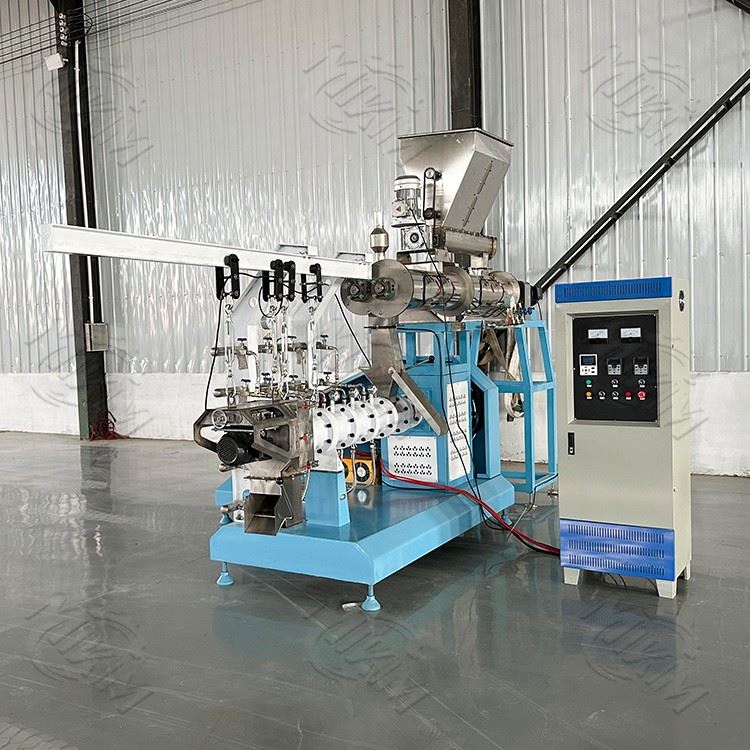


Floating Fish Food Extruder
Feed produced by fish floating food machines has a relatively longer shelf life.
Description
Processing principle of floating fish feed machine
1. Raw Material Combination: Add 20%-30% corn flour and wheat flour (high starch content) to the starch formula. These starches act as "gas-generating agents"-they gelatinize at high temperatures, preparing for subsequent gas production. Simultaneously, add 5%-10% wheat flour (for viscosity) to "lock" air bubbles within the particles, preventing them from escaping.
2. High-Temperature Heating in the Fish Feed Extruder Machine: After the raw materials enter the extruder, the barrel temperature rises to 110-160℃ (similar to cooking rice porridge). The starch gelatinizes, becoming a viscous "pastry." Simultaneously, the moisture in the raw materials (12%-14%) turns into supersaturated vapor, which is firmly encapsulated by the gelatinized starch.
3. Instant Pressure Reduction: The steam expands into bubbles. When the high-temperature, high-pressure raw material is extruded from the floating fish meal extruder die, the pressure drops instantly from several MPa to atmospheric pressure-like opening a cola bottle cap and the bubbles suddenly bursting out. The steam in the raw material also expands rapidly, forming numerous tiny bubbles (0.1-0.5 mm in diameter) inside the granules. After cooling, the bubbles solidify, and the particle density becomes 0.8-0.9 g/cm³ (less than water), allowing it to float.


fish pellet mill
How to make puffed pellets?
1. The first step is "raw material grinding." The first part of the fish feed making production line is the "grinder." Raw materials such as corn, soybean meal, and fishmeal are poured into the grinder, where high-speed rotating blades grind them into a fine powder. Generally, it needs to be ground to 0.8-1.2 millimeters (about the size of flour). The finer the powder, the easier it is to mix evenly and extrude into pellets later. After grinding, the powder is piped to the "raw material silo" for temporary storage, awaiting the next stage.
2. The second step is "precision mixing." The powder enters the "mixer" from the raw material silo, while vitamins, minerals, and palatability enhancers are added according to the formula. The dual-shaft paddles in the mixer rapidly agitate all the raw materials and additives into a uniform "mixed powder," much like kneading dough at home, ensuring that every bite of feed has the same nutritional value. Mixing time is generally 5-8 minutes. Insufficient mixing will result in some pellets being more nutritious than others, affecting animal growth.
3. The third step is "high-temperature extrusion," which is the most crucial step. The mixed powder then enters the "extruder"-the core equipment of the fish food pellet production line. The screw inside the extruder rotates rapidly, pushing the mixed powder forward while simultaneously heating it to 110-130℃ and applying pressure of 3-5 MPa. Under this high temperature and pressure, the starch in the mixed powder gelatinizes, generating gas. When extruded from the die holes of the extruder, the pressure suddenly drops, the gas expands, and the mixed powder becomes fluffy granules, like mini popcorn.
4. The fourth step is "cooling and drying." The freshly extruded granules are 80-90℃ and still very soft, so they are sent to a "cooling machine." A fan in the cooling machine blows cold air, lowering the temperature of the granules to room temperature (25-30℃) and removing excess moisture, making the granules harder and more resistant to storage. Cooling time is generally 10-15 minutes; if cooling is incomplete, the granules are prone to mold.
5. The fifth step is "screening and packaging." The cooled granules enter a "screening machine" to remove broken pieces and unqualified small granules, leaving only uniformly sized, qualified granules. Finally, the pellets are packaged by weight using a "packaging machine," for example, in 20-kilogram bags, and sealed to become the finished extruded feed sold in the market. The entire fish food pellet making production line, from raw materials to finished products, can produce several hundred kilograms per hour, which is much more efficient than manual labor.
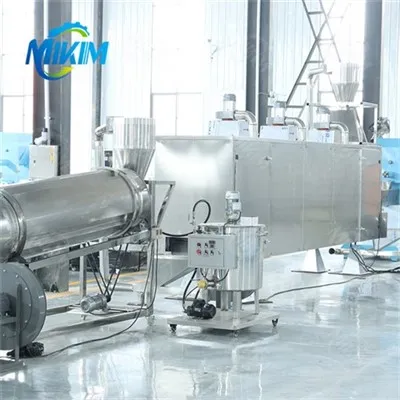


fish floating feed production line
Product Parameters
|
|
|
|
|
|
|---|---|---|---|---|
|
|
|
|
|
|
|
|
|
|
|
|
|
|
|
|
|
|
|
|
|
|
|
|
Customer visit


Others are also interested in these:Aquafeed Expander,Automatic Feed Pellet Machine,Large Extruder Fish Feed,Aquaculture Feed Pellet Extruder
Hot Tags: floating fish food extruder, China floating fish food extruder manufacturers, suppliers, factory, advanced fish feed extruder, new fish pellet extrusion equipment, durable fish pellet making equipment, automatic fish pellet making equipment, automatic fish pellet shaping machine, commercial fish pellet extrusion equipment
Send Inquiry
You Might Also Like


