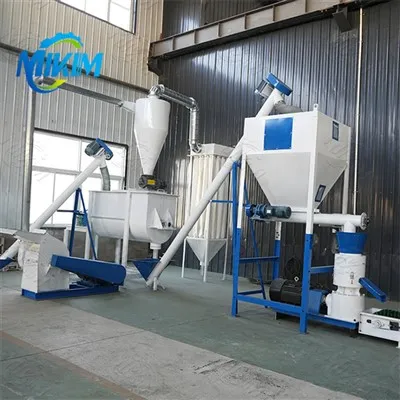
Extruded Pet Food Processing Line for Dog and Fish Feed
Leave a message
What Is an Extruded Pet Food Processing Line?
An extruded pet food processing line is a complete system used to produce different kinds of pet food, floating fish feed, and sinking feed. The line combines a twin-screw extruder with conveying, drying, flavoring, and cooling equipment, and it operates with simple control and accurate parameter management. The products are finished at the stipulated temperature, pressure, humidity, and time, which keeps quality consistent from batch to batch. Because of the reasonable design and stable construction, the equipment can be maintained reliably, and the line can produce a variety of shapes and tastes to meet the different requirements of pet food.
Line Flow and Equipment Stages
The processing flow of the line is: mixer, screw conveyor, twin-screw extruder, air conveyor, dryer, flavoring line, and cooling machine. The mixer blends the powdered raw materials evenly, the screw conveyor feeds the mash into the extruder at a controlled rate, and the twin-screw extruder cooks and shapes the pellets. The air conveyor moves the hot pellets to the dryer, where moisture is reduced to stabilize the product, and the flavoring line applies oils and flavor coatings before the cooling machine brings the pellets to a packable temperature.
Raw Materials and Formulation
The line adopts corn powder, rice powder, wheat flour, and meat as the main raw materials, mixed with water and oil during processing. This simple base formula supports a wide range of pet food and fish feed recipes, and the same machine can process formulations for dog kibble, bird kibble, and puppy food by adjusting the formula and process parameters. The moisture and oil content are controlled during conditioning so that the starch gelatinizes properly inside the extruder and the pellets take on a stable, uniform structure.
Technical Specifications
| Model (Electric) | Capacity (kg/h) | Main Power | Cutting Blade Power | Cutting Power | Conditioner Power |
|---|---|---|---|---|---|
| 65 | 250-300 | 22 kW | 1.5 kW | 1.5 kW | 3 kW |
| 70 | 500-600 | 45 kW | 1.5 kW | 1.5 kW | 3 kW |
| 75 | 800-1000 | 55 kW | 1.5 kW | 1.5 kW | 3 kW |
| 85 | 1200-1500 | 90 kW | 3 kW | 2.2 kW | 5.5 kW |
| 95 | 2000-2500 | 110 kW | 3 kW | 3 kW | 11 kW |
| 120 | 3000-4000 | 160 kW | 5.5 kW | 3 kW | 15+7.5 kW |
| 136 | 5000-6000 | 200 kW | 7.5 kW | 5.5 kW | 22+7.5 kW |
Capacities range from 250-300 kg/h on model 65 to 5000-6000 kg/h on model 136, with main power from 22 kW to 200 kW. Larger models add power to the cutting and conditioning stages to keep pellet size and gelatinization quality stable at higher throughput.
Water Stability and Quality Advantages
The feed pellets produced by this line exhibit excellent stability in water, thanks to the optimized ring die compression ratio and conditioning process. The production line precisely controls steam pressure and pelleting temperature, resulting in a compact pellet structure that maintains its integrity for 2-4 hours after introduction into the water, with a loss rate of only 3%-5%, far lower than that of powdered feed. In addition, the screening module removes unqualified loose pellets, further reducing waste, minimizing water pollution, and easing the burden on aquaculture water purification systems.
FAQ
Which products can an extruded pet food processing line make?
The line produces different kinds of pet food, floating fish feed, and sinking feed, so one platform can cover dog kibble, bird kibble, puppy food, and aquaculture feed recipes.
What raw materials are used in the line?
Typical raw materials are corn powder, rice powder, wheat flour, and meat, mixed with water and oil. Formulas can be adjusted for different species and target pellet shapes.
What capacity range is available?
Seven models cover capacities from 250-300 kg/h on model 65 to 5000-6000 kg/h on model 136, with main power from 22 kW to 200 kW.
Why do the pellets stay stable in water?
The optimized ring die compression ratio and precisely controlled conditioning process create a compact pellet structure that maintains its integrity for 2-4 hours in water, with a loss rate of only 3%-5%.
How does the screening module help aquaculture?
The screening module removes unqualified loose pellets before packaging, reducing waste and minimizing water pollution caused by feed fines, which eases the load on water purification systems.
Can the same line produce both floating and sinking feed?
Yes. By adjusting the extrusion parameters and die design, the line can produce floating feed for fish that feed at the surface and sinking feed for bottom feeders.