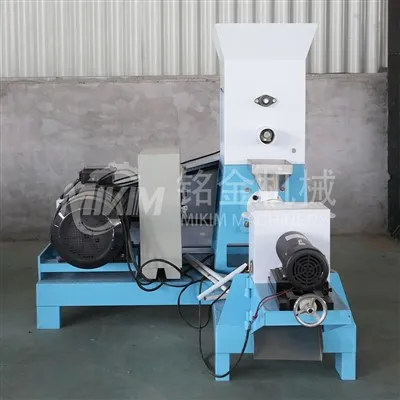
Fish Feed Pellet Extruder for Freshwater and Seawater Fish Farming
Leave a message
How a Fish Feed Pellet Extruder Works
A fish feed pellet extruder uses screw extrusion to cook and expand the feed, increasing its volume. Once cooked, the pellet releases a particular scent and the process eliminates some of the dangerous microorganisms present in the material. The finished pellets float on the surface of the water and hold their shape for an extended period, which makes feeding convenient and reduces feed waste: fish eat directly from the surface, digest the pellets easily and gain weight faster. Because the pellets remain buoyant, the farmer can see how much feed is being taken, which makes ration control far easier than with sinking or powdered feed.
Raw Materials for Fish Feed Pellets
Fish feed pellets can be made from a variety of materials. Fish meal, soybean meal, corn meal, rice bran, wheat bran and other cereal grains are frequently used, and the ratios depend on the size, the nutritional needs and the species of the fish being raised. Fish meal and soybean meal are rich in protein and essential amino acids, while corn and rice bran provide the carbohydrates and fiber needed for digestion and energy.
Binding agents are also needed to hold the pellets together. Starch, gelatin and other hydrocolloids serve this purpose, ensuring that the pellets keep their form instead of breaking down in water. Supplements such as vitamins, minerals and amino acids can be added to give the fish a complete, well-rounded diet, stimulating growth and development and increasing the nutritional value of the pellets.
Technical Parameters of the DGP Series
The DGP series covers five high-yield models for freshwater and seawater fish farming. The table below summarizes the published specifications.
| Model | Capacity (kg/h) | Main motor (kW) | Feeder motor (kW) | Cutter motor (kW) | Screw diameter (mm) | Weight (kg) |
|---|---|---|---|---|---|---|
| DGP-100 | 500 | 37 | 1.5 | 1.5 | 100 | 1500 |
| DGP-120 | 600-700 | 55 | 1.5 | 1.5 | 120 | 1800 |
| DGP-135 | 800-900 | 75 | 1.5 | 2.2 | 135 | 2000 |
| DGP-160 | 1000-1200 | 90 | 2.2 | 2.2 | 160 | 2500 |
| DGP-200 | 1800-2000 | 132 | 3 | 3 | 200 | 3200 |
Machine size grows from about 2 x 2.8 x 1.2 m on the DGP-100 to 2.35 x 3.45 x 1.65 m on the DGP-200, so installation space should be planned in advance, together with the room needed around the machine for feeding, maintenance and pellet discharge.
Start-up and Operating Checks
Before startup, check the motor steering after connecting the line. The material is a powder, so stir in water evenly; a moisture level around 20% is the ideal starting point for many formulas. Add a bottle of water through the primary screw feed port and start the main machine. Then introduce the material into the hopper and switch on the feeder; the feeding pace should be modest at first. The cutter must be running at high speed when it is switched on, and the belt tension can be adjusted freely once the machine is unloading regularly. These steps keep the start-up smooth and prevent clogging in the barrel.
Frequently Asked Questions
Q: What is the working principle of the extruder?
Screw extrusion cooks and expands the feed mixture at high temperature. The pellet is shaped at the die, releases a distinct scent and is freed of some harmful microorganisms in the process.
Q: What moisture content should the material have at start-up?
A moisture level around 20% is the ideal starting point for many formulas. Water should be stirred into the powder evenly before the material is fed to the machine.
Q: Which models are available in the DGP series?
Five models: DGP-100 at 500 kg/h, DGP-120 at 600-700 kg/h, DGP-135 at 800-900 kg/h, DGP-160 at 1000-1200 kg/h and DGP-200 at 1800-2000 kg/h.
Q: Which raw materials can be used?
Fish meal, soybean meal, corn meal, rice bran and wheat bran are common, with starch or gelatin as binder and vitamins, minerals or amino acids added as supplements.
Q: What should be checked before start-up?
Check the motor steering after connecting the line, mix water evenly into the powder, keep the feeder pace modest at first and make sure the cutter runs at high speed when it is switched on.