


How Does a single screw fish feed extruder machine Work?
Leave a message
content
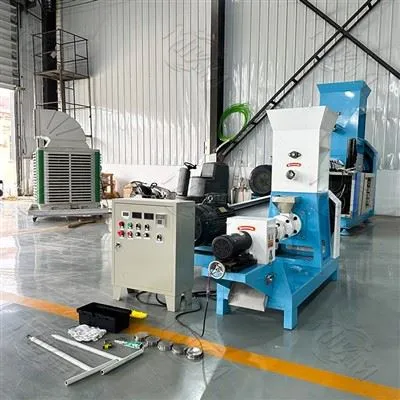
Screw length-to-diameter ratio: Determines the adequacy of raw material processing. The length-to-diameter ratio (the ratio of screw length to diameter) of a single-screw floating fish feed machine is a key parameter affecting the extrusion and puffing effect, with a common range of 16:1-25:1. A larger length-to-diameter ratio means a longer residence time of the raw material in the extrusion chamber, resulting in more thorough compression, friction, and heating, leading to better melting and puffing effects. For example, when producing high-quality floating fish feed, a screw with an length-to-diameter ratio of 20:1 or higher is required to ensure sufficient starch gelatinization and protein denaturation; while for producing ordinary sinking fish feed, an length-to-diameter ratio of 16:1-18:1 is sufficient. It should be noted that an excessively large length-to-diameter ratio will also increase equipment energy consumption and screw wear; therefore, it should be selected appropriately based on the type of feed.
Screw channel depth variation: Enables gradient compression and melting of the raw material. The screw channel depth of a single-screw fish extruder machine gradually decreases from the feeding section to the discharging section, divided into the feeding section (deepest screw channel), the compression section (gradually shallower screw channel), and the metering section (shallowest screw channel). The feeding section features a deep screw channel, accommodating more raw material and ensuring efficient conveying. The compression section's screw channel gradually shallows, allowing for gradual compression and heating of the material, preventing it from failing to fully melt due to sudden pressure. The metering section has the shallowest screw channel, further increasing pressure and temperature to ensure complete expansion of the material. This gradient design ensures a gradual processing of the material within the extrusion chamber, guaranteeing stable expansion. For example, in pet food production, the rate of change in screw channel depth in the compression section must be controlled within a reasonable range to prevent excessive heat generation during compression, which could lead to nutrient loss.
Screw Helix Angle Design: Balancing Conveying Efficiency and Extrusion Effect. The screw helix angle refers to the angle between the helix edge and the screw axis, directly affecting the material conveying speed and extrusion effect. In a single-screw fish feed processing machine, a larger screw helix angle results in a faster material conveying speed but a relatively weaker extrusion effect; a smaller screw helix angle results in a slower conveying speed but a better extrusion effect. Single-screw extruders typically employ a variable helix angle design. A larger helix angle is used in the feeding section to improve feeding efficiency, while a smaller helix angle is used in the compression and metering sections to enhance the extrusion effect and ensure the raw material is fully melted and expanded. This design achieves a balance between conveying efficiency and extrusion effect, allowing the equipment to improve feed quality while maintaining production capacity. For example, when producing high-fiber feed, a smaller helix angle is needed in the compression and metering sections to enhance the extrusion action and ensure the fibrous raw material is fully softened and expanded.
Screw Material Selection: Ensuring the Durability and Feed Safety of the Single-Screw Floating Fish Extruder Machine. The screw operates under high temperature, high pressure, and high friction environments for extended periods, requiring materials with high strength, high wear resistance, and high temperature resistance. A common screw material is 38CrMoAl alloy, which, after nitriding treatment, achieves a surface hardness of HRC60 or higher and a service life of 1500-2000 hours. High-quality screw materials not only extend the equipment's lifespan but also prevent metal debris caused by screw wear from contaminating the feed, ensuring feed safety. This characteristic is highly consistent with the safety operation requirements of extruders and is an important guarantee for achieving stable and safe production.
Related equipment


about Us
MIKIM's fish feed pellet production lines and supporting machinery offer excellent value for money. Not only are they affordable, eliminating middlemen markups and allowing small and medium-sized enterprises (SMEs) and fish farmers to purchase complete sets of equipment at reasonable costs, but they also boast exceptional efficiency. The fully automated process, from raw material crushing and precise ingredient mixing to extrusion pelleting and maturation, is completed in one continuous flow. This results in high starch gelatinization rates and uniform pellet formation, significantly improving production efficiency and feed quality, truly achieving "low cost, high output." Choosing a MIKIM fish feed pellet production line means enjoying comprehensive pre-sales and after-sales service, including 24-hour online customer support, a one-year warranty on the entire machine, professional on-site installation, commissioning, and maintenance, and a stable supply of spare parts. Customers can buy with confidence and use with peace of mind, with both excellent value and service quality!!!
Customer visit

Certificate of Honor

FAQ
1. What is the price of the single screw fish feed making machine?
The price ranges from approximately $1,500-$55,000
2. Do you provide maintenance services for your customers?
Yes, we offer comprehensive after-sales maintenance services to our customers.
If you would like to learn more about MIKIM machinery, please contact us. We offer one-stop service and welcome your inquiries!!!


