How is aquatic floating feed produced
Leave a message
Production process description
Aquatic floating feed requires a specialized process to ensure buoyancy and water stability, with extrusion as the core step.
The process begins with raw material selection and pretreatment: high-protein ingredients (fish meal, shrimp meal, soybean protein concentrate) are prioritized, and starch-rich materials (corn starch, potato starch) are added (20–30% of the formula) to enhance expansion. All materials are crushed to a fine particle size (0.8–1.5 mm) to improve extrusion uniformity, and moisture is adjusted to 16–18% by adding warm water.
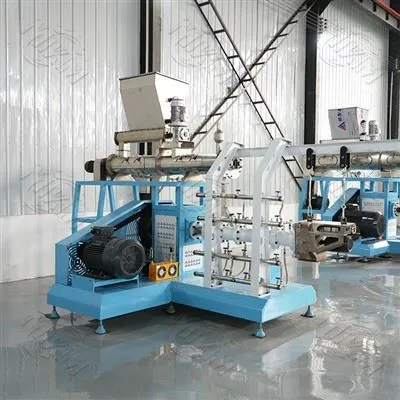
Second, twin-screw extrusion is the key link: the mixed material is fed into a twin-screw extruder, where rotating screws generate strong shear force. The barrel is divided into 3–5 heating zones (gradually increasing from 80°C to 120°C), causing starch to fully gelatinize (rate ≥90%) and proteins to denature. Under 4–8 MPa pressure, the material is pushed through a special floating die; the sudden pressure release makes the material expand (expansion rate 1.2–1.8 times), forming porous pellets that can float on water. A high-speed cutter trims the pellets to 2–6 mm (matching fish size).
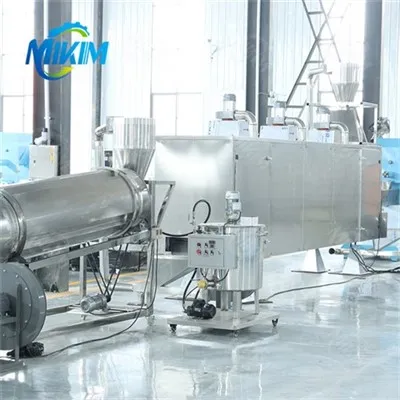
Third, drying and cooling are critical for water stability: the extruded pellets are sent to a multi-layer belt dryer (temperature 60–70°C, air speed 1.5–2 m/s) to reduce moisture from 20–22% to 8–10%, which prevents pellet dissolution in water. After drying, they are cooled to room temperature with a fan to avoid condensation. Fourth, oil coating enhances nutrition and palatability: a vacuum coating machine sprays fish oil or soybean oil (3–5% of feed weight) onto the cooled pellets, ensuring the oil penetrates the porous structure (instead of remaining on the surface, which reduces water pollution).
Finally, quality testing and packaging are conducted: samples are tested for floating rate (≥95% floating for 2–4 hours), water stability (dissolution rate ≤5% in 2 hours), and nutrient content. Qualified feed is packaged in moisture-proof, oxygen-proof plastic bags to extend shelf life, and stored in a cool, dry warehouse.


Parameters of twin screw extruder
|
|
|
|
|
|
|
|---|---|---|---|---|---|
|
|
|
|
|
|
|
|
|
|
|
|
|
|
|
|
|
|
|
|
|
|
|
|
|
|
|
|
|
|
|
|
|
|
|
|
|
|
|
|
|
|
|
|
|
|
|
|
|
Main Products



Why Choose Us
1. In addition to floating fish feed, if customers also want to process shrimp feed, livestock and poultry feed, pet feed, premix and other types, we can customize the complete production line plan according to the customer's product plan;
2. The entire production line adopts a modular design and can be customized according to the customer's actual needs, formula, plant structure, floor space and other requirements;
3. Fish feed equipment and electrical components can be configured according to customer requirements, and motor and electrical component brands can also be replaced according to customer needs.
4. We can also undertake technical transformation projects for floating fish feed production. Continuous equipment upgrades, optimizations and services will bring you many benefits.
For more information on process flow design, equipment layout, factory construction plans, individual equipment pricing, or turnkey project proposals, please feel free to contact us!!!