


How Small Fish Feed Pellet Making Machines Work in Pellet Production?
Leave a message
content
Multi-size pellet production function: adaptable to different aquaculture stages. By changing the die orifice diameter and adjusting the cutting speed, fish feed production equipment can produce pellets of various sizes from 1-5mm, perfectly adapting to different aquaculture stages such as fry, juveniles, and adult fish: When producing starter feed for fry, a small-diameter die of 1-1.5mm is selected, combined with a high-speed cutting device (cutting speed 300-350r/min), to produce fine small pellets suitable for the size of fry's mouths; when producing feed for juveniles, a 2-2.5mm die is selected, and the cutting speed is adjusted to 250-300r/min, resulting in pellets of moderate size that are easy for juveniles to eat; when producing feed for adult fish, a large-diameter die of 3-5mm is selected, and the cutting speed is reduced to 200-250r/min, resulting in larger pellets that meet the feeding needs of adult fish. For example, a certain integrated aquaculture farm uses a twin-screw extruder. By changing different die heads, it can simultaneously produce 1mm carp fry feed, 3mm grass carp juvenile feed, and 4mm black carp adult feed, increasing equipment utilization by 60% and eliminating the need to purchase separate equipment for different breeding stages.
Sinking/floating feed switching function: adapts to the feeding habits of different fish species. Different fish species have significantly different feeding habits. Automatic fish food making equipment can flexibly switch between sinking, floating, and semi-floating feeds by adjusting extrusion parameters: When producing floating feed (suitable for mid-to-upper-level fish such as bass and tilapia), increasing the screw speed (350-400 rpm) and decreasing the raw material moisture (10%-12%) enhances extrusion, making the pellets porous, less dense than water, and achieving a buoyancy rate of over 95%. When producing sinking feed (suitable for bottom-dwelling fish such as grass carp and common carp), decreasing the screw speed (300-320 rpm) and increasing the raw material moisture (12%-14%) reduces extrusion, resulting in pellets with a density greater than water, leading to fast and stable sinking. When producing semi-floating feed (suitable for mid-level fish such as crucian carp), precise control of the screw speed and moisture content allows the pellets to remain suspended in water for 3-5 hours before sinking.
Special-shaped pellet production function: Improves palatability and feeding efficiency. In addition to conventional cylindrical pellets, small fish food making machines can produce feed pellets of special shapes, such as flat round and strip-shaped pellets, by changing special die heads, thus improving palatability for fish. For example, when producing bass feed, using a flat round die head produces pellets that are easier for bass to swallow, increasing feeding efficiency by 15%. When producing ornamental fish feed, using a strip-shaped die head, combined with precise cutting, produces uniformly long strip-shaped feed, suitable for the small-mouthed feeding habits of ornamental fish. Furthermore, the special shapes of the pellets exhibit greater stability in water, further enhancing water resistance. For instance, an ornamental fish feed processing plant used an extruder to produce strip-shaped koi feed; the pellets remained water-resistant for up to 12 hours, did not easily disintegrate in water, and significantly increased the koi's feeding activity, enhancing the product's market competitiveness.
Related equipment


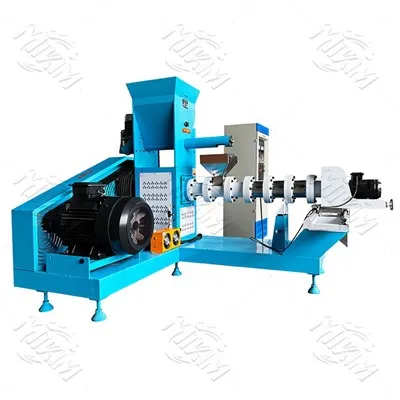
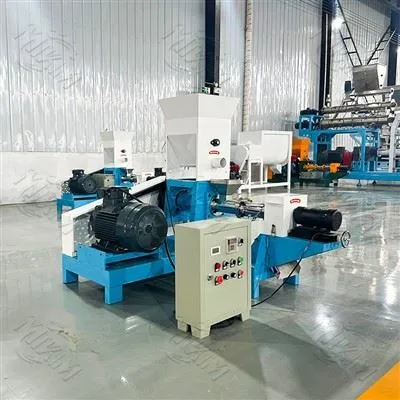
about Us
MIKIM's fish feed pellet production lines and supporting machinery offer excellent value for money. Not only are they affordable, eliminating middlemen markups and allowing small and medium-sized enterprises (SMEs) and fish farmers to purchase complete sets of equipment at reasonable costs, but they also boast exceptional efficiency. The fully automated process, from raw material crushing and precise ingredient mixing to extrusion pelleting and maturation, is completed in one continuous flow. This results in high starch gelatinization rates and uniform pellet formation, significantly improving production efficiency and feed quality, truly achieving "low cost, high output." Choosing a MIKIM fish feed pellet production line means enjoying comprehensive pre-sales and after-sales service, including 24-hour online customer support, a one-year warranty on the entire machine, professional on-site installation, commissioning, and maintenance, and a stable supply of spare parts. Customers can buy with confidence and use with peace of mind, with both excellent value and service quality!!!
Customer visit

Certificate of Honor

FAQ
1. What is the price of the small fish feed pellet making machine?
The price ranges from approximately $1,500-$55,000
2. Do you provide maintenance services for your customers?
Yes, we offer comprehensive after-sales maintenance services to our customers.
If you would like to learn more about MIKIM machinery, please contact us. We offer one-stop service and welcome your inquiries!!!


