


How to choose Automated Feed Pellet Equipment
Leave a message
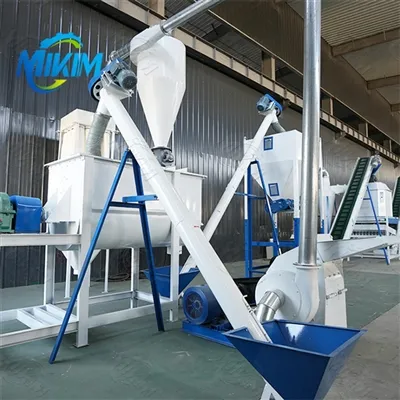
Hammer mill crushers are currently the most widely used equipment, accounting for over 70% of all crushing operations. Their core working principle involves high-speed rotating hammers impacting the raw materials to achieve crushing. The equipment has a simple structure, consisting of a casing, rotor, hammers, and screen. The hammer speed can reach 1500-3000 r/min, and the output particle size is controlled by changing the screen aperture (1-10mm). This type of equipment is suitable for processing medium-to-low hardness, brittle raw materials such as corn, soybean meal, and fishmeal. It boasts high crushing efficiency (0.5-10 tons per hour) and affordable prices (small equipment costs 10,000-50,000 RMB, large equipment costs 100,000-300,000 RMB). A medium-sized feed mill in Shandong uses two hammer mills with an hourly capacity of 5 tons each, combined with a "coarse crushing + fine crushing" process, to crush corn to below 2mm, achieving a monthly output of 300 tons and an equipment utilization rate of 90%.
Toothed roller crushers utilize a "compression + shearing" crushing method. Two opposing rotating toothed rollers compress and shear the raw material, making them suitable for processing coarse fiber or high-moisture materials such as straw, alfalfa, and distiller's grains. Their advantages include excellent crushing effect on fibrous materials, uniform output particle size (3-5mm), and less clogging, making them suitable for producing feed for ruminants such as cattle and sheep. A cattle and sheep feed mill in Inner Mongolia used a toothed roller crusher to process straw, achieving a 30% increase in crushing efficiency compared to hammer mills, while retaining the straw fibers intact, meeting the digestive needs of ruminants. However, this equipment is less efficient at processing brittle materials and is relatively expensive (a 3-ton-per-hour capacity unit costs approximately 80,000-150,000 RMB).
Cone crushers are suitable for high-hardness materials (such as shells, ores, and other mineral additives). They crush the material through the compression action between the cone and the liner, achieving an output particle size controllable to 1-3mm with high crushing precision. These machines are expensive (200,000-500,000 RMB per unit) and are only used in large feed mills or in the production of specialty feeds requiring mineral additives.
Selection techniques should follow the principle of "raw material suitability + capacity matching": hammer mills are preferred for processing brittle grains, toothed roller mills for processing coarse fibrous materials, and conical mills for processing high-hardness materials; small production lines (monthly output < 100 tons) should select equipment with an hourly capacity of 0.5-2 tons, while large production lines (monthly output > 500 tons) should select equipment with an hourly capacity of 5-10 tons, avoiding both "using large machines for small tasks" and "using small machines for large tasks."
Related equipment


about Us
MIKIM's fish feed pellet production lines and supporting machinery offer excellent value for money. Not only are they affordable, eliminating middlemen markups and allowing small and medium-sized enterprises (SMEs) and fish farmers to purchase complete sets of equipment at reasonable costs, but they also boast exceptional efficiency. The fully automated process, from raw material crushing and precise ingredient mixing to extrusion pelleting and maturation, is completed in one continuous flow. This results in high starch gelatinization rates and uniform pellet formation, significantly improving production efficiency and feed quality, truly achieving "low cost, high output." Choosing a MIKIM fish feed pellet production line means enjoying comprehensive pre-sales and after-sales service, including 24-hour online customer support, a one-year warranty on the entire machine, professional on-site installation, commissioning, and maintenance, and a stable supply of spare parts. Customers can buy with confidence and use with peace of mind, with both excellent value and service quality!
Customer visit

Certificate of Honor

FAQ
1. What is the price of the Poultry Feed Complete Equipment?
The price ranges from approximately $1,500-$55,000
2. Do you provide maintenance services for your customers?
Yes, we offer comprehensive after-sales maintenance services to our customers.
If you would like to learn more about MIKIM machinery, please contact us. We offer one-stop service and welcome your inquiries!!!


