


How to Choose Pet Food Production Equipment
Leave a message
Nutrient retention is a core requirement for high-end pet food, necessitating equipment planning that prioritizes low-temperature processing. Probiotics, Omega-3, and taurine in pet food are sensitive to high temperatures; therefore, low-temperature extrusion equipment must be planned, with extrusion temperatures controlled at 85-90℃, 15-20℃ lower than ordinary feed. This requires a twin-screw low-temperature extruder paired with a steam and warm water mixing conditioning system to prevent localized overheating. To minimize nutrient loss during processing, a short-flow production line should be planned, keeping the distance between raw material handling, extrusion, and cooling stages within 10 meters to shorten the feed's residence time in the equipment. Simultaneously, vacuum packaging equipment should be planned to immediately vacuum-seal the feed after cooling to below 40℃, preventing nutrient oxidation and loss.
Flavor control and customized production capabilities must be enhanced through equipment planning. Pets are highly sensitive to feed flavor; therefore, specialized flavor spraying equipment is needed to precisely spray flavorings such as chicken essence oil and fish extract after extrusion and cooling, with a spraying amount error controlled within ±0.1%, ensuring uniform flavor in every pellet. To cater to the needs of different pet breeds and age groups, equipment planning must enable rapid changeover capabilities. For example, pellet mills should be equipped with interchangeable multi-specification ring dies (2-8mm), and extruder screw speeds should be infinitely adjustable via a PLC system (50-300 r/min), allowing for rapid production transitions from puppy food to adult dog food, and from cat food to dog food, with a transition time controlled within 30 minutes. Additionally, small-scale experimental equipment, such as a laboratory extruder with a 20kg/hour capacity, should be planned for new product formulation development, supporting product iteration and upgrades.
Safety, hygiene, and cost-effectiveness must be balanced. Pet food must meet food-grade hygiene standards. Equipment planning should utilize a seamless, corner-free design to prevent bacterial growth from raw material residue. A CIP (Clean-In-Place) fully automatic cleaning system should be included to achieve high-temperature sterilization and cleaning of the equipment's interior. Equipment materials should be food-grade 304 stainless steel with a polished surface and a roughness ≤Ra0.8μm for easy cleaning. In terms of cost, the initial investment in high-end equipment is relatively high. The investment for a production line with an hourly capacity of 100kg is approximately 500,000 to 800,000 yuan. The financial pressure can be reduced by "phased investment + leasing of some auxiliary equipment". For example, raw material storage tanks can be leased to reduce the initial investment in fixed assets. At the same time, an energy recovery system should be planned to use the waste heat generated by the extruder for feed preheating, reducing energy consumption costs and saving 20-30 yuan in electricity costs per ton of feed.
Related equipment


about Us
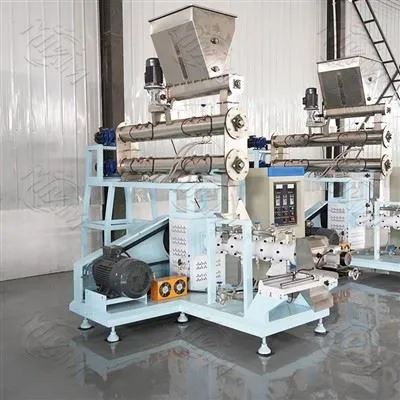
MIKIM's fish feed pellet production lines and supporting machinery offer excellent value for money. Not only are they affordable, eliminating middlemen markups and allowing small and medium-sized enterprises (SMEs) and fish farmers to purchase complete sets of equipment at reasonable costs, but they also boast exceptional efficiency. The fully automated process, from raw material crushing and precise ingredient mixing to extrusion pelleting and maturation, is completed in one continuous flow. This results in high starch gelatinization rates and uniform pellet formation, significantly improving production efficiency and feed quality, truly achieving "low cost, high output." Choosing a MIKIM fish feed pellet production line means enjoying comprehensive pre-sales and after-sales service, including 24-hour online customer support, a one-year warranty on the entire machine, professional on-site installation, commissioning, and maintenance, and a stable supply of spare parts. Customers can buy with confidence and use with peace of mind, with both excellent value and service quality!
Customer visit

Certificate of Honor

If you would like to learn more about MIKIM machinery, please contact us. We offer one-stop service and welcome your inquiries!!!


