How to handle abnormal temperature and moisture in pet food machines?
Leave a message
The core cause of abnormal discharge temperature in dog and cat food extruder machines lies in the heating and temperature control systems. Heating system malfunctions, such as damaged electric heating elements leading to insufficient heating power, or unstable steam pressure (below 0.6 MPa), cause temperature fluctuations. A malfunctioning temperature sensor can also cause data distortion, leading to misjudgments by the control system and inaccurate heating adjustments. An abnormal cooling system, such as excessive or insufficient cooling water flow, can also cause temperature fluctuations due to an inability to balance the heat generated. Abnormal discharge moisture content is related to the raw material pretreatment, conditioning, and cooling systems. This can be caused by excessively high initial raw material moisture (>18%), insufficient steam addition from the conditioner, a malfunctioning conditioner preventing even mixing of steam with the raw material, resulting in localized excessive moisture, or insufficient airflow or short cooling time in the cooling system, failing to reduce the moisture content of the extruded, high-temperature, high-humidity particles to below 12%.
Resolving abnormal discharge temperature and moisture content in cat food machinery requires systematic troubleshooting and precise control. Temperature Anomaly Handling: First, check the heating system. For electric heating models, use a multimeter to check the continuity of the heating element and replace any damaged elements. For steam heating models, ensure the steam pressure is stable at 0.6-0.8 MPa and install a pressure stabilizing valve. Second, calibrate the temperature sensor. Compare the measured data with a standard thermometer; if the error exceeds ±3℃, replace the sensor. Adjust the cooling system water flow to ensure the temperature of each section of the barrel is stable within ±2℃ of the set value. Moisture Anomaly Handling: Check the initial moisture content of the raw material; dry any material exceeding the standard. Inspect the conditioner, clean any blockages in the steam nozzles, and ensure even steam spraying. Increase the cooling system airflow (by 20%-30%) and extend the residence time of particles in the cooler (from 5 minutes to 8 minutes) to ensure the output moisture content is stable at 10%-12%. One company, by replacing the heating element, calibrating the sensor, and optimizing the cooling system, controlled the output temperature fluctuation within ±2℃, stabilized the moisture content at 11%, and extended the product shelf life to 6 months.
Preventing these anomalies requires establishing a dual-protection mechanism. At the raw material level, the moisture content of each batch of raw materials is tested before they enter the warehouse, and only those that pass the test can be used. At the equipment level, the heating system and temperature sensors are checked daily, and the temperature control system is calibrated weekly. During production, the discharge temperature and moisture content are checked every 15 minutes, and a monitoring log is maintained. Any abnormalities are immediately adjusted. Additionally, online moisture and temperature detectors are installed at the cooling system outlet to enable real-time monitoring and automatic alarms, ensuring that problems are detected and resolved early.
Related equipment



about Us
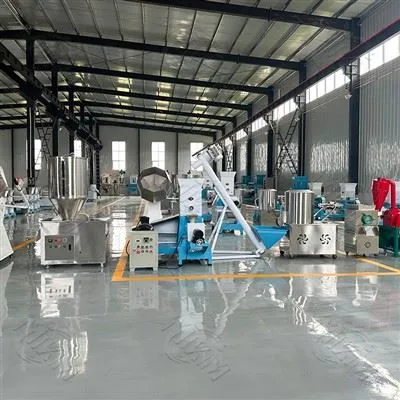
MIKIM's fish feed pellet production lines and supporting machinery offer excellent value for money. Not only are they affordable, eliminating middlemen markups and allowing small and medium-sized enterprises (SMEs) and fish farmers to purchase complete sets of equipment at reasonable costs, but they also boast exceptional efficiency. The fully automated process, from raw material crushing and precise ingredient mixing to extrusion pelleting and maturation, is completed in one continuous flow. This results in high starch gelatinization rates and uniform pellet formation, significantly improving production efficiency and feed quality, truly achieving "low cost, high output." Choosing a MIKIM fish feed pellet production line means enjoying comprehensive pre-sales and after-sales service, including 24-hour online customer support, a one-year warranty on the entire machine, professional on-site installation, commissioning, and maintenance, and a stable supply of spare parts. Customers can buy with confidence and use with peace of mind, with both excellent value and service quality!
Customer visit

Certificate of Honor

FAQ
1. What is the price of the cat food extruder machine?
The price ranges from approximately $3,500-$55,000
2. Do you provide maintenance services for your customers?
Yes, we offer comprehensive after-sales maintenance services to our customers.
If you would like to learn more about MIKIM machinery, please contact us. We offer one-stop service and welcome your inquiries!!!