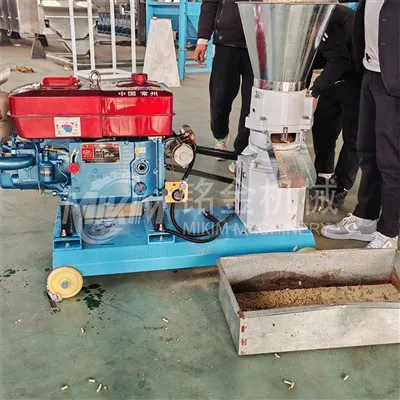
How to Make Rabbit Feed Pellets with a Feed Pellet Machine
Leave a message
Ration Formulation for Rabbits
Rabbits need a ration that is high in fibre and moderate in energy, and the pellet form is what stops them sorting out the palatable fraction and leaving the minerals behind. A practical farm formula combines energy grains, protein meals, minerals and a vitamin premix in fixed proportions so that every batch is repeatable. The working ratio below is a starting point that must be adjusted to the age and purpose of the animals and to the nutrient content of the local grain.
| Ingredient | Share of the mix | Role |
|---|---|---|
| Wheat | 40% | Energy and pellet binding |
| Corn | 30% | Energy |
| Oats | 20% | Fibre and bulk |
| Soybean cake | 5% | Protein |
| Fish meal | 2% | Protein and amino acids |
| Bone meal | 2% | Calcium and phosphorus |
| Salt | 1% | Electrolyte balance |
| Multivitamin premix | 0.5% | Micronutrients |
Grinding and Mixing the Mash
Every ingredient is ground before it reaches the mixer, because rabbits cannot digest whole grain efficiently and coarse particles do not bind into a durable pellet. Aim for a mash that is fine enough to press into a smooth pellet but not dusty, then mix all ingredients, including the salt and the vitamin premix, until the colour of the batch is uniform. The premix is the smallest fraction and the easiest to lose in a short mix, so it should be added after the bulk ingredients are already moving and the mixer run long enough for the marker nutrients to disperse evenly.
Pelleting: Machine Settings and Die Choice
The prepared mash is fed into the pellet machine, where the die and pressure rollers compress it into cylinders. Three settings decide the result. Pellet diameter is set by the die and is chosen for the size of the animals. Die compression ratio sets the pressure and therefore the hardness: a long hole gives a hard, durable pellet for high-fibre rations, while a short hole suits mixes with more fat. Mash moisture sets how easily the material flows; too dry and the die chokes, too wet and the pellet leaves the machine soft. The knives are then set to cut a consistent length, because uniform length helps both intake and drying.
Model Capacities for Small Rabbit Feed Mills
| Model | Capacity | Dimensions | Weight |
|---|---|---|---|
| MK-125 | 80-100 kg/h | 110 x 35 x 70 cm | 95 kg |
| MK-150 | 120-150 kg/h | 115 x 35 x 80 cm | 100 kg |
| MK-210 | 200-300 kg/h | 115 x 45 x 95 cm | 300 kg |
| MK-260 | 500-600 kg/h | 138 x 46 x 100 cm | 350 kg |
| MK-300 | 700-800 kg/h | 130 x 53 x 105 cm | 600 kg |
Drying, Cooling and Storage
Freshly pressed pellets are warm and slightly plastic, so they are spread in a thin layer in a dryer or on a ventilated floor to cool and harden. In warm, dry weather one to two days is enough; in humid conditions it takes longer, and the pellets must be turned so that the underside does not stay damp. Pellets are ready for storage when they are cool to the touch and firm enough not to deform between the fingers. Store them in sealed containers or bags in a dry room, off the floor and away from the wall, and use the oldest stock first. Damp pellets grow mould within days, and mouldy feed is a direct health risk to the herd.
Quality Checks on Finished Rabbit Pellets
Each production batch should be checked for moisture, protein and fibre so that the formula can be corrected against the actual raw material. Moisture is determined under ISO 6496:1999, crude protein under ISO 5983-1:2005 and crude fibre under ISO 6865:2000, with bulk and maize-based ingredients sampled on the principles of ISO 6497:2002. Pellet durability and moisture for transport and storage are judged on the principles of ASABE S269.4. On the hygiene side, contaminant limits for rabbits must remain within the mandatory requirements of GB 13078-2017, and the machine itself should be guarded and electrically installed according to ISO 12100:2010 and IEC 60204-1.
Frequently Asked Questions
Q: Why pellet rabbit feed instead of feeding mash?
A: Pelleting prevents selective feeding, so the animal consumes the minerals and vitamins it would otherwise leave in the trough. It also raises fibre intake consistency and reduces dust and feed wastage.
Q: What pellet diameter is suitable for rabbits?
A: Match the diameter to the size of the animals and to the die available on the machine. Small does require a finer pellet than adults, and a consistent cut length matters as much as diameter for intake.
Q: How long must pellets be dried?
A: Usually one to two days in warm, dry weather, spread in a thin layer and turned so the underside dries. In humid conditions allow longer and do not bag pellets that still feel warm or damp.
Q: What mash moisture is right for pelleting?
A: Start with the natural moisture of the ground mix and add water only if the die chokes or the pellets come out crumbly. Excess water produces soft pellets that spoil quickly in storage.
Q: How is the formula kept consistent between batches?
A: Weigh every ingredient to the same ratio, verify the mix uniformity with grab samples, and test finished pellets for moisture, crude protein and crude fibre using ISO 6496:1999, ISO 5983-1:2005 and ISO 6865:2000 so that grain variation can be corrected.