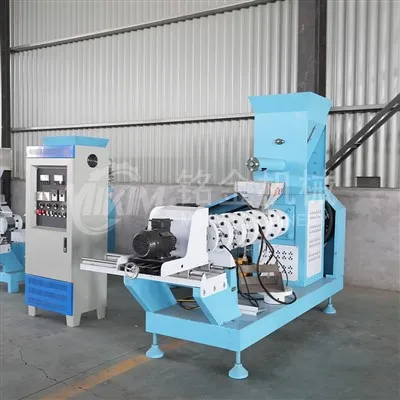
How to safely disassemble and reassemble a feed extruder machine to avoid damaging parts?
Leave a message
When relocating a workshop, the disassembly and reassembly of the extruder is a critical step. If the disassembly is handled roughly (such as forcibly striking the screw or failing to protect precision components), it can easily lead to screw bending and bearing damage. If the reassembly is not properly calibrated, the equipment will be unstable (such as vibration and abnormal noise, and reduced production capacity). Many factories have incurred equipment maintenance costs of over 10,000 yuan due to improper relocation.
Dismantling process (before relocation)
1. Label and protect:
Find some labels and name each component with its installation location, such as "Heating coil, first section of barrel," and take several photos for future reference. For delicate small parts like sensors and couplings, remember to wrap them in foam to prevent damage.
2. Disassemble parts in sequence:
First, disconnect all the wires, labeling each wire beforehand and then bundling them neatly. Next, disassemble auxiliary equipment such as the feeder and cooler separately, being careful not to let them collide with the main unit. After the heating coil has cooled down, remove it, remembering the installation order to avoid reassembling incorrectly.
3. Disassemble core major components:
Once the barrel has completely cooled, you can disassemble the die head and screw. If the screw is stuck and cannot be pulled out, do not use a hammer; use a special tool to slowly pull it out. When disassembling the barrel, use soft slings to support it and avoid scratching the surface. If the motor and gearbox are too heavy to move, disassemble them separately, ensuring balance during hoisting.
4. Handle loading and transportation with care:
When loading, place wooden blocks under heavy components to prevent damage during transport. Small parts such as bearings and sensors should be placed separately in a dedicated toolbox. Avoid violent shaking throughout the entire transportation process.
Re-inspect the site: The floor of the new workshop must be poured according to the size of the original equipment; adjustments must be made if it is unsuitable. The floor must be level, with an error of no more than 2 mm per square meter. Sufficient space must be left for future operation and maintenance.


Installation process (after relocation)
1. Re-inspect the site:
The floor of the new workshop must be poured according to the size of the original equipment; adjustments must be made if it is unsuitable. The floor must be level, with an error of no more than 2 mm per square meter. Sufficient space must be left for future operation and maintenance.
2. Place equipment components:
Using a crane, slowly place the motor, gearbox, and barrel into the designated positions according to the previously marked locations. First, secure the base with bolts, but do not overtighten.
3.Carefully adjust the position:
Adjust the barrel to ensure its axis is horizontal, with an error of no more than 0.1 mm per meter, then tighten the base bolts. Next, calibrate the couplings of the motor and gearbox; the radial deviation between them should not exceed 0.05 mm. Then, use a feeler gauge to check the barrel and screw to ensure they are on the same axis with uniform gaps.
4. Connect the equipment and test:
Connect the circuit according to the previously taken photos, ensuring all wire numbers correspond. After connecting the cooling pipes, check for leaks. Then connect the feeding system. Let the equipment idle for 30 minutes to check the temperature, vibration, and listen for any unusual noises. Then load the material test to see if the output and product quality are the same as before the relocation.


Why Choose Us
MIKIM boasts extensive experience in poultry feed pellet production lines, significantly reducing the incidence of poultry diseases. Its equipment is not only widely used across various industries domestically but also exported to Southeast Asia, Europe, Africa, and South America, earning a high reputation internationally. This global presence not only demonstrates the adaptability and competitiveness of its products, but also demonstrates the company's experience in adapting to diverse market standards and logistics conditions, enabling it to provide a stable supply chain for its overseas customers. Whether serving large domestic farms or cross-border feed companies, MIKIM can leverage its global service network to ensure a consistent, high-quality experience.
For more information on process flow design, equipment layout, factory construction plans, individual equipment pricing, or turnkey project proposals, please feel free to contact us!!!
FAQ
1. What is the price of the fish feed floating pellet making ?
The price ranges from approximately $3,500-$32,000
2. Do you provide maintenance services for your customers?
Yes, we offer comprehensive after-sales maintenance services to our customers.