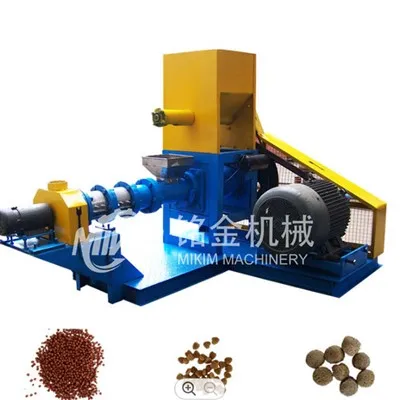
How to Use a Small Floating Fish Feed Pellet Extruder to Make Pellets?
Leave a message
content
Techniques for producing floating aquatic feed. Suitable for mid-to-upper-level fish such as bass and tilapia, the core principle is to improve buoyancy and water resistance. The starch content in the raw material formula is controlled at 35%-50%, using high-quality grains such as corn and wheat flour. Protein sources are mainly fishmeal and soybean meal (30%-40%). The extruder parameters are adjusted as follows: temperature 130-160℃, pressure 4-6MPa, twin-screw speed 300-400r/min, ensuring uniform internal porosity of the pellets, a buoyancy rate ≥95%, and water resistance for 8-12 hours. After drying and cooling, oil spraying can be applied to form a protective film on the pellet surface, further enhancing water resistance and palatability.
Techniques for producing hard pellet feed for livestock and poultry. Suitable for chickens, ducks, pigs, and other livestock and poultry, the core principle is to ensure pellet hardness and nutritional balance. The raw material formula contains 25%-35% starch and 25%-40% protein, with 5%-10% oil added to improve palatability. The parameters for the floating fish feed pellet extruder machine should be adjusted as follows: temperature 120-140℃, pressure 3-5MPa, speed 250-350r/min. Pellet hardness should be controlled at 2-5kg to avoid damage to livestock's mouths from excessively hard pellets, or excessively soft pellets that easily crumble and lead to waste. High extrusion degree is not necessary; the focus should be on ensuring a compact pellet structure and uniform nutrition, suitable for large-scale feeding.
Specialty feed production techniques: When producing feed for young animals (fish fry, piglets), use a small fish food pellet making machine, controlling the temperature at 80-100℃ and reducing the extrusion pressure to 2-3MPa. This results in loose, easily chewed and digestible pellets while retaining heat-sensitive nutrients such as vitamins and probiotics. When producing high-end pet food, increase the proportion of meat (40%-50%), reduce the starch content (20%-30%), adjust the extruder temperature to 110-130℃, shorten the raw material residence time, reduce the loss of meat flavor substances, and improve palatability and nutritional value.
Related equipment
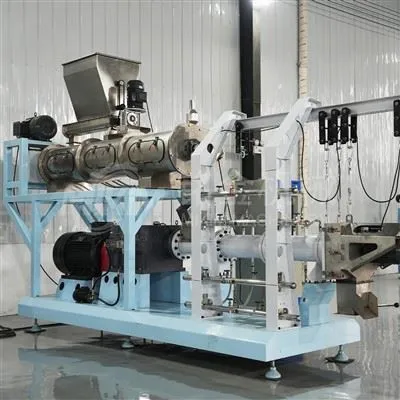


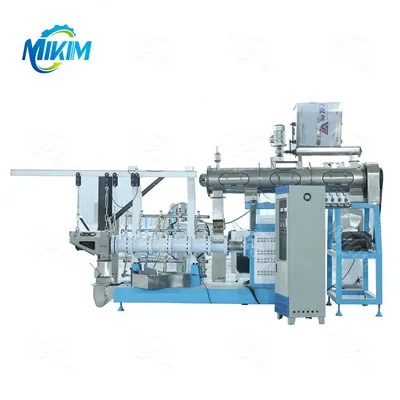
about Us
MIKIM's fish feed pellet production lines and supporting machinery offer excellent value for money. Not only are they affordable, eliminating middlemen markups and allowing small and medium-sized enterprises (SMEs) and fish farmers to purchase complete sets of equipment at reasonable costs, but they also boast exceptional efficiency. The fully automated process, from raw material crushing and precise ingredient mixing to extrusion pelleting and maturation, is completed in one continuous flow. This results in high starch gelatinization rates and uniform pellet formation, significantly improving production efficiency and feed quality, truly achieving "low cost, high output." Choosing a MIKIM fish feed pellet production line means enjoying comprehensive pre-sales and after-sales service, including 24-hour online customer support, a one-year warranty on the entire machine, professional on-site installation, commissioning, and maintenance, and a stable supply of spare parts. Customers can buy with confidence and use with peace of mind, with both excellent value and service quality!!!
Customer visit

Certificate of Honor

FAQ
1. What is the price of the fish food production machine?
The price ranges from approximately $1,500-$55,000
2. Do you provide maintenance services for your customers?
Yes, we offer comprehensive after-sales maintenance services to our customers.
If you would like to learn more about MIKIM machinery, please contact us. We offer one-stop service and welcome your inquiries!!!