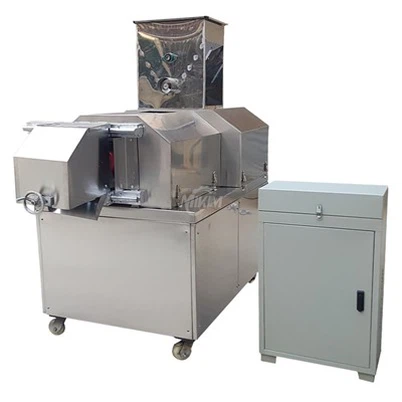
Multifunctional Fish Feed Cat Food Dog Food Pellet Extruder: Modular Dry Extrusion Line
Leave a message
What a Multifunctional Pellet Extruder Does
A multifunctional pellet extruder turns several feed formulas into one shared production stream. The same machine handles floating and sinking aquatic feed, dry cat food kibble and dog food kibble by changing the die, the cutter setting and the conditioning parameters. Because dry extrusion relies on mechanical shear and friction inside the barrel rather than on a large water addition, the raw material is cooked and sterilised as it is pressed, and the finished pellet leaves the die with a dense, water-stable structure that resists breaking in storage and handling.
Modular Line Design and Upgrade Path
The line is built from independent modules: crushing, mixing, extrusion and pelleting, and cooling. Standardised interfaces connect each module, so a producer can expand capacity by adding a pelletizing module, move into functional feed by adding an additive premixing module, or service one module without stopping the whole plant. This keeps production interruption losses low and lets a small workshop grow into a medium feed factory on a similar footprint.
Crushing module: hammers grain and oilseed meal to a consistent particle size
Mixing module: blends macro ingredients with vitamins, minerals and additives
Extrusion module: cooks, sterilises and shapes the mash through interchangeable dies
Cooling module: lowers pellet temperature and moisture before packing
Working Principle of Dry Extrusion
Material enters the feeding device and is conveyed into the barrel, where the screw shaft presses it under high pressure and rising temperature. The combination of pressure, shear and heat cooks and sterilises the raw material from the inside, so starch gelatinises and proteins are denatured into forms the animal digests more easily. The cooked mass is then pushed through a shaping die; the die aperture sets pellet diameter, and the rotating cutter sets pellet length. Because diameter and length are controlled separately, one extruder can serve fish, cat and dog formulas without a second machine. Feed size and feeding speed still decide the result: an even grind and a steady feed rate give uniform pellets, while surges or coarse lumps cause soft pellets, blocked die holes and extra wear on the screw and bearings.
DGP Model Specifications
| Model | Capacity (kg/h) | Main motor (HP) | Feeder motor (kW) | Cutter motor (kW) | Screw diameter (mm) | Machine size (m) | Weight (kg) |
|---|---|---|---|---|---|---|---|
| DGP-40 | 40-50 | 12 | 0.4 | 0.4 | 40 | 1.4 x 1.25 x 1.2 | 360 |
| DGP-60 | 120-150 | 25 | 0.4 | 0.4 | 60 | 1.47 x 1.12 x 1.25 | 560 |
| DGP-70 | 200-250 | 30 | 0.4 | 0.4 | 70 | 2.05 x 1.4 x 1.3 | 740 |
| DGP-85 | 300-350 | 35 | 1.5 | 0.55 | 80 | 2.15 x 1.5 x 1.3 | 850 |
| DGP-90 | 400-450 | 50 | 1.5 | 0.55 | 90 | 2.2 x 2 x 1.35 | 1200 |
Model selection follows planned hourly output: the DGP-40 suits a small aquatic feed workshop, the DGP-70 fits a growing farm feed unit, and the DGP-85 or DGP-90 supports a continuous medium-scale line. Main motor, feeder motor and cutter motor ratings are matched so that capacity rises without overloading any single drive.
Pelleting Effect on Feed Energy and Growth
Pelleted feed reduces the energy fish and shrimp must spend on eating. High-temperature maturation and precise shaping deliver a ration that is easy to take in and easy to digest, and the compact pellet form removes the need for frequent swimming to feed. Calculations from extruded pellet lines report an increase in the energy conversion rate of 15-20 percent and a weight gain improvement of 10-12 percent over the same period, while a stable supply of pellets avoids the extra energy cost caused by feed shortages.
Operation and Maintenance Practice
Match die aperture to species and life stage: smaller pellets for fry, larger pellets for adult fish and dogs
Hold mash moisture in the range that produces firm pellets, and adjust when the formula changes
Feed at a steady, moderate rate; overloading the barrel causes surging and rapid die wear
Inspect the screw, die and cutter after each shift and record wear in a simple log
Set cutter speed for the required pellet length instead of forcing throughput
Allow the cooling module to work fully before packing so pellets harden without cracking
Frequently Asked Questions
Q: Can one extruder produce fish feed, cat food and dog food?
Yes. The die and cutter are interchangeable and the conditioning settings are adjusted per formula, so the same machine covers all three product families within its rated capacity.
Q: How is pellet diameter and length controlled?
Diameter is set by the shaping die aperture and length by the cutting device, which means one machine can deliver several pellet sizes without extra tooling changes beyond the die.
Q: Why is cooking inside the barrel important?
Pressure, shear and heat cook and sterilise the raw material, gelatinise starch and denature protein, so pellets bind well and animals digest the feed more efficiently.
Q: What happens if feed size or feeding speed is unstable?
Coarse lumps block die holes and sudden surges overload the motor and drive parts, producing irregular pellets, a higher share of fines and faster wear on the screw and bearings.
Q: How does modular design reduce downtime?
Because each process module uses standardised interfaces, an individual module can be disassembled for service while the rest of the line stays in place, so production interruptions stay short.
Q: What maintenance keeps output stable?
Check the die, cutter and screw each shift, keep the barrel clean, feed a uniform grind at a steady rate, and replace worn dies before pellet quality drops.