Pet Dog Food Making Machine for Poultry and Fish Feed Pellets
Leave a message
Overview: One Line for Dog, Poultry and Fish Feed Pellets
A pet dog food making machine line is not limited to one species. The same extruder, dryer and seasoning train produces dog food, cat food, poultry feed, fish feed and shrimp feed, because the key variables are the formula, the die and the temperature profile rather than the animal itself. As pet ownership has grown and the market has split into products for adult and young animals, demand for different kibble shapes and textures has increased steadily.
Palatability is the reason formula design matters so much. A dog's sense of smell is far more sensitive than a human's, and dogs are attracted to meat and fish aromas rather than to sweet or milky notes. Products built only around a dairy-like smell can therefore score poorly on intake even when the nutrition is correct.
Equipment Configuration and Process Flow
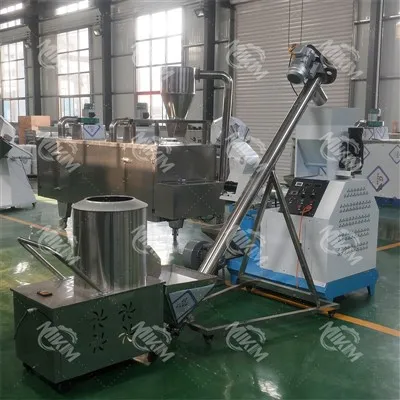
The standard configuration of the line runs: crusher, mixer, feeding machine, single-screw feed extruder, conveyor, multi-layer drying equipment, seasoning line, cooling conveyor, vibrating screen and packaging machine.
Crusher - grinds cereals and protein meals to the fineness the formula requires.
Mixer - blends macro ingredients, vitamins and minerals into a uniform mash.
Feeding machine - delivers mash to the extruder at a controlled and even rate.
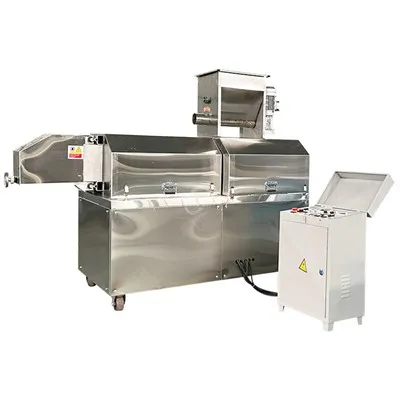
Single-screw extruder - cooks and shapes the mash, with adjustable raw material, temperature and moisture settings.
Multi-layer dryer - removes moisture evenly across several passes so pellets dry without case hardening.
Seasoning line and cooling conveyor - apply oil or powder coating, then bring pellets to ambient temperature.
Vibrating screen and packaging machine - remove fines and pack the graded product at the required bag weight.
Extruder Model Parameters
Five models are available so output can be matched to the target market. Capacity, motor ratings and screw diameter are listed below.
| Model | Capacity (kg/h) | Main Motor (kW) | Feeder Motor (kW) | Cutter Motor (kW) | Screw Diameter |
|---|---|---|---|---|---|
| DGP-100 | 500 | 37 | 1.5 | 1.5 | 100 mm |
| DGP-120 | 600-700 | 55 | 1.5 | 1.5 | 120 mm |
| DGP-135 | 800-900 | 75 | 1.5 | 2.2 | 135 mm |
| DGP-160 | 1000-1200 | 90 | 2.2 | 2.2 | 160 mm |
| DGP-200 | 1800-2000 | 132 | 3 | 3 | 200 mm |
Machine dimensions and shipping weight follow the same sequence, from 2 x 2.8 x 1.2 m and 1500 kg on DGP-100 up to 2.35 x 3.45 x 1.65 m and 3200 kg on DGP-200, which is useful when planning floor space and lifting equipment.
| Model | Machine Size (m) | Weight (kg) |
|---|---|---|
| DGP-100 | 2 x 2.8 x 1.2 | 1500 |
| DGP-120 | 2.2 x 2.9 x 1.2 | 1800 |
| DGP-135 | 2.2 x 3.1 x 1.37 | 2000 |
| DGP-160 | 2.3 x 3.15 x 1.38 | 2500 |
| DGP-200 | 2.35 x 3.45 x 1.65 | 3200 |
Formula and Process Settings That Control Quality
Raw material mix, barrel temperature and moisture are set together. Raising moisture softens the mash and improves flow but lowers expansion; raising temperature increases cook and aroma but shortens the working window before the melt darkens. Keeping the three values inside a recorded range for each formula is what makes output repeatable.
Seasoning and cooling decide the final texture. Coating after drying protects heat-sensitive oils, and cooling before packing prevents condensation inside the bag, which is the most common cause of mould during storage.
Why the Puffing Process Matters
Puffing is applied for seven practical reasons: it improves palatability, changes or improves nutritional value, raises digestion and absorption rate, modifies shape and structure for easier eating, reduces water content to extend shelf life, adjusts bulk density for different packing formats, and reduces mould, salmonella and other harmful organisms through the thermal load of extrusion. Together these effects let one machine serve dog, fish, shrimp and other pet feed formulas with consistent quality.
Frequently Asked Questions
Q: Which animals can be fed with pellets from this line?
Dogs, cats, fish, shrimp, poultry and other pet or farmed species, because shape, size and formula are set by the die and recipe.
Q: What capacity should a first-time buyer select?
DGP-100 gives 500 kg/h and DGP-200 gives 1800-2000 kg/h, so the choice follows expected daily sales volume and shift pattern.
Q: Are temperature and moisture adjustable during production?
Yes. Raw material, temperature and moisture settings can be adjusted on the extruder to suit each formula and the texture the market prefers.
Q: Why is a multi-layer dryer used?
Several drying passes remove moisture gradually so the pellet core dries without a hard surface shell that would trap moisture inside.
Q: What does the vibrating screen do?
It removes fines and oversize pieces after cooling, so only graded, uniform pellets reach the packaging machine.
Q: Why season after drying instead of before extrusion?
Heat-sensitive oils, fats and flavours are preserved when they are applied after drying rather than being pushed through the extruder barrel.