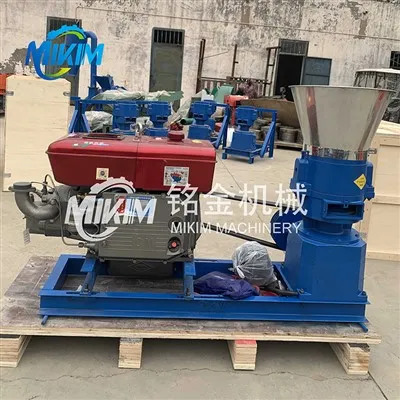
Fish Feed Manufacturing Line: Sinking and Floating Feed
Leave a message
What Is a Fish Feed Manufacturing Line?
A fish feed manufacturing line produces aqua fish feed and pet food that sinks, floats, or sinks slowly. Its purpose is to make pellets with a high in-shape rate and a pleasing appearance, which reduces feed waste and helps prevent pollution of the aquaculture water body. The line covers grinding, mixing, preconditioning, extrusion cooking, drying, coating, and cooling.
From Raw Material to Powder
Fish meal, cereals, vegetable proteins, and other high-quality ingredients are selected and ground according to the nutritional and pellet size requirements of different aquatic animals. The grinding stage is crucial because the particle size of the raw material directly affects the quality of the finished granules. After grinding, the powder is combined with small components such as vitamins and mineral premixes, then preconditioned and fed directly into the fish feed extruder.
Extrusion Cooking: The Core Step
The core procedure of the line is extrusion cooking, carried out in three steps: preconditioning, extrusion cooking, and die texturing and shaping. Twin-screw extrusion cooking achieves high physical and nutritional standards by controlling parameters such as shear, temperature, and residence time, and by combining them precisely. Direct steam injection, a venting device, effective barrel cooling, and precisely controlled screw speed and screw configuration optimize bulk density, cooking degree, the ratio of proteins to lipids, and other functional and nutritional pellet properties. After extrusion, the pellets are cooled, oil coated, and possibly treated with additives to finish the preparation.
Model Specification Table
The table below lists common extruder configurations for fish and pet feed production, allowing buyers to compare capacity, power, and screw diameter.
| Model | Capacity (kg/h) | Main Power (kW) | Screw Diameter | Packing Weight (kg) |
|---|---|---|---|---|
| MK40 | 40-60 | 5.5 | 40 mm | 350 |
| MK50 | 60-80 | 7.5-11 | 50 mm | 360 |
| MK60 | 100-150 | 15 | 60 mm | 386 |
| MK70 | 200-250 | 18.5 | 70 mm | 640 |
| MK80 | 250-300 | 22 | 80 mm | 750 |
| MK90 | 350-400 | 30 | 90 mm | 1050 |
| MK100 | 400-500 | 37 | 100 mm | 1200 |
| MK120 | 600-700 | 55 | 120 mm | 1880 |
| MK135 | 700-800 | 75 | 133 mm | 2100 |
| MK160 | 1000-1200 | 90 | 155 mm | 2500 |
| MK200 | 1800-2000 | 132 | 195 mm | 3000 |
Cost Advantages of Pellet Feed
Aquatic feed pellet production lines can reduce costs in raw material processing and transportation. If an aquaculture farm processes powdered feed in-house, it must purchase several raw materials separately, which creates large transport volumes and low density, low truck loading rates, and multiple shipments. Pellet lines allow centralized processing: pellets are dense and compact, so a truck of the same load capacity can carry significantly more feed value per trip. Integrated processing also reduces losses during raw material pre-processing, improves raw material utilization, and lowers overall processing costs.
FAQ
What types of pellets can the line produce?
The line produces sinking, floating, and slow-sinking pellets, allowing farmers to match feed behavior to the feeding habits of different fish species.
Why is particle size important before extrusion?
Raw material particle size directly affects granule quality. A consistent grind helps the mash mix evenly, precondition properly, and cook uniformly in the extruder.
How does twin-screw extrusion improve pellet quality?
Controlling shear, temperature, and residence time optimizes bulk density, cooking degree, and the protein-to-lipid ratio, producing stable, nutritious pellets.
What happens after the pellets leave the extruder?
Pellets are cooled, then oil coated and possibly treated with additives, which improves palatability, energy content, and shelf life.
How do I choose the right model?
Match capacity to production targets: a MK40 at 40-60 kg/h suits small farms and trials, while a MK160 or MK200 handles commercial-scale output of 1000-2000 kg/h.
Why are pellets cheaper to transport than powder?
Pellets are dense and compact, so trucks carry far more feed value per load, which reduces the number of shipments and total transport costs.