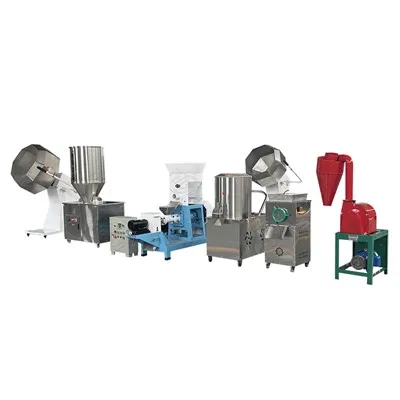
Pig, Chicken, Duck, Rabbit and Cattle Feed Pellet Production Line Plant
Leave a message
Introduction
Intensive production of animal feed pellets is of urgent need due to the prosperous breeding industry, and the feed pellet production line is the equipment that meets that need at scale. It makes various poultry and aquatic feed for rabbits, ducks, cattle, chickens, sheep, pigs, pigeons, fish and shrimp, and the whole line can be controlled by an automatic PLC system. This article explains the processing technology, the equipment flow, the model specifications and the three quantified advantages.
Processing: raw material, grinding, mixing, pelletizing, cooling, crumbling, screening and grading, packing.
PLC control automates the whole line from feed to bagged pellets.
Pellet feed suits automated feeding lines, cutting a 10000-hen farm's daily feeding from 3-4 hours to 1-2 hours, labor down 50%.
Waste falls from 5%-8% for powder to 1%-2% for pellets, saving 1-1.5 tons per 10000 broilers per cycle.
Shelf life reaches 30-60 days versus 15-20 days for powder.
Product Introduction
The feed pellet production line can be used to make various poultry feed and aquatic feed for rabbits, ducks, cattle, chickens, sheep, pigs, pigeons, fish and shrimp. The whole production line can be controlled by the automatic PLC control system, which manages batching, conditioning and pelleting parameters for consistent product quality with minimal operator intervention.
Feed Pellets Processing Technology and Equipment Flow
The processing technology runs: raw material, feed grinding, feed mixing, feed pelletizing, pellet cooling, pellet crushing, screening and grading, and pellet packing. The equipment flow is: feed grinder, feed mixer, feed pellet mill, counterflow cooler, feed pellets crumbler, feed pellets grading sieve, and automatic weighing and packing machine. Each stage is sized to the line rating, with the pellet mill defining the capacity ceiling.
Product Parameters
| Model | 320 | 350 | 400 | 420 | 508 |
|---|---|---|---|---|---|
| Capacity | 2-5 t/h | 1.5-8 t/h | 2-10 t/h | 3-12 t/h | 4-20 t/h |
| Main motor power | 37 kW | 55 kW | 75/90 kW | 110 kW | 132/160 kW |
| Screw feeder power | 0.55 kW | 0.75 kW | 0.75 kW | 1.5 kW | 1.5 kW |
| Conditioner power | 2.2 kW | 2.2 kW | 2.2 kW | 5.5 kW | 7.5 kW |
| Ring die inner diameter | 320 mm | 350 mm | 400 mm | 420 mm | 508 mm |
| Ring die rotational speed | 305 rpm | 336 rpm | 307 rpm | 287 rpm | 287 rpm |
| Roller outer diameter | 140 mm | 165 mm | 190 mm | 206 mm | - |
| Dimension | 2300x1000x2100 | 3200x1100x1700 | 3200x1300x1900 | 3500x1300x2800 | 3500x1500x2900 |
Product Advantages
The first advantage is reduced feeding labor cost. Pellet feed can be directly adapted to automated feed lines such as chain feed lines and auger feed lines, eliminating manual mixing and dividing. This can reduce daily feeding time for a 10000-hen laying-hen farm from 3-4 hours for powder feed to 1-2 hours, reducing labor costs by 50%. The second is reduced feed waste. Powder feed emits dust during handling and feeding, with a waste rate of 5%-8%; pellet feed is dust-free, reducing waste to 1%-2%. This can save 1-1.5 tons of feed per 10000 broiler chickens over a single breeding cycle. The third is extended feed shelf life. Pellet feed has minimal contact area with air and moisture; under standard storage conditions it has a shelf life of 30-60 days, more than double that of powder feed at 15-20 days, reducing waste costs from spoilage and suiting seasonal stockpiling.
Frequently Asked Questions
Which animals can this line make feed for? Rabbits, ducks, cattle, chickens, sheep, pigs, pigeons, fish and shrimp, by selecting the die and formula for each species.
How much labor does pellet feeding save? automated feeding lines cut daily feeding time on a 10000-hen farm from 3-4 hours to 1-2 hours, reducing labor cost by 50%.
How much feed waste does pelleting save? Waste falls from 5%-8% for powder to 1%-2% for dust-free pellets, saving 1-1.5 tons per 10000 broilers per breeding cycle.
How long does pellet feed store? 30-60 days under standard conditions, more than double the 15-20 days of powder feed.
Which model suits a 10 t/h plant? The 400 model at 2-10 t/h or 420 at 3-12 t/h, depending on your operating hours. Confirm with the supplier.
Is the line PLC controlled? Yes. The whole line can be controlled by an automatic PLC system for consistent, low-labor operation.