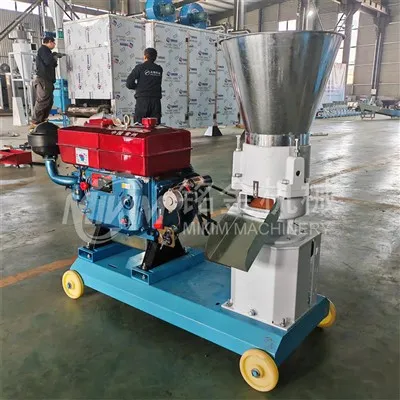
Small Scale Pellet Production Line for Feed and Biomass
Leave a message
What Is a Small Scale Pellet Production Line?
A small scale pellet production line is a compact system that integrates crushing, mixing, pelletizing, cooling, and screening into one continuous process. It is specially designed for processing biomass fuel, animal feed such as tilapia fish feed pellets, chemical raw materials, and other pelletizing needs. Because of its space-saving structure, user-friendly operation, and low energy consumption, it is ideal for small and medium-sized enterprises and for startup investments that want to begin pellet production without building a large plant.
Process Flow: From Raw Material to Finished Pellets
The process runs through five stages. First, raw material pretreatment: large pieces such as branches and straw are crushed into fine particles of usually 3-5mm by a crusher, and a drying unit such as a rotary dryer controls the moisture of the raw material at 10%-15%, because excessive moisture affects the forming effect. Second, conveying: the pretreated material is sent to the pellet mill by a screw conveyor or belt conveyor. Third, compression molding, the core link: the material is pressed through the die to form cylindrical particles. Fourth, cooling and screening: freshly formed particles leave the machine at about 80°C and must be cooled in a cooling tower to harden and take shape while moisture is reduced; a vibrating screen then removes debris and unformed particles. Fifth, packaging and storage: the granules are weighed and packed by an automatic packaging machine, usually 15-25kg per bag, or stored in bulk in a moisture-proof warehouse.
Ring Mold vs Flat Mold Pellet Machine
Two die designs are common in small production lines. In a ring mold pellet machine, the raw material is fed into the ring mold cavity and rotating pressure rollers squeeze it through the holes of the ring mold, which are usually 6-12mm in diameter. The high pressure of 50-100MPa and high temperature of 60-100°C soften the lignin in the material, enhance its plasticity, and form cylindrical particles after extrusion. In a flat mold pellet machine, the press roller rotates on a flat die and the material passes vertically downward through the die holes. Its structure is simpler and it is suitable for softer raw materials.
Technical Parameters by Model
Five line sizes are available. The table below lists the main parameters as published by the supplier.
| Model | Power (kW) | Grinder Power (kW) | Output (kg/h) | Size (mm) | Weight (kg) | Volume (m³) |
|---|---|---|---|---|---|---|
| 500 | 7.5-11 | 3 | 500-700 | 2300x1050x2500 | 430 | 0.5 |
| 750 | 7.5-11 | 3 | 700-900 | 2350x1160x2600 | 460 | 0.75 |
| 1000 | 7.5-15 | 3-4 | 1000-1500 | 2400x1300x2900 | 540 | 1 |
| 1500 | 11-15 | 4 | 1500-2000 | 2798x1200x3020 | 800 | 1.5 |
| 2000 | 11-15 | 4 | 2000-2500 | 2800x1750x3100 | 1000 | 2 |
Because the original parameter table on the page mixes several units in one layout, buyers should confirm the mixer power and the exact configuration of each model with the supplier before ordering.
Applications and Advantages
The line is used for tilapia and other fish feed pellets, pet food and dog food production, biomass fuel pellets, and chemical raw material granulation. Its main advantages are a modular and flexible design, high efficiency and energy saving, a stable and durable structure, eco-friendly and low-noise operation, and comprehensive service support. This combination makes it a practical entry-level choice for small producers who want to test several markets with one machine.
FAQ
What is the price of the aquaculture feed pellet production line?
According to the supplier, the price ranges from approximately US$23,000 to US$125,000, depending on the model and configuration. Buyers should confirm the exact equipment list before ordering.
Do you provide maintenance services for your customers?
Yes, the supplier states that comprehensive after-sales maintenance services are provided to customers, supporting long-term stable operation.
Can the line produce tilapia fish feed?
Yes. The line is designed for pelletizing needs including animal feed, so tilapia fish feed pellets, pet food, and dog food can all be produced by selecting the appropriate die and settings.
Should I choose a ring mold or flat mold machine?
Ring mold machines handle most raw materials, using die holes of 6-12mm and high pressure of 50-100MPa. Flat mold machines have a simpler structure and suit softer raw materials, which makes them a lower-cost option for light-duty use.
What output can I expect?
The five models cover outputs from 500-700 kg/h up to 2,000-2,500 kg/h, so the choice depends on the daily production target of the plant.
What moisture should the raw materials have?
Raw material moisture should be controlled at 10%-15% through drying before pelleting, because excessive moisture affects the forming effect and pellet quality.