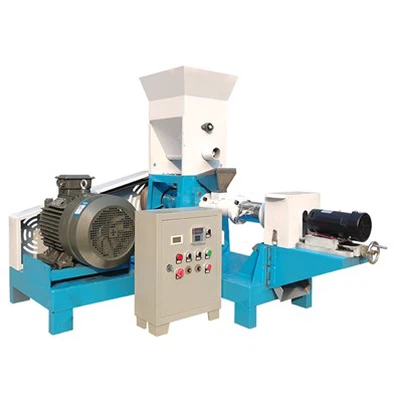
Can a Small Fish Feed Making Machine Cut Feed Cost per Ton?
Aug 30, 2023
Leave a message
Quick Answer: Can a Small Fish Feed Making Machine Cut Feed Cost?
It cuts the part of the cost that belongs to the feed mill. On-site extrusion removes the mill's margin, its bagging and its freight, and replaces them with your raw material, your power and your labour. On the DGP-70 the connected power is 19.3 kW against an output of 200–250 kg/h, which is 86 kWh of connected power per ton of feed before the dryer. Whether that is cheaper than the bag depends on two numbers you can write down today: the delivered price of the bag, and the cost of your own raw material per ton.
The calculation below uses published motor ratings and outputs only. It does not assume a raw material price, because that price is local. Substitute your own figures and the answer comes out in minutes.
01
What the Bag Price of a Small Fish Feed Machine Actually Contains
A delivered bag contains five cost blocks. Only one of them disappears when you extrude on site, and knowing which is which prevents a wrong comparison.
• Raw material. You pay it either way. It is the largest block in both cases.
• Processing. Milling, conditioning, extrusion, drying and cooling. This block moves to your site; the power and labour that produced it become yours.
• Bagging and handling. Bags, stitching, pallets and warehouse labour.
• Freight to farm. Distance and volume. Feed is bulky, so this block is larger than most buyers expect.
• Mill margin and distributor margin. The block that disappears entirely when you produce your own.
02
Power per Ton on a Small Fish Feed Making Machine
Connected power divided by rated output gives a stable comparison between models, because both numbers come from the same published table. It is not the metered consumption: the motor runs below nameplate for part of the cycle. It is the figure to compare machines with, not the figure to put in a budget.
Model
Output (kg/h)
Main motor (kW)
Feeder (kW)
Cutter (kW)
Screw dia. (mm)
Packing size (m)
Net weight (kg)
DGP-60
120-150
15
0.4
0.4
Φ60
1.36*1.33*0.86
420
DGP-70
200-250
18.5
0.4
0.4
Φ70
1.36*1.33*0.86
550
DGP-80
300-350
22
1.5
0.55
Φ80
2.3*1.7*1.4
720
DGP-90
400-450
30
1.5
0.55
Φ90
2.3*1.8*1.4
1100
DGP-100
500
37
1.5
1.5
Φ100
2.0*2.8*1.2
1500
Table 1. DGP models used for the small-farm range. Connected power is the sum of the main motor, feeder and cutter ratings in the same row.
Read across one row: the DGP-60 carries 15.8 kW for 120–150 kg/h, the DGP-70 carries 19.3 kW for 200–250 kg/h, the DGP-80 carries 24.05 kW for 300–350 kg/h. Output rises faster than power in this range, which is why the power cost per ton falls as the model gets larger. That is the argument for sizing up, and the reason a machine bought too small costs more per ton to run than a machine bought at the right size.
03
The Payback Calculation for a Small Fish Feed Machine
Payback needs three inputs and one subtraction. Write them down before comparing quotations.
Input 1: the delivered cost per ton of bought feed
Invoice price plus freight plus unloading, divided by tons received. Use the price you actually paid last month, not a quoted price.
Input 2: your cost per ton of own feed
Raw material per ton, plus power per ton, plus labour per ton, plus bags. Power per ton is connected power divided by output, multiplied by your tariff and by the hours the machine actually runs.
Input 3: annual tons
Tons per day multiplied by production days. This is the multiplier that turns a small saving per ton into a payback period.
Payback in months equals the machine and dryer investment divided by the monthly saving. Run the calculation twice: once at rated output, once at 60 percent of rated output. A machine that pays back at rated output and does not pay back at 60 percent is a machine sized too large for the farm.
A worked example shows the arithmetic. If the machine and dryer together cost 20 units and the saving is 1 unit per month, payback is 20 months. At 60 percent of rated output the saving becomes 0.6 units per month and payback moves to 33 months. The same investment produces two different answers, and the difference is how hard the machine is actually run.
04
When Buying Feed Still Wins Over a Small Fish Feed Making Machine
There are conditions where extrusion does not pay, and saying so is part of an honest quotation.
• Very low annual tonnage. A farm using a few tons a year does not recover the setup cost, because the fixed part of the investment is spread over too few tons.
• No reliable raw material supply. If grain and protein meal have to be bought at retail in small lots, the raw material block rises and the saving disappears.
• No power or no labour. A site without three-phase power needs a diesel drive, which changes the cost base; a site without a spare operator cannot run a second production task.
• One formula, one size, small volume. A single-pond farm buying one bag size gains little from formula control.
05
What Changes on the Farm Beyond the Small Fish Feed Machine Price
Two changes show up after the first month and are usually left out of the purchase case.
• Freshness. Feed extruded this week has not spent weeks in a warehouse or a container. Mould and fines in stored bags are the failure that farms report most often.
• Formula control. Protein and fat levels are set by you, per pond and per growth stage. A farm feeding one bag to every pond is paying for protein the fish cannot use.
06
Frequently Asked Questions About Small Fish Feed Making Machines
What Does a Small Fish Feed Making Machine Cost to Run per Ton?
Connected power per ton on the DGP-70 is 19.3 kW against 200–250 kg/h, so about 86 kWh of connected power per ton before drying. Multiply by your local tariff for the power part of the cost.
Is a Small Fish Feed Machine Price the Only Cost to Compare?
No. The dryer, the packing station and the spare dies sit outside the machine price and inside the project cost. Two machine prices are only comparable with the same auxiliary list.
What Output Does a Small Floating Fish Feed Machine Need for One Ton a Day?
1,000 kg over an 8-hour shift is 125 kg/h, which the DGP-60 covers at 120–150 kg/h. A 6-hour shift needs 167 kg/h, which moves the choice to the DGP-70 at 200–250 kg/h.
Does Making Feed on Site Change Pellet Quality?
It changes who controls it. Die diameter and cutter setting fix pellet size, and the formula fixes protein and fat; both are set on site instead of at the mill.
How Many Tons a Year Justify the Investment?
Run the payback calculation at 60 percent of rated output. If the machine does not pay back over your annual tonnage at that rate, the farm is below the volume where on-site extrusion makes sense.
Send us your bought-feed price and annual tonnage, and we will run the payback with you
Give us the delivered price per ton, the tons per day, the shift length, the power tariff and the raw materials you can source locally. We will reply with the model, the connected power per ton and the payback table for your own figures.
Request a quotation