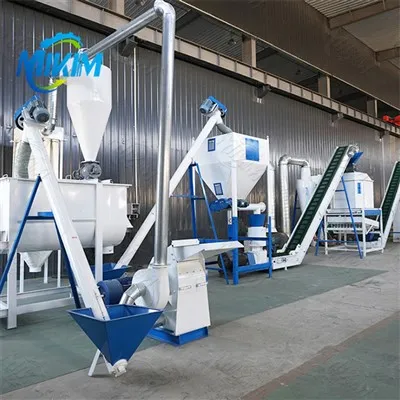
What are the essential selection factors for a floating fish feed extruder line mixer?
Leave a message
For manual floating fish feed pellet production lines (all operations from batching and feeding to discharge are manual, with a monthly output of <50 tons), the key selection criteria for mixing equipment are "simple operation and low cost." Basic mixing equipment should be chosen, without complex configurations. A small double-helix conical mixer (0.5-1 ton per hour) without an automatic control system is recommended. This equipment is equipped with only simple start/stop buttons and time relays. The mixing time (3-5 minutes) is set manually, feeding is done manually, and discharge is controlled by a manual valve. This type of equipment costs 50,000-80,000 RMB per unit, is easy to operate, and can be mastered by ordinary workers, making it suitable for family workshops or small-scale farmers. It is important to note that the mixing equipment in a manual production line should be equipped with a simple sampling port for easy manual sampling to check the mixing uniformity and avoid feed quality problems caused by human error.
For semi-automatic floating fish feed production lines (semi-automatic batching, manual feeding assistance, semi-automatic discharge, with a monthly output of 50-300 tons), the mixing equipment must have "basic automation functions" to improve production efficiency. We recommend choosing a double-helix conical mixer or a horizontal paddle mixer (1-5 tons per hour) with a PLC-based basic control system. Equipment configuration includes: automatic timing (mixing time can be preset for different formulas), feeding alarm (alarm when the feed amount reaches the preset value), and automatic discharge valve (linked with subsequent pellet mills for orderly discharge). Simultaneously, a manual-assisted feeding platform should be provided, working in conjunction with a semi-automatic batching scale for precise feeding. A medium-sized feed mill in Hebei province, using a semi-automatic production line equipped with a 3-ton-per-hour double-helix conical mixer with PLC control, improved the efficiency of batching and mixing by 60%, increasing the per capita production capacity from 10 tons to 15 tons per day. This type of equipment costs 150,000-300,000 RMB per unit, balancing efficiency and cost, making it the mainstream choice for medium-sized feed mills.
Fully automatic fish feed processing line (fully automated batching, feeding, mixing, and discharging, monthly output > 300 tons) requires mixing equipment with "highly automated integration functions" to achieve coordinated operation with the entire production line. We recommend choosing a ribbon mixer or a large double-helix conical mixer (hourly capacity 5-20 tons) with an intelligent PLC control system. Key features include: seamless integration with an automatic batching system (automatically receiving batching signals and completing feeding), real-time data monitoring (touchscreen display of mixing time, temperature, speed, etc.), automatic fault diagnosis and alarms (automatic shutdown alarms for faults such as motor overload and feed blockage), and remote control functionality (managers can monitor equipment operation status via a mobile app). Additionally, an automatic cleaning system is included; after batch production, the equipment interior is automatically purged with compressed air, reducing manual intervention.
Related equipment


about Us
MIKIM's fish feed pellet production lines and supporting machinery offer excellent value for money. Not only are they affordable, eliminating middlemen markups and allowing small and medium-sized enterprises (SMEs) and fish farmers to purchase complete sets of equipment at reasonable costs, but they also boast exceptional efficiency. The fully automated process, from raw material crushing and precise ingredient mixing to extrusion pelleting and maturation, is completed in one continuous flow. This results in high starch gelatinization rates and uniform pellet formation, significantly improving production efficiency and feed quality, truly achieving "low cost, high output." Choosing a MIKIM fish feed pellet production line means enjoying comprehensive pre-sales and after-sales service, including 24-hour online customer support, a one-year warranty on the entire machine, professional on-site installation, commissioning, and maintenance, and a stable supply of spare parts. Customers can buy with confidence and use with peace of mind, with both excellent value and service quality!
Customer visit

Certificate of Honor

FAQ
1. What is the price of the floating fish feed production line?
The price ranges from approximately $3,500-$55,000
2. Do you provide maintenance services for your customers?
Yes, we offer comprehensive after-sales maintenance services to our customers.
If you would like to learn more about MIKIM machinery, please contact us. We offer one-stop service and welcome your inquiries!!!