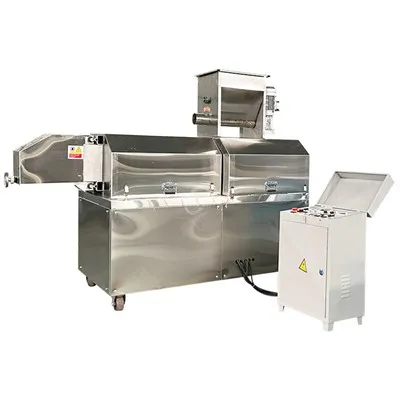
Safe Operation Guidelines for Fish Food Extruders: Pre-Start, Running and Shutdown Rules
Leave a message
Why Extruder Safety Needs Clear Written Rules
A fish food extruder combines fast-rotating screws and cutter blades, hot barrel surfaces and dusty raw materials, so the margin for error is small. Accidents on this type of equipment cluster around three routine moments: start-up checks that were skipped, careless handling near the cutter while the machine is running, and cleaning that started before the rotor had come to a stop. The guidelines below follow the natural rhythm of the working day, before start-up, during operation and after shutdown, and they apply to small fish feed machines as well as to larger lines.
Before Start-Up: Blades, Material Condition and Protective Gear
Work through a short pre-start checklist every shift rather than relying on memory, because the checks that get skipped are exactly the ones that cause injuries.
Cutting blade sharp, correctly seated and locked, retaining bolts tightened with a torque wrench
Die and cutter gap set to the recipe, die holes free of hardened residue
Raw material dry, free of lumps and free of stones, wire or packaging fragments
Hopper and feeder free of foreign objects and of material left from the previous batch
Guards, inspection covers and safety interlocks in place and working
Emergency stop tested, machine grounded, cables and plugs free of damage
Confirm that the cutting blade is sharp and securely installed. A blade that is loose can leave the housing at speed and cause serious injury. Confirm that the raw materials are dry and free of lumps, because lumped material feeds unevenly and can overload or jam the machine. Wear a dust mask whenever handling feed raw materials, since airborne fines damage the respiratory tract over months of exposure, and wear gloves against sharp impurities such as wire or bone fragments.
During Operation: Steady Feeding and Warning Signs
Never use hands or tools to move particles near the cutting blade while the machine is running, and do not stand directly in front of the discharge port for long periods, because hot pellets can splash out and burn. Feed at a steady rate instead of pouring the whole batch in at once; a sudden load can clog the hopper, cause overflow or trip the motor. If abnormal noise appears or smoke is seen, disconnect the power immediately and wait for a qualified technician to diagnose the fault before restarting. Do not open the machine to investigate on your own.
| Warning sign | Likely cause | Immediate action |
|---|---|---|
| Sharp knocking from the barrel | Foreign object inside or worn screw flight | Stop, isolate power, inspect after cooling |
| Motor current climbing steadily | Overfeeding or partially blocked die | Reduce feed rate, clean the die |
| Smoke or burning smell | Overheating, belt slip or electrical fault | Stop, isolate power, call a technician |
| Uneven or crumbling pellets | Worn cutter blade or wrong die gap | Stop, reset or replace the blade |
| Vibration that grows over the shift | Loose fastener or coupling wear | Stop, check base and coupling bolts |
Notice the direction of any warning early. A slow rise in motor current over several minutes is far easier to correct than a sudden trip, and both are avoided by feeding at the rate the machine was designed for.
After Shutdown: Wait, Isolate and Clean Safely
After powering off, wait until the cutter has completely stopped rotating before removing residue from the hopper and the barrel. Switch off the main isolator and lock it out so the machine cannot restart while anyone is working inside. The die contains many small holes; clear them with a fine needle and light pressure, because excess force can break the die or the needle and cause injury. After cleaning, return tools to their designated places and keep the work area clear so that no debris is left to trip the next operator.
The Four Habits Behind Most Avoidable Incidents
First, cleaning before the cutter stops: even with the switch off, the blade can keep spinning and cause a severe cut. Second, reaching into the discharge area while the machine is loaded to pull out a stuck pellet. Third, running the machine without a dust mask, which quietly harms the operator over months. Fourth, ignoring smoke or abnormal noise and continuing to feed. Every one of these is prevented by the same simple rule: stop, isolate the power, lock it out, and wait until every moving part is completely still before a hand goes near the machine.
Two supporting rules belong in the same written procedure. Prohibit loose clothing, long sleeves and jewellery near rotating shafts, and assign one named person to confirm before each shift that guards and interlocks are in place and that the emergency stop works. A rule that is written, posted at the machine and checked on a fixed schedule is the difference between a safe line and one that depends on luck.
Frequently Asked Questions
Q: Is a dust mask really necessary for feed raw materials?
Yes. Fine feed dust stays airborne for a long time and repeated exposure damages the respiratory tract, so a properly fitted mask is standard practice for anyone loading the hopper or cleaning the machine.
Q: How long should the operator wait before cleaning after shutdown?
Waiting is not measured in seconds but in state: the rotor and cutter must be completely still, the main isolator switched off and locked out, and the barrel cool enough that residue can be handled safely.
Q: Can the die be cleaned with a hard steel tool?
No. Use a fine needle or a soft brass tool with light pressure. Hard scraping enlarges the die holes, changes the pellet size and can break the die or injure the operator.
Q: What should be done if the motor trips repeatedly?
Do not simply reset and restart. Stop the machine, isolate the power, then check the feed rate, the die condition and the drive belt or coupling before allowing the machine back into service.
Q: Who is allowed to open the machine for inspection?
Only a qualified technician should open guards or the electrical cabinet. Operators handle routine feeding, cleaning and visual checks, and report faults instead of repairing them.
Q: Does the safety routine differ for small household machines?
The scale is smaller but the hazards are the same. Sharp blades, hot surfaces and dust apply equally, so the same pre-start checklist and lockout rule should be used.