


What are the operating steps for a fish feed processing line?
Leave a message
Walking into a fish feed factory, you'll see a bunch of machines running, but you might not know the order of their operations. Actually, the operation of a fish feed production line follows a fixed procedure, from raw material processing to feed packaging. Every step must be executed correctly; otherwise, the feed will either be substandard or unsuitable for feeding fish.
Fish Feed Factory Production Line: 8 Core Operational Steps
1. Raw Material Receiving and Storage (Step 1) Raw materials (corn, soybean meal, fishmeal) are transported to the factory by truck. First, the quality is checked (e.g., is the corn moldy, does the fishmeal have an off-odor?). If there are no problems, they are poured into the warehouse silos (the silos are large iron drums that can store hundreds of tons of raw materials). Different raw materials are placed in different silos to avoid mixing.
2. Raw Material Cleaning (Step 2) The raw materials are sent from the silos to the cleaning machine to screen out stones and clods of dirt, and remove metallic impurities. For example, small stones in the corn will be screened out, and iron nails will be attracted by a magnetic separator-this step is very important, otherwise impurities will damage the hammers of the crusher.
3.Crushing Raw Materials (Step 3) The cleaned raw materials are sent to the crusher and ground into fine powder (e.g., corn ground into 80-mesh powder). After grinding, the powder is piped to the powder silo for temporary storage, awaiting mixing with other raw materials.If it is not ground fine enough, the crusher screen is reduced, and it is ground again.
4. Precise Ingredient Formulation (Step 4) Weigh the cornmeal, soybean meal, fishmeal, vitamins, and other additives from the feed silo according to the formula using a feed scale. For example, to make 1000kg of bass feed, weigh out 300kg of cornmeal, 250kg of soybean meal, 200kg of fishmeal, and 5kg of vitamins-this must be done exactly according to the formula; even a slight increase or decrease will not work.
5. Mixing and Stirring (Step 5) Pour all the weighed ingredients into a mixer and stir for 15-20 minutes until thoroughly mixed (you can grab a handful of powder to check if the color is uniform; if it is, the mixture is ready).
6. Pelletizing/Extrusion (Step 6) The mixed powder is fed into a pellet mill or extruder: a pellet mill is used for sinking feed to press into pellets; an extruder is used for floating feed to heat and extrude into floating pellets. Pellet size can also be adjusted by changing the mold (e.g., 2mm for fry, 5mm for larger fish).
7. Cooling and Drying (Step 7) The freshly made pellets are very hot and have a high moisture content (above 20%). They are sent to a cooler to lower the temperature to room temperature and the moisture content to below 12% – otherwise the feed will mold and cannot be stored.After cooling, a sieve is used to remove debris, ensuring the finished product consists of intact pellets.
8. Packaging and Warehousing (Step 8) The qualified pelleted feed is sent to a packaging machine to be packaged into 25kg or 50kg bags (the bags will be printed with feed type, production date, and shelf life), and then transported to the finished product warehouse for storage, ready to be sold to fish farms.


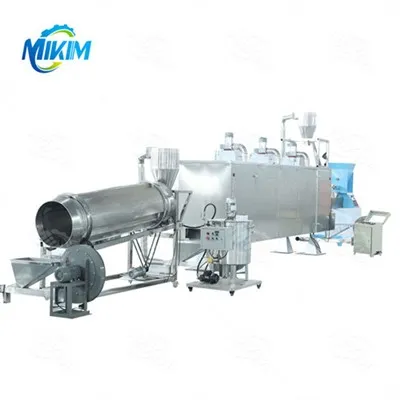
Operational Tips
Each step needs to be monitored. For example, check the fineness of the powder during grinding, the evenness of the mixture during mixing, and the moisture content after cooling. Adjustments should be made promptly if any problems arise to ensure the production of qualified fish feed.
Why Choose Us
MIKIM boasts extensive experience in poultry feed pellet production lines, significantly reducing the incidence of poultry diseases. Its equipment is not only widely used across various industries domestically but also exported to Southeast Asia, Europe, Africa, and South America, earning a high reputation internationally. This global presence not only demonstrates the adaptability and competitiveness of its products, but also demonstrates the company's experience in adapting to diverse market standards and logistics conditions, enabling it to provide a stable supply chain for its overseas customers. Whether serving large domestic farms or cross-border feed companies, MIKIM can leverage its global service network to ensure a consistent, high-quality experience.
For more information on process flow design, equipment layout, factory construction plans, individual equipment pricing, or turnkey project proposals, please feel free to contact us!!!
FAQ
1. What is the price of the fish food processing line?
The price ranges from approximately $10,000-$33,000
2. Do you provide maintenance services for your customers?
Yes, we offer comprehensive after-sales maintenance services to our customers.


