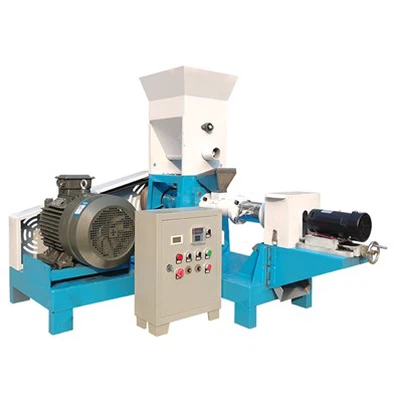
How to Clear Clogged Ring Die Holes on a Floating Feed Machine
Leave a message
Why Floating Feed Die Holes Clog
A ring die is the forming part of a floating feed machine. Feed mash is pressed through tapered holes by the rollers and cut into pellets, so the condition of the hole walls controls output, pellet shape and the load on the main motor. When part of the holes are blocked, the pellet rate falls, the pellets come out rough or incomplete, and the pressure inside the pressing chamber rises. Floating feed formulations are usually higher in starch and fat and are processed at a higher moisture level than ordinary compound feed, which makes the die more prone to blockage.
In practice, blockage has four common sources:
Sticky or over-moist mash that smears on the hole wall and then hardens.
Stone, sand or metal particles from raw materials pressed into the hole taper.
Fine powder and binder-rich mash that compacts under the roller.
Feed residue left in the die when the machine stands idle for a long time.
Cleaning is planned maintenance rather than a repair, and it follows three steps: remove the ring die safely, clear the holes with a tool that matches the hole diameter, and reinstall the die so the locating faces and the rollers are correctly aligned.
Remove the Ring Die Safely
Isolate the main power supply and wait until the rotor has come to a complete stop before opening the die chamber. Release the clips that secure the ring die and lift it out with the lifting hook or hoist supplied for the machine. A ring die has a hard but brittle case, so it must never be lifted by hand by the hole edge or levered with a screwdriver, and it must not be dropped onto a hard floor.
Place the die on a rubber mat or a clean wooden pallet, working face upwards. A soft, grit-free surface protects the working face from scoring and keeps removed debris from being pressed back into the holes while you handle the die. Keep the rollers and locating pins on the same mat.
Match the Cleaning Tool to the Hole Diameter
The cleaning tool must suit the hole diameter. An oversized tool deforms the hole mouth, changes the pellet diameter and shortens die life, so check the die specification before you start.
| Hole diameter | Recommended tool | Working method |
|---|---|---|
| Above 2 mm | Cleaning needle of matching size, or a stainless steel needle of the same diameter | Insert from the discharge end, rotate gently while pushing through, then blow the hole out with compressed air |
| Below 2 mm | Nylon bristle brush, warm water, air gun | Soften the residue and brush it out, then blow the hole clear; a hard steel needle must not be used |
Always work from the discharge side of the die. The holes are tapered, and pushing a needle the wrong way drives residue deeper and can close the narrow end permanently. Clear a group of holes, blow them out and move on in a fixed pattern so that no hole is missed.
Soften Stubborn Blockages with a Warm-Water Soak
If a hole is blocked by hardened feed that resists the needle or the brush, soak the ring die in warm water for about 10 minutes to soften the material, then repeat the needle or brush cleaning and the air blow-out. Warm water is enough; boiling water or steam can distort a thin die and is not needed for feed residue.
Do not use excessive force or metal scrapers. Levering a blocked hole opens the taper, creates burrs at the hole mouth and changes the hole geometry, which shows up later as irregular pellets and uneven die wear. After soaking, confirm that material leaves the hole freely and that the hole mouth is clean and free of burrs before the die goes back into the machine.
Reinstall, Align and Verify Every Hole
Stand the clean die upright and hold it up to the light to check that every hole is open and that no debris or burrs remain at the mouths. During installation, align the locating pins, seat the die squarely in its carrier and confirm the orientation: a die fitted backwards or off-centre produces abnormal noise immediately after start-up and damages both the hole surface and the rollers.
Tighten the clips evenly and in a diagonal sequence so that the die is not distorted. Run the machine briefly at idle, listening for rubbing or knocking, and only then feed material. Add a short check to the shift routine: record pellet quality and the ampere reading, and clean the die after every long idle period or whenever the pellet rate falls.
Frequently Asked Questions
Q: How often should the ring die of a floating feed machine be cleaned?
Clean after every long idle period and whenever pellet output or pellet appearance falls. Cleaning right after shutdown, while residue is still soft, is far easier than cleaning a hardened die the next morning.
Q: Can a steel drill bit be used to open a blocked hole?
Only for holes larger than 2 mm, and only with a bit of exactly the same diameter. Holes below 2 mm must be treated with a nylon brush and warm water, because a hard needle deforms the taper.
Q: Why do only part of the holes become blocked?
Local differences in mash moisture, binder-rich lumps and hard particles block holes in groups. Roller and die misalignment also loads one sector more heavily, so blockage repeats in the same area.
Q: Is it acceptable to run the machine with a few blocked holes?
No. Blocked holes raise chamber pressure and produce uneven load on the rollers. The remaining open holes carry more material, wear faster, and pellet quality continues to fall.
Q: Can soaking the die cause damage?
Warm water for about 10 minutes is safe. Boiling water, steam or acid solutions can distort or corrode a thin die and shorten its service life.