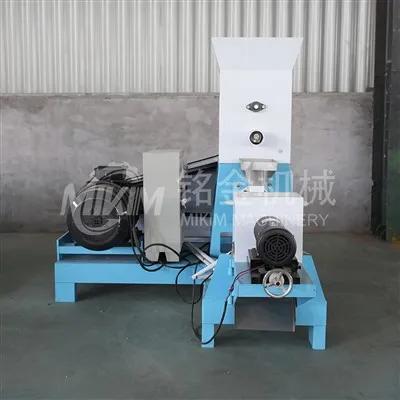
What are the Stages of Pellet Manufacturing with dry dog food making machine?
Leave a message
content
The core of high-nutrient pelleting lies in "precise temperature control, layered processing, and enhanced post-processing nutrition supplementation." The key differences from ordinary pellets lie in three stages: extrusion and maturation, mixing, and post-processing. The first step, raw material pretreatment, employs finer screening standards. All raw materials undergo three screenings (vibrating screen + air separation + magnetic separation) to ensure no impurities are present. The particle size is increased to 100-120 mesh to facilitate nutrient release and animal digestion. Moisture content is strictly controlled at 12%-13%, precisely matching the pelleting requirements of high-nutrient raw materials and preventing nutrient loss due to excessive moisture.
The second step, segmented extrusion and maturation, utilizes an Automatic Dog Food machine for precise temperature control in multiple zones. The feeding section operates at 80-100℃, allowing the raw materials to gradually adapt to the temperature; the extrusion section operates at 120-130℃ to ensure starch gelatinization and protein denaturation while minimizing the loss of heat-sensitive nutrients; and the discharge section operates at 110-120℃ to further stabilize the quality of the raw materials. During the puffing process, the screw speed is adjusted (400-500 rpm) to control the residence time of the raw material in the cavity to 10-15 seconds, achieving a balance between "fully cooked" and "nutrient retention." The puffed raw material is then rapidly cooled to room temperature, avoiding excessive airflow during cooling to prevent rapid moisture loss and impact subsequent granulation.
The third step involves layered mixing, separating the cooled puffed material into two parts: the base material (puffed raw material + vegetable powder) is first poured into a mixer and stirred for 5 minutes; then the nutrient materials (probiotics, vitamins, amino acids, deep-sea fish oil) are added and stirred for 3 minutes to ensure uniform dispersion and prevent prolonged mixing with the base material, which could lead to loss of active ingredients. The mixing process must be completely sealed to prevent external impurities from entering, while maintaining the mixer temperature below 30°C to protect heat-sensitive nutrients.
The fourth step, granulation and post-processing, uses a high-precision food granulator with a food-grade stainless steel die to avoid contaminating the raw material; the extrusion pressure is controlled at 4-6 MPa to ensure uniform particle density and prevent nutrient loss. After granulation, the pellets undergo a low-temperature drying process at 70-80℃ for 25-30 minutes, slowly reducing the moisture content to 11%-12% to maximize nutrient retention. After drying, the pellets are cooled to room temperature and then screened and graded to remove substandard pellets. Finally, a post-coating treatment is performed, where remaining heat-sensitive nutrients (such as Vitamin C and probiotics) are dissolved and evenly sprayed onto the pellet surface. After air drying, the pellets are sealed and packaged. This process ensures that the high-nutrient pellets produced by the food pelleting machine are fully cooked, safe, and hygienic, while maximizing nutrient retention and enhancing product added value.
Related equipment
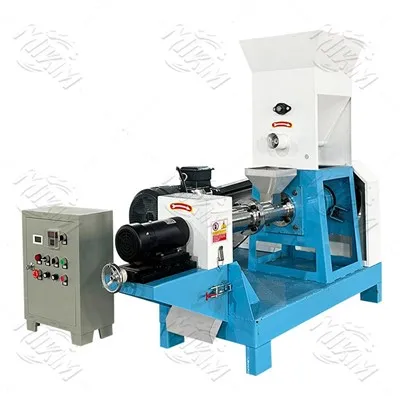


about Us
MIKIM's fish feed pellet production lines and supporting machinery offer excellent value for money. Not only are they affordable, eliminating middlemen markups and allowing small and medium-sized enterprises (SMEs) and fish farmers to purchase complete sets of equipment at reasonable costs, but they also boast exceptional efficiency. The fully automated process, from raw material crushing and precise ingredient mixing to extrusion pelleting and maturation, is completed in one continuous flow. This results in high starch gelatinization rates and uniform pellet formation, significantly improving production efficiency and feed quality, truly achieving "low cost, high output." Choosing a MIKIM fish feed pellet production line means enjoying comprehensive pre-sales and after-sales service, including 24-hour online customer support, a one-year warranty on the entire machine, professional on-site installation, commissioning, and maintenance, and a stable supply of spare parts. Customers can buy with confidence and use with peace of mind, with both excellent value and service quality!!!
Customer visit

Certificate of Honor

FAQ
1. What is the price of the Pet food manufacturing Machine?
The price ranges from approximately $1,500-$55,000
2. Do you provide maintenance services for your customers?
Yes, we offer comprehensive after-sales maintenance services to our customers.
If you would like to learn more about MIKIM machinery, please contact us. We offer one-stop service and welcome your inquiries!!!