What Is the Core Process in a Feed Pellet Production Line?
Leave a message
Conditioning and Pelleting: the Core of the Line
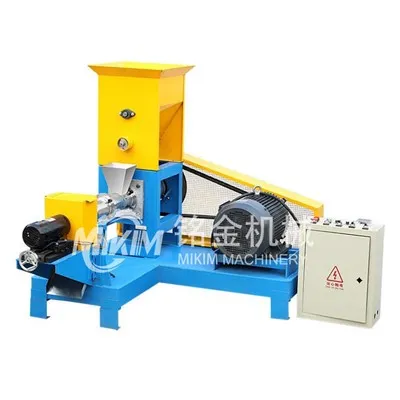
In a feed pellet production line the core process is the combination of steam conditioning and die pelleting, because this is the only stage that actually forms the pellet. Ground and mixed material is heated with saturated steam in the conditioner so that starch gelatinizes, proteins soften and the particles bind, then the conditioned mash is pressed through the die of the pellet mill. Conditioning temperature, retention time, moisture addition and die specification together decide pellet durability, formation rate and surface quality, so all other equipment in the line exists to feed this stage with a consistent, well-prepared mixture.
Upstream Processes That Decide Pellet Quality
Upstream equipment sets the ceiling for what the pellet mill can achieve. Grinding controls particle size and distribution; a hammer mill that is too fine wastes energy and slows throughput, while a coarse grind gives weak pellets. Mixing must be uniform, because any variation in premix or oil addition appears later as variable hardness and colour. Batching accuracy and continuous, even feeding prevent the conditioner from being starved or overloaded, which is a common cause of unstable pellet quality.
Grinding: a hammer mill reduces crop straw, grain, soybean meal and similar raw materials to the target fineness.
Conveying: sealed screw conveyors move grain and powdery material cleanly, with little residue and dust.
Mixing: a stainless steel mixer blends powders, premixes and liquids quickly and evenly.
Dosing: automatic batching weighs each component to recipe, removing manual proportioning errors.
Downstream Processes: Cooling, Crumbing and Packing
Pellets leave the die hot, soft and moisture-laden, so cooling is part of the forming process rather than a separate handling step. A counter-flow cooler removes heat and surplus moisture evenly, hardening the pellet and protecting it from mould during storage. Crumbling or sieving then produces the required size range and removes fines, and the packer weighs and bags the finished feed to a controlled accuracy. Cooling performance and the cooling time set at the control panel have a direct effect on breakage in the silo and on shelf life.
Typical Configuration of a Commercial Line
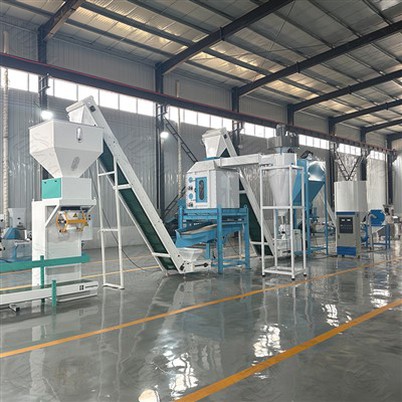
The table below shows a representative configuration for a large commercial feed plant; the layout and the machine sizes are matched to the site and to the target feed types.
| Item | Typical value |
|---|---|
| Capacity | 15-20 t/h |
| Application | Large commercial feed plant; poultry, sheep, cattle and shrimp feed |
| Operators required | 4-5 people per shift |
| Shipment volume | About 6 x 40 ft containers |
| Pellet size range | 1-12 mm, selectable by die and cutter setting |
| Main equipment | Hammer mill, screw conveyors, mixer, pellet mill, cooler, crumbler, packer |
| Control | Central computer control with automatic batching |
| Line footprint | Laid out according to available land size and building height |
How to Evaluate the Core Equipment
Because conditioning and pelleting carry the quality, the pellet mill deserves the closest technical review. Check the die and roller material and the heat treatment process, since high-strength wear-resistant alloys and controlled heat treatment are what allow higher pressure and temperature with a stable pellet formation rate and longer service life. Then confirm that grinding, conveying, mixing, cooling and packing capacities are balanced with the mill, that the control system can hold recipes and log parameters, and that the layout can be adapted to the raw materials, formula and plant area actually available. A line that is balanced end to end needs less maintenance and fewer component replacements than one built around a single oversized machine.
Frequently Asked Questions
Q: What exactly is the core process in a feed pellet production line?
Steam conditioning followed by die pelleting. Conditioning prepares the mash thermally and hydraulically, and the pellet mill forms the pellet; every other stage exists to support these two steps.
Q: How fine should raw materials be ground?
Fineness is chosen from the animal species and the target pellet diameter: finer grinding improves binding and digestibility but lowers mill throughput, so the screen size is a compromise validated on the actual line.
Q: Why do pellets sometimes come out soft or crumbly?
The usual causes are low conditioning temperature, insufficient retention time, wrong moisture addition, worn die and rollers, or an unbalanced grind. Check these in order before changing the formula.
Q: How many operators does a 15-20 t/h line need?
With automatic batching and central computer control, a large commercial line is typically run by about 4-5 people per shift, mainly for supervision, die changes and packing.
Q: Is variable frequency control worth fitting?
Yes, for most modern lines. Variable frequency speed regulation lets the machine follow production demand instead of running at a fixed speed, which improves adaptability, stability and energy use under part load.
Q: Can one line produce pellets for several animal species?
Within limits, yes. Die and cutter changes plus recipe settings give pellet sizes from about 1 mm to 12 mm, but formulas with very different fat content or grinding requirements need the line to be sized for the widest case.