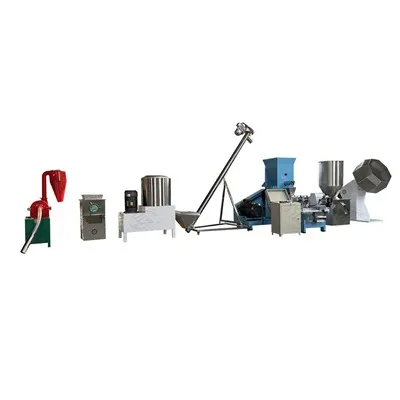
Finished Product Molding Rate of a Feed Pellet Line: Key Factors and How to Raise It
Leave a message
What the Finished Product Molding Rate Means
The finished product molding rate of a feed pellet line is the proportion of raw material fed into the process that leaves the line as qualified, intact pellets suitable for packing. Material discharged as fines, dust, or cracked and misshapen pellets is either recycled back into the process or lost as waste. A higher molding rate therefore means better raw material utilization, lower specific energy consumption, and more uniform feed quality.
The rate is measured twice in practice: once at the pellet mill outlet, and again after cooling and screening. Pellets that break during cooling count against the finished product exactly like pellets that failed at the die, so the post-cooler, post-screener figure is the one that should be reported and used for cost calculations.
A realistic target is normally expressed as a range rather than a single number, because different formulas bond differently. A high-fat, high-fibre recipe will always mold less readily than a simple maize-soybean mash, so one die and one steam setting cannot be expected to deliver an identical rate across a whole product portfolio.
Process Variables That Decide the Molding Rate
Several process variables interact to decide how much of the material becomes sound pellets. Adjusting one setting to cure a defect usually shifts the load onto another, so the variables are best reviewed together rather than one at a time.
| Variable | How it affects the molding rate |
|---|---|
| Formula and particle size | A grind that is too coarse produces weak pellets that crack, while excessive fines restrict flow through the die. Fat and fibre levels change how well particles bond during pressing. |
| Steam conditioning | Conditioning softens starch and activates natural binding properties. Insufficient conditioning produces powdery, brittle pellets; excess moisture makes the die slip and pellets crumble. |
| Die condition and hole geometry | A worn die, or one whose hole diameter, effective thickness and taper do not suit the formula, lowers compression and yields soft or misshapen pellets. |
| Roller gap and die contact | Uneven roller clearance gives unsteady extrusion, so some pellets are over-compressed and others under-compressed within the same pass. |
| Cooling | Pellets that are packed or conveyed while still warm and moist break easily; counterflow cooling before screening is essential. |
| Screening and recycle rate | Fines returned at an uncontrolled rate overload the mill and hide the underlying cause of a low yield. |
A Step-by-Step Sequence for Raising the Rate
Improvement work is most effective when it follows the material flow, because every stage sets the conditions for the next one.
1. Grinding: match hammer mill screen size to the formula and to the die in use, and confirm the result with a sieve test rather than by eye.
2. Conditioning: control steam addition, mash temperature and retention time as one set; a short, well-controlled cycle is more stable than a long, wet one.
3. Die selection: choose hole diameter, effective thickness and taper for the recipe, and record which die produced the best result for each product.
4. Roller adjustment: keep roller gap and die contact even across the full track width, and re-check after every die change.
5. Cooling: use counterflow cooling to reach a moisture and temperature level at which pellets are firm before packing.
6. Screening: screen after cooling and recycle fines at a controlled, measured rate so the mill load stays steady.
How the Molding Rate Drives Line Economics
A line with a low molding rate spends energy twice: first to form the pellets, then to regrind and reprocess the fines. That double cost applies to the affected material and occupies capacity that could be producing fresh feed. Because fines also reduce the effective throughput of the cooler and the packer, the loss compounds along the line instead of staying at the die.
A high molding rate brings benefits beyond yield. Fewer fines mean less dust at packing, better storage stability, and feed that is easier for the end user to handle. For these reasons the molding rate is one of the first indicators examined when output per kilowatt-hour falls, or when complaints about dusty feed start to appear.
Monitoring Practice and Common Misconceptions
Operators should weigh pellets and fines at the cooler outlet at regular intervals and track the ratio over time rather than relying on a single measurement. A slow decline usually signals die wear more reliably than a visual inspection, because wear is gradual and the packed product can still look acceptable long after the rate has fallen.
Misconception 1: a new die automatically guarantees a high molding rate. A new die still has to be matched to the formula and run in gradually, or it will produce variable pellets much like a worn one.
Misconception 2: more steam always improves binding. Over-conditioning produces soft, sticky pellets that deform at the cutter and can block the die.
Misconception 3: recycling fines hides the problem. Returning fines at a high rate simply adds cost and masks the cause, while reducing the capacity available for fresh material.
Frequently Asked Questions
Q: Where should the molding rate be measured?
Measure at the pellet mill outlet and again after cooling and screening, then use the post-screener figure as the official finished product molding rate.
Q: What causes a sudden drop in the molding rate?
A sudden drop usually points to a change of batch characteristics, a blocked or wrongly sized screen, or a drop in steam quality. Check the material first, then the mechanical settings.
Q: Can a high molding rate be achieved with a coarse grind?
Only within limits. Very coarse particles produce weak pellets that crack during cooling and conveying, so grind size has to be matched to the die rather than set for throughput alone.
Q: How does cooling relate to the molding rate?
Cooling is part of the molding process, not an afterthought. Pellets that leave the cooler warm and moist are soft, and they are counted as losses when they break at the conveyor or in the bag.
Q: Is a higher molding rate always better for feed quality?
Not by itself. Hardness and durability must stay within the range the animals tolerate; the aim is a stable, high rate at the correct hardness, not maximum compression.
Q: How often should rollers and dies be inspected?
Inspect at every die change and record the running hours. Wear parts should be planned as consumables so inspection does not interrupt an order that is already scheduled.