


What is the difference between fish extruder machine and fish pellete feed machine?
Leave a message
Core Working Principles
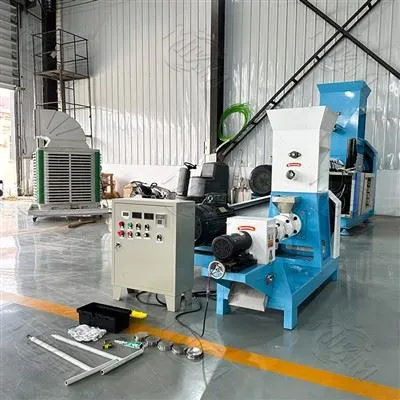
Fish extruder machine: It relies on a screw system to shear, compress, and knead raw materials. During processing, the machine creates an environment of high temperature (110 - 130°C) and high pressure (3 - 10 MPa). When the conditioned materials are pushed out of the die, the sudden pressure drop makes the internal water vapor expand instantly. This forms a porous structure in the feed, which is the core principle for the feed to float. In this process, the materials are fully matured.
Fish pellet feed machine: Its operation is relatively straightforward. It mainly uses components such as a ring die and pressure rollers. The powdery raw materials are directly squeezed into the die holes under the extrusion force of the pressure rollers and then cut into granular shapes by a cutter. The whole process has no obvious high - temperature and high - pressure 膨化 (expansion) link, and the raw materials are barely matured.
Properties of Finished Feed
Fish extruder machine: The produced feed is mostly floating or slow - sinking. It has a porous internal structure and a low density (≤1 g/cm³). Besides, it has strong water stability and is not easy to disperse or dissolve when soaked in water for a long time, which can reduce water pollution. Moreover, the particle texture is relatively loose yet structurally intact.
Fish pellet feed machine: The finished feed is generally sinking feed with a dense texture and a density greater than that of water. Its surface is relatively smooth. However, its water resistance is poor. When soaked for a long time, it is prone to crumbling, which may lead to nutrient loss and water quality deterioration.
Nutritional Utilization of Feed
Fish extruder machine: The high - temperature and high - pressure environment in the extrusion process can degrade the long - chain structures of nutrients such as proteins and fats into short - chain structures that are easier to digest. It also improves the gelatinization degree of starch (generally ≥85%), which enhances the digestibility and absorption rate of the feed by fish. Additionally, high temperature and pressure can kill bacteria, molds and other harmful microorganisms in raw materials, and inactivate anti - nutritional factors in ingredients like soybean meal, thus improving the safety and quality of the feed.
Fish pellet feed machine: Since there is almost no maturation process, the nutrients in the feed remain in their original state. The starch gelatinization degree is low, and proteins are not denatured. This makes it more difficult for aquatic animals to digest and absorb the feed. Meanwhile, the machine cannot effectively remove harmful substances in raw materials, so the safety of the feed largely depends on the purity of the raw materials themselves.
Equipment Characteristics and Costs
Fish extruder machine: It has a complex structure, integrating components such as a screw conveying system, a high - pressure barrel, and a temperature control device. Twin - screw extruders, which are commonly used, have higher performance but are more expensive. They also have high production efficiency and low failure rates, making them suitable for large - scale feed processing plants.
Fish pellet feed machine: It has a simple structure, mainly consisting of a feeding device, an extrusion mechanism, and a cutting device. It occupies a small area, produces low noise, and has a relatively low price. It is easy to operate and maintain, but its production capacity is generally lower than that of extruders.
Application Scenarios
Fish extruder machine: It is suitable for large and medium - sized feed factories and intensive aquaculture bases. It is especially ideal for breeding surface - feeding or middle - water - layer fish such as tilapia, koi, and salmon. It can also add more liquid ingredients like fish oil in the later stage to produce high - value aquatic feed.
Fish pellet feed machine: It is widely used in small - scale individual farmers and small feed workshops. It is suitable for breeding bottom - feeding fish such as crucian carp and catfish that are accustomed to ingesting sinking feed. It can also process feed for livestock and poultry, with a wide range of raw material adaptability. For example, it can process straw and rice husk into granular feed.
Related equipment



about Us
MIKIM's fish feed pellet production lines and supporting machinery offer excellent value for money. Not only are they affordable, eliminating middlemen markups and allowing small and medium-sized enterprises (SMEs) and fish farmers to purchase complete sets of equipment at reasonable costs, but they also boast exceptional efficiency. The fully automated process, from raw material crushing and precise ingredient mixing to extrusion pelleting and maturation, is completed in one continuous flow. This results in high starch gelatinization rates and uniform pellet formation, significantly improving production efficiency and feed quality, truly achieving "low cost, high output." Choosing a MIKIM fish feed pellet production line means enjoying comprehensive pre-sales and after-sales service, including 24-hour online customer support, a one-year warranty on the entire machine, professional on-site installation, commissioning, and maintenance, and a stable supply of spare parts. Customers can buy with confidence and use with peace of mind, with both excellent value and service quality!
Customer visit

Certificate of Honor

If you would like to learn more about MIKIM machinery, please contact us. We offer one-stop service and welcome your inquiries!!!


