


What is the Simplified Manufacturing Process for Small-Scale Livestock Feed process?
Leave a message
Production process description
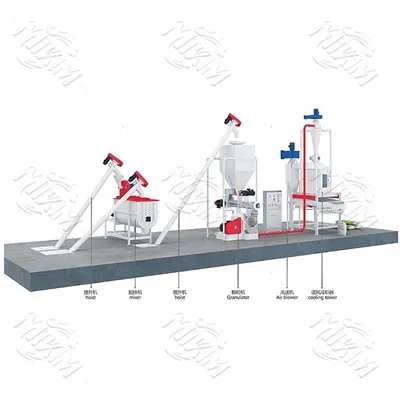
Small-scale feed production (for family farms, small livestock breeders) uses simplified equipment and processes to reduce costs, focusing on basic mixing and pelleting. The process starts with manual raw material sorting: main ingredients (corn, soybean meal, wheat bran) are sorted by hand to remove stones, moldy grains, and impurities-no professional inspection equipment is used, so farmers rely on visual and sensory checks (e.g., no musty smell, uniform color).
Second, semi-automatic crushing: a small hammer mill (capacity 0.5–1 ton/hour) is used to crush corn into 2–4 mm particles; soybean meal is usually purchased pre-crushed to save time. The crushed materials are stored in separate bins.
Third, manual weighing and mixing: ingredients are weighed using a platform scale according to a simple formula (e.g., 70% corn, 20% soybean meal, 8% wheat bran, 2% premix). The weighed materials are added to a small horizontal mixer (capacity 50–100 kg/batch) and mixed for 3–5 minutes-farmers often check uniformity by taking samples from different parts of the mixer and comparing colors.
Fourth, small-scale pelletizing (optional): if making pelleted feed, a small pellet mill (electric, 0.2–0.5 ton/hour) is used. The mixed material is moistened with water (to 15–18% moisture) by hand, then fed into the mill. The mill uses mechanical pressure (no steam conditioning) to press the material through a die, forming soft pellets that are dried in the sun for 2–3 hours (reducing moisture to ≤14%).
Finally, simple packaging and storage: the finished feed is packed into plastic bags or sacks, labeled by hand (feed type, production date), and stored in a dry, ventilated room. No cooling or screening equipment is used, so the feed has a shorter shelf life (1–2 months) and is used quickly to avoid mold growth.



Related equipment parameters
|
|
|
|
|
|
|
|
|---|---|---|---|---|---|---|
|
|
|
|
|
|
|
|
|
|
|
|
|
|
|
|
|
|
|
|
|
|
|
|
|
|
|
|
|
|
|
|
|
|
|
|
|
|
|
|
|
|
|
|
|
|
|
|
Main Products


about Us
MIKIM has 13 years of dedicated experience in the field of feed machinery. It has deeply engaged in the entire chain of design and production, and has formed a complete technical system covering pellet feed production lines and extruded feed production lines. It can provide integrated equipment solutions from raw material crushing, mixing, conditioning to granulation, drying and packaging. Its core equipment such as twin-shaft paddle mixers, ring die pellet mills, twin-screw extruders, etc. have all been verified by the market for a long time and are suitable for the production needs of various types of feed such as fish, livestock, poultry, and pets. What is more noteworthy is that the company continues to track industry technology trends and optimizes equipment in the direction of intelligent and automated upgrades of feed machinery, which can help customers improve production efficiency and meet the development needs of the modern breeding industry.
For more information on process flow design, equipment layout, factory construction plans, individual equipment pricing, or turnkey project proposals, please feel free to contact us!!!

FAQ
1. What is the price of the Small Scale Poultry Feed Pellets production line ?
The price ranges from approximately $11,000-$60,000
2. Do you provide maintenance services for your customers?
Yes, we offer comprehensive after-sales maintenance services to our customers.


