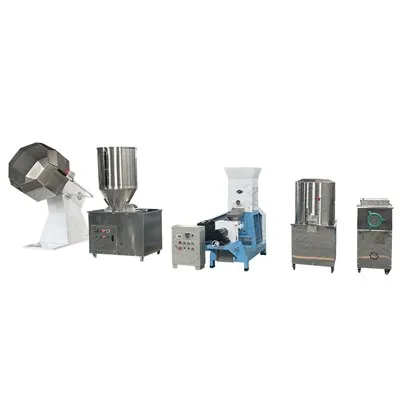
What should I check if the fish feed production machine is not rotating?
Leave a message
The motor, transmission system, and screw of the floating fish feed making machine have no mechanical faults, but the equipment still does not rotate. The problem is mostly in the electrical control system - such as relay failure in the control cabinet, PLC program disorder, or false triggering of safety sensors, which causes the equipment to be unable to receive the start signal, or to automatically stop due to "false fault judgment" after starting.
Fault Causes and Solutions
1.Faulty relays or contactors in the control cabinet
Causes: The motor starting relay (or contactor) contacts may be oxidized due to long-term arcing, leading to poor contact and preventing the motor from receiving power; or the relay coil may be burned out due to voltage fluctuations, preventing it from engaging the contacts and disconnecting the power circuit;loose relay terminals may cause a circuit break, preventing signal transmission.
Solutions: After powering off, open the control cabinet and use sandpaper to polish the relay contacts to remove the oxide layer; use a multimeter to test the relay coil resistance. If the resistance is infinite (burned out), replace it with the same model relay (e.g., Schneider LC1D40 model suitable for a 37kW motor); tighten the terminals to ensure good wiring contact, and test the relay's engagement state (no sparks, no abnormal noise).
2.PLC Program Malfunction or Parameter Error
Causes: A sudden power outage (workshop power failure) causes the PLC program to be lost or malfunction, resulting in the inability to output control signals (e.g., inability to start the motor or feeder); or the operator mistakenly modifies PLC parameters (e.g., setting the screw speed to 0 r/min), causing the equipment to fail to operate according to the set procedure, and resulting in no response after pressing the start button.
Solutions: Contact the equipment manufacturer to obtain the PLC backup program and rewrite it via the programming cable; if the program is not lost, enter the parameter setting interface and restore the factory settings (or reset key parameters according to the instruction manual, such as screw speed 300 r/min, tempering temperature 85℃); after setting, perform a no-load test to verify whether the motor, feeder, and heating system start in the programmed sequence.
3.Safety sensor malfunction or false alarm
Cause: The extruder is equipped with safety sensors (such as the barrel end cover safety switch, emergency stop button, and die head pressure sensor). If the barrel end cover is not fully closed (safety switch not triggered), the emergency stop button is not reset, or the pressure sensor falsely reports "overpressure," the PLC will lock the equipment and prevent the motor from starting; or the sensor circuit may be short-circuited (e.g., damaged cable), continuously sending fault signals.
Solution: Check if the barrel end cover is closed and ensure good contact of the safety switch contacts (press the switch and observe if the indicator light on the control cabinet illuminates); rotate the emergency stop button clockwise to reset; use a multimeter to test the pressure sensor signal. If the value is abnormal (e.g., no pressure but displays 1.8MPa), calibrate the sensor or replace it with a new one; repair damaged sensor wiring to ensure normal signal transmission, and test the safety protection function (e.g., the equipment stops immediately when the end cover is opened).


Why Choose Us
MIKIM boasts extensive experience in poultry feed pellet production lines, significantly reducing the incidence of poultry diseases. Its equipment is not only widely used across various industries domestically but also exported to Southeast Asia, Europe, Africa, and South America, earning a high reputation internationally. This global presence not only demonstrates the adaptability and competitiveness of its products, but also demonstrates the company's experience in adapting to diverse market standards and logistics conditions, enabling it to provide a stable supply chain for its overseas customers. Whether serving large domestic farms or cross-border feed companies, MIKIM can leverage its global service network to ensure a consistent, high-quality experience.
For more information on process flow design, equipment layout, factory construction plans, individual equipment pricing, or turnkey project proposals, please feel free to contact us!!!

FAQ
1. What is the price of the fish food pellet making machine?
The price ranges from approximately $5,000-$25,000
2. Do you provide maintenance services for your customers?
Yes, we offer comprehensive after-sales maintenance services to our customers.