


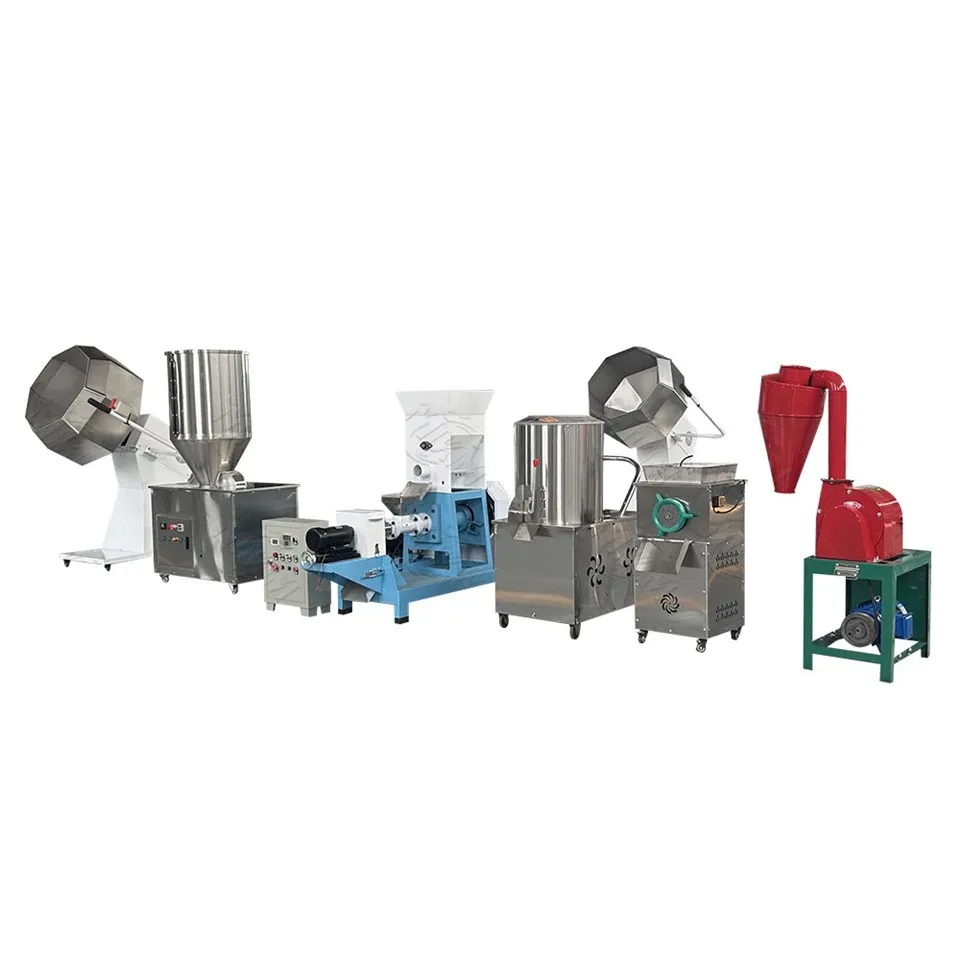


1500–2000 Kg/H Fish Feed Making Production Line
A 1500-2000 kg/h fish feed making production line built around a wet twin-screw extruder is the standard choice for commercial aquafeed plants.
Description
A 1500-2000 kg/h fish feed making production line produces premium floating feed at scale, every day. If you run a feed mill, supply many farms, or farm intensively and buy thousands of tons of pellets a year, this line turns that spend into your own high-margin output. Commercial feed prices keep climbing and bag quality stays hit-or-miss from outside suppliers. You feel the squeeze every season. This guide explains why twin-screw leads at this capacity, what the wet process adds, the full wet twin-screw model range, a complete plant configuration with power ratings, and a realistic investment and payback picture. We cover species from shrimp to salmon and walk you from layout to commissioning.
Key Takeaways
- A fish feed making production line at this capacity is best served by a wet-type twin-screw aquatic feed extruder, which handles high-fat, high-protein mashes that single-screw machines struggle with.
- Steam conditioning before extrusion lifts starch gelatinization and water stability, so pellets float 12–24 hours and breakage stays below 8 percent.
- The Wet-type Twin-Screw floating fish feed extruder machine covers 250 kg/h up to 4000 kg/h across five models, with the 95型 (2000–2500 kg/h) and 120型 (3000–4000 kg/h) sitting in the commercial band.
- A complete 1.5–2 t/h plant adds a boiler, grinder, mixer, dryer, oil sprayer, cooler, screener, and automatic packer, with total power typically 160–260 kW and a footprint near 400–600 m².
- At this scale, producing feed on-site or for resale commonly recovers the plant cost in 8 to 18 months, driven by volume and margin per ton.
1. What Is a 1500–2000 kg/h Fish Feed Making Production Line?
A fish feed making production line at the 1.5–2 t/h level is a commercial-grade plant. It receives raw ingredients in bulk, grinds and mixes them to formula, steam-conditions the mash, extrudes it through a twin-screw barrel, then dries, coats, cools, screens, and packs the finished pellets automatically.
The "1500–2000 kg/h" window defines the hourly throughput the wet twin-screw extruder is sized for. At 2 t/h and 8 hours a day for 300 days, the line can produce about 4,800 tons of feed a year. That volume is enough to supply a large integrated farm or to run a regional feed business selling to neighboring ponds and cages.
Unlike a small farm line, a plant this size is usually PLC-controlled, runs with a shift team, and is laid out for material flow rather than packed into one room. The twin-screw extruder is the heart, but the boiler and conditioning system are what separate "wet" quality from "dry" quality at this scale.
Tell us what you feed, and we will size it. Share your daily tonnage and target species (shrimp, salmon, grouper, eel) with our engineers, and we will match the twin-screw extruder and every station, then send a configured quote. Request a configured quote
2. Wet-type Twin screw floating fish food pellet maker machine: Core of a High-Capacity Plant
The MIKIM Wet-type Twin screw floating fish food extruder machine uses two intermeshing screws turning in a closed barrel, with steam injected at the conditioner ahead of it. Two screws do what one cannot: they move sticky, high-fat, high-protein mashes through the barrel without slip or choke, and they shear the material so uniformly that every pellet gets the same cook.
At 1.5–2 t/h, this matters because commercial formulas for salmon, eel, and grouper run fat levels of 12–20 percent and protein of 40–50 percent. A single screw struggles with that viscosity and can stall or give uneven expansion. Twin-screw keeps output steady and lets you push oil content higher without sacrificing pellet integrity.
The wet Type Twin screw floating fish feed pellet processing machine also gives the finest buoyancy control of any extruder type. By tuning screw speed, steam, and die, you make buoyant floating feed, slow-sinking mid-water feed, or dense sinking feed from one machine, with consistent density batch to batch.

3. Twin-Screw vs Single-Screw Fish Feed Extruder
Buyers at this capacity often weigh twin-screw against a wet single-screw. The differences are concrete:
- Throughput stability. Twin-screw holds rated capacity on difficult mashes; single-screw loses output on high-fat feeds.
- Fat handling. Twin-screw comfortably processes 12–20 percent fat. Single-screw is best kept under about 12 percent.
- Texture uniformity. Two screws shear more evenly, so fines and uneven pellets drop.
- Cost. Twin-screw costs more to buy and needs a more skilled operator. Single-screw is cheaper and simpler.
- Service life. Twin-screw barrels and screws wear evenly and last longer under heavy commercial duty.
For this capacity aimed at premium species, twin-screw is the safer long-term bet. If your formulas stay below 12 percent fat and your margin is tight, a wet single-screw 1 t/h line can do the job for less, though it tops out well below 2 t/h.
Wondering about twin-screw and single-screw system differences? Compare their structure, output and suitable applications to pick your processing machine.
4. Wet-type Twin screw floating fish machine vs Wet-type single screw floating fish feed pellet machine: When to Upgrade
The upgrade question is really about fat, volume, and product mix. Move from wet single-screw to wet twin-screw when:
- Your daily volume pushes past about 1.5 t/h and single-screw capacity gets tight.
- You add salmon, eel, or grouper feeds with fat above 12 percent.
- You sell feed to other farms and need batch-to-batch consistency that protects your brand.
- You want to coat more oil post-extrusion without soft pellets.
Stay on wet single-screw if you serve tilapia, catfish, and carp at under 1.5 t/h with standard formulas. The single-screw delivers excellent floating feed at lower capital and simpler operation. The twin-screw earns its premium only when the application demands it.
If your need is below 2 t/h and cost-led, also compare the dry single-screw 40–2000 kg/h line, which drops the boiler entirely for the lowest entry cost.
5. Why Twin-Screw for High-Fat, High-Protein & Premium Feed
Premium aquafeed is where twin-screw pays for itself. Three reasons:
- High fat without choking. Salmon and eel feeds need 12–20 percent fat for energy and flesh quality. Twin-screw moves that mash smoothly; single-screw stalls.
- Higher digestibility. Uniform shear and steam conditioning raise starch gelatinization past 85 percent, so fish convert more feed to weight. Better FCR (feed conversion ratio) means lower cost per kg of fish.
- Post-extrusion oil coating. The porous extruded pellet absorbs sprayed fish oil without losing shape, letting you hit energy targets that a compressed sinking pellet cannot.
The business case is margin. Premium species accept higher feed prices, and a consistent, high-stability pellet lets you command that premium while cutting complaints about wasted or disintegrating feed. At 1.5–2 t/h, those gains compound across thousands of tons a year.
6. Process Flow & Plant Layout for a 1.5–2 t/h Line
A wet twin-screw plant follows the full flow, and its defining advantage is the steam conditioner (station 4), which delivers the water stability and digestibility that justify wet over dry at this commercial scale. Each station below states what it does, why it matters, and the typical equipment.
1–2T/H Fish Feed Pellet Production Line Factory Showcase | Complete Floating Aquafeed Line Display
1. Raw material receiving and pre-cleaning
- What it does: bulk ingredients are magnet-separated and sieved to remove stones, metal, and agglomerates.
- What it costs you if you skip it: at 2 t/h, a single missed bolt can shut the line for hours and damage the grinder or extruder.
- Equipment: magnetic separator and rotary screener, typically 0.37–0.75 kW, one set.
2. Grinding (hammer mill)
- What it does: reduces all ingredients to 60–80 mesh for even cooking.
- Why you should care: consistent fineness is what lets starch gelatinize fully and keeps fines under 8 percent at packing.
- Equipment: large hammer mill, typically 30–55 kW at this scale, one or two units.
3. Batching and mixing
- What it does: computer-controlled batching weighs each ingredient to formula, then a double-shaft mixer blends to ±1 percent.
- Why this matters to you: automated batching removes human weighing error across thousands of tons, protecting formula cost and fish performance.
- Equipment: micro-ingredient weigher, main weigher, and double-shaft mixer, typically 7.5–15 kW, one set.
4. Steam conditioning
- What it does: the mash passes through a conditioner where live steam pre-cooks it, raising temperature and moisture before extrusion.
- Why you should care: this is the step that earns the wet line its premium. Steam pre-gelatinization lifts water stability so pellets float 12–24 hours and resist leaching, and it lowers the energy the extruder itself must supply. A dry line skips it and gives up this stability edge, which is exactly why a 1.5–2 t/h commercial plant runs wet.
- Equipment: steam conditioner plus boiler (the boiler is a separate plant item, commonly sized to the line's steam demand), conditioner drive typically 3–15 kW.
5. Twin-screw extrusion and puffing
- What it does: two intermeshing screws compress, shear, and cook the conditioned mash, then force it through a die. Pressure release puffs the pellet.
- Why you should care: this is where floating feed is made and where twin-screw shines on high-fat mashes. Die changes set pellet size from 0.8 mm to 12 mm, and screw tuning sets buoyancy.
- Equipment: wet twin-screw extruder with main motor, feeder, and cutter. See the model table in Section 7.
6. Drying
- What it does: a multi-layer belt dryer drops moisture to 8–10 percent.
- The payoff: at commercial volume, mold risk and storage life decide your margins. Correct drying protects months of inventory. Because steam already pre-cooks the mash, the dryer only removes moisture, keeping the plant's energy per ton in check despite running a boiler.
- Equipment: 5–7 layer dryer with fans and heat, drive typically 2.2–5.5 kW plus heating, one or two units.
7. Oil spraying
- What it does: a drum coats pellets with fish oil and attractants post-extrusion.
- Why you should care: post-coating raises energy without softening the pellet, key for high-fat premium diets.
- Equipment: oil spray drum, typically 0.75–1.5 kW, one set.
8. Cooling
- What it does: counter-flow cooler brings pellets to room temperature.
- Why you should care: packing hot pellets causes condensation, mold, and cracking. Cooling protects bag life.
- Equipment: counter-flow cooler, typically 0.75–2.2 kW, one unit.
9. Screening
- What it does: separates fines (target under 8 percent) from whole pellets.
- Where the money is: fines waste nutrition and foul water; returning them to the mixer recovers value.
- Equipment: vibrating screener, typically 0.25–0.55 kW, one set.
10. Automatic packing
- What it does: electronic weighers fill and seal 5–50 kg bags or fill bulk totes.
- Why you should care: at 2 t/h, manual packing is impossible to keep accurate; automatic packing holds ±0.2 percent and tracks output.
- Equipment: automatic weigher-packer, typically 1.5–3 kW, one to two units.

Table 1: Whole-line equipment list (example: 95型, 2000–2500 kg/h)
| Equipment | Function | Typical power | Qty |
|---|---|---|---|
| Pre-cleaner (magnet + sieve) | Remove stones, metal, clumps | 0.37–0.75 kW | 1 |
| Hammer mill | Grind to 60–80 mesh | 30–55 kW | 1–2 |
| Batching weigher + mixer | Weigh and blend to ±1% | 7.5–15 kW | 1 set |
| Steam boiler + conditioner | Pre-cook mash with steam | 3–15 kW (cond.) + boiler | 1 set |
| Twin-screw extruder (95型) | Extrude and puff | 110 kW (main) + 3 + 3 | 1 |
| Multi-layer dryer | Dry to 8–10% moisture | 2.2–5.5 kW + heat | 1–2 |
| Oil spray drum | Coat with oil / attractant | 0.75–1.5 kW | 1 |
| Counter-flow cooler | Cool to room temperature | 0.75–2.2 kW | 1 |
| Vibrating screener | Remove fines (<8%) | 0.25–0.55 kW | 1 |
| Automatic packer | Weigh and seal 5–50 kg | 1.5–3 kW | 1–2 |
Table 2: Whole-line typical indicators (example: 95型, 2000–2500 kg/h)
| Indicator | Typical value |
|---|---|
| Total line power | Approx 180–260 kW (incl. conditioning) |
| Footprint | Approx 400–600 m² |
| Operators | 4–6 workers per shift |
| Installation period | 20–40 days |
| Final product moisture | 8–10% |
| Fines rate after screening | < 8% |
The 95型 (2000–2500 kg/h) example above is a reference plant; boiler size, layout, and footprint are finalized in your customized quotation.
7. Complete Wet-type Twin screw floating fish feed making machine Range (1500–2000 kg/h)
The wet twin-screw family scales from 250 kg/h to 4000 kg/h. For a 1500-2000 kg/h fish feed making production line, the 95型 (2000–2500 kg/h) is the direct fit, with the 85型 (1200–1500 kg/h) just below and the 120型 (3000–4000 kg/h) for those planning to grow.
| Model | Capacity (kg/h) | Main motor (kW) | Cutter (kW) | Feeder (kW) | Conditioner (kW) |
|---|---|---|---|---|---|
| 65型 | 250–300 | 22 | 1.5 | 1.5 | 3 |
| 70型 | 500–600 | 45 | 1.5 | 1.5 | 3 |
| 85型 | 1200–1500 | 90 | 3 | 2.2 | 5.5 |
| 95型 | 2000–2500 | 110 | 3 | 3 | 11 |
| 120型 | 3000–4000 | 160 | 5.5 | 3 | 15+7.5 |
Note the conditioner power grows with capacity because larger mashes need more steam conditioning to reach full gelatinization. The 120型 lists a dual conditioner (15+7.5 kW) for two-stage pre-cooking at industrial volume.


Confirm your model and get pricing: send your target output and species, and we will match the twin-screw size, specify the boiler, and quote the full plant with lead time. Size my twin-screw plant
8. Species & Formulas: Shrimp, Salmon, Grouper, Eel
At this capacity you are likely serving premium species. Starting points:
- Shrimp: pellet 0.5–2 mm, slow-sinking or sinking, protein 35–40 percent. Water stability must exceed 6 hours, so steam conditioning is essential. Formulas lean on fish meal and squid meal with binders.
- Salmon / trout: pellet 4–9 mm for adults, protein 40–50 percent, fat 12–20 percent. This is where twin-screw earns its place, handling the high oil without choking.
- Grouper: pellet 3–6 mm, protein 40–50 percent, high marine content. Floating or slow-sinking for cage observation.
- Eel: pellet 3–5 mm, protein 45–50 percent, very high energy. Eel feed commands the highest price per ton, rewarding consistent quality.
Because twin-screw shear is uniform, you can raise plant-protein share in omnivorous formulas while keeping digestibility high, a direct cost lever at volume. For species that only need standard floating feed, the same line also produces tilapia and catfish diets by swapping dies and adjusting the formula.
If you need only the extruder, see our floating fish feed machine options.


9. Price, Investment & Payback for a Commercial 2 t/h Plant
A 1500-2000 kg/h fish feed making production line with a wet twin-screw extruder typically costs in the USD 120,000–350,000 range, depending on automation, stainless-steel grade, dryer type, and boiler. This is a commercial capital item, not a farm accessory, and the return is built on volume.
At 2 t/h, 8 hours a day, 300 days, the plant makes about 4,800 tons a year. If you were buying that feed at, say, USD 500–700 per ton and can make equivalent quality on-site for USD 350–500 per ton, the saved or margin capture per ton is roughly USD 100–200. Across 4,800 tons, that is USD 480,000–960,000 a year in value, before counting freshness and supply-security benefits.
For illustration only (not a real customer): a regional mill supplying 20 farms at 2 t/h, buying feed at USD 600 per ton and making equivalent quality at USD 420 per ton, captures about USD 180 per ton across the 4,800 tons a year the line produces, roughly USD 860,000 a year in margin before freshness and supply-security gains.
Payback commonly lands at 8 to 18 months for plants that run at 70 percent or higher utilization. Below 50 percent utilization, fixed costs (depreciation, labor, boiler) can erase the gain, so secure off-take contracts or your own farm demand before investing. Energy runs about 60–100 kWh per ton including the boiler, a modest slice versus raw materials at 60–70 percent of cost.
10. Turnkey Aquafeed Plant: From Layout to Commissioning
MIKIM delivers this line as a turnkey project, not a crate of machines. The path:
- Define volume and species. Your daily tons and target species set the twin-screw model and boiler size.
- Receive a plant layout. We supply a CAD drawing showing material flow, equipment spacing, and utility points.
- Confirm specs and price. You get the full equipment list with powers, lead time, and a fixed quotation.
- Manufacturing and pre-test. We build, wire, and run each machine before shipment.
- Installation. MIKIM engineers supervise on-site assembly or guide your team remotely.
- Commissioning and training. We start the line, tune extrusion parameters for your formula, and train your shift team on operation, die changes (30–45 minutes), and maintenance.
- Spare parts and after-sales. We stock screws, dies, cutters, and bearings, and provide remote troubleshooting plus periodic overhaul guidance.
Get your turnkey quote: tell us your daily feed tonnage, target species, and floating-or-sinking ratio, and we will size the twin-screw extruder, boiler, and every station, then send a configured quote. Get a configured quote
See the full Fish Feed Production Line catalog for more commercial aquafeed plants from MIKIM.
Authoritative references: For background on commercial aquafeed production and extrusion, see the FAO aquaculture feed manual, the WorldFish: feed is 30–70% of operating cost, and the Aquatic feed manufacturing technical guide.
FAQ
Q1: Does a Wet-type Twin screw floating fish feed pellet production line need a steam boiler?
A: Yes. Wet extrusion requires steam conditioning before the extruder, so a boiler is part of the plant. The boiler adds capital and operating cost but delivers the higher starch gelatinization and water stability that premium floating feed needs.
Q2: Can the Wet-type Twin screw floating fish feed pellet making production line make both floating and sinking feed?
A: Yes. By tuning screw speed, steam, and die, the twin-screw produces floating, slow-sinking, or sinking pellets with tight density control. One machine serves shrimp, salmon, grouper, and eel diets.
Q3: What capacity should I choose at this scale?
A: Pick the model that covers your required kg/h with headroom. For a 1500-2000 kg/h fish feed making production line, the 95型 (2000–2500 kg/h) is the direct fit. If you plan to grow past 3 t/h, step to the 120型 (3000–4000 kg/h).
Q4: How much space and how many workers does the plant need?
A: A 1.5–2 t/h wet twin-screw plant typically needs about 400–600 m² and 4–6 operators per shift, plus a boiler room. Final footprint depends on your layout, dryer length, and bulk storage.
Q5: How long until the plant pays for itself?
A: With 70 percent or higher utilization, payback commonly falls between 8 and 18 months, driven by volume and margin per ton. Below 50 percent utilization the economics weaken, so confirm off-take before investing. Send your numbers for a tailored estimate.
Our factory

Customer Visit

Qualification Certificate

Delivery & After-Sales Support


Hot Tags: 1500–2000 Kg/H Fish Feed Making Production Line, China 1500–2000 Kg/H Fish Feed Making Production Line manufacturers, suppliers, factory, fish feed pellet mill plant, fish feed pellet making plant, animal feed extruder production machine, floating fish feed machine plant, extruder line for floating fish feed, fish food extruder plant
Send Inquiry
You Might Also Like