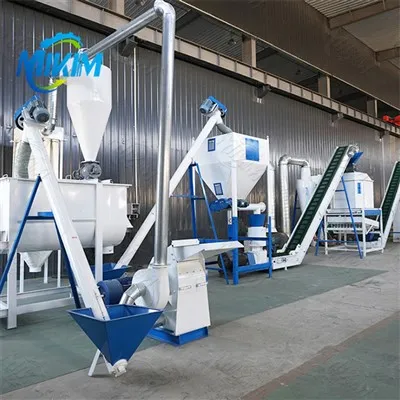
What type of mixing machine is included in a fish feed pellet line?
Leave a message
The double-helix conical mixer is currently the most widely used type in feed production lines, accounting for over 60%. Its structure consists of a conical mixing chamber with two symmetrical helical stirring rods. During operation, the helical rods rotate around their own axis and also revolve along the inner wall of the mixing chamber, achieving mixing through a dual action of "shearing + convection." The advantages of this equipment are high mixing uniformity (coefficient of variation ≤5%), short mixing time (3-5 minutes per batch), and good adaptability to granular and powdered raw materials, making it suitable for producing conventional livestock and poultry feed for pigs, chickens, and cattle.
The horizontal paddle mixer is known for its high-efficiency mixing and is suitable for processing high-fiber, high-moisture raw materials. Its mixing chamber has a horizontal structure and contains multiple sets of staggered paddles. When the paddles rotate at high speed, they generate strong vortices, rapidly dispersing and mixing the raw materials. For cattle and sheep feed containing coarse fiber ingredients such as straw powder and distiller's grains, or wet-based feed with a moisture content of up to 20%, the horizontal paddle mixer provides a significantly better mixing effect than the double-helix conical mixer, with the coefficient of variation for mixing uniformity controlled within 4%. However, this equipment has higher energy consumption; a machine with an hourly capacity of 5 tons requires 15kW of power, and batch-to-batch cleaning is more difficult, making it suitable for continuous production of a single formula.
The V-type mixer is a small, high-precision mixing device, mainly used for small-batch, high-value feed production, such as specialty aquatic feed and pet food. Its structure consists of two symmetrical V-shaped cavities. The mixing process is gentle, effectively protecting the activity of heat-sensitive ingredients (such as probiotics and vitamins). This equipment offers extremely high mixing uniformity (coefficient of variation ≤3%), but has a low hourly capacity (typically ≤1 ton), making it suitable for research institutions or small specialty feed mills.
Ribbon mixers are designed for large-scale production lines, with an hourly capacity of over 20 tons. They employ a double-layer ribbon structure, where the inner ribbon pushes the raw material to both ends, while the outer ribbon pulls it towards the center, creating a highly efficient circulating mixture. Their advantages include high throughput and stable mixing, making them suitable for use with automated production lines for continuous feeding and discharging. However, they require high initial investment (500,000-1,000,000 RMB per unit) and have relatively high maintenance costs.
Related equipment


about Us
MIKIM's fish feed pellet production lines and supporting machinery offer excellent value for money. Not only are they affordable, eliminating middlemen markups and allowing small and medium-sized enterprises (SMEs) and fish farmers to purchase complete sets of equipment at reasonable costs, but they also boast exceptional efficiency. The fully automated process, from raw material crushing and precise ingredient mixing to extrusion pelleting and maturation, is completed in one continuous flow. This results in high starch gelatinization rates and uniform pellet formation, significantly improving production efficiency and feed quality, truly achieving "low cost, high output." Choosing a MIKIM fish feed pellet production line means enjoying comprehensive pre-sales and after-sales service, including 24-hour online customer support, a one-year warranty on the entire machine, professional on-site installation, commissioning, and maintenance, and a stable supply of spare parts. Customers can buy with confidence and use with peace of mind, with both excellent value and service quality!
Customer visit

Certificate of Honor

FAQ
1. What is the price of the floating fish feed production line?
The price ranges from approximately $3,500-$55,000
2. Do you provide maintenance services for your customers?
Yes, we offer comprehensive after-sales maintenance services to our customers.
If you would like to learn more about MIKIM machinery, please contact us. We offer one-stop service and welcome your inquiries!!!