

How Does A Floating Fish Food Making Production Line Maintain Ecological Balance?
Leave a message
Large-scale aquaculture (tens of thousands of fish or more) places far greater pressure on the ecological environment than small-scale aquaculture due to its high stocking density and large feed demand, making it prone to ecological problems such as water pollution and disease outbreaks. Modern large-scale aquaculture feed equipment, through automated production lines and integrated management, achieves pollution source control, efficient resource utilization, and ecological risk early warning, becoming a core support for the ecological balance of large-scale aquaculture.
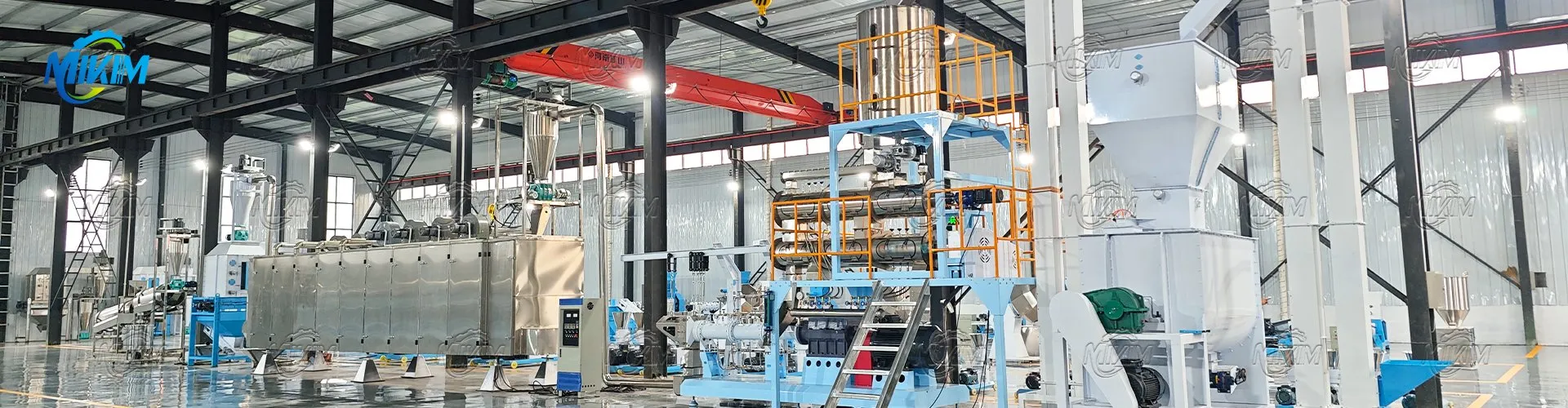
A floating fish food production line achieves centralized pollution control through full-process automation. The large feed demand of large-scale aquaculture makes it difficult to uniformly control feed quality and pollution emissions using traditional decentralized production models. A fish meal pellet making production line integrates raw material processing, pelleting, cooling, and packaging, all uniformly controlled by a PLC central control system. In the raw material processing stage, the system automatically detects the content of heavy metals and mycotoxins in the raw materials, directly discarding substandard materials. In the pelleting stage, precise control of temperature and pressure improves feed foam resistance and reduces residual feed pollution.
Automated feeding and wastewater treatment linkage equipment achieves end-of-pipe pollution control. Large-scale aquaculture generates massive amounts of wastewater, and relying solely on feed optimization is insufficient to completely control pollution. Therefore, the integrated design of feed equipment and wastewater treatment systems is crucial. Intelligent feeding systems transmit feed amounts and aquatic animal growth data to the wastewater treatment system in real time. When feed amounts increase, the system automatically increases the operating power of the wastewater treatment equipment, enhancing solid-liquid separation and biological purification.
Big data-driven feed management equipment enables precise early warning of ecological risks. Large-scale aquaculture ecosystems are complex with numerous risk points. The IoT module equipped in the feed equipment can collect real-time data on feed consumption, dissolved oxygen in the water, pH levels, and aquatic animal mortality rates. Big data analysis is used to construct ecological risk early warning models. When the model detects a sudden decrease in aquatic animal feed intake or abnormal water pH in a certain area, it immediately issues an alert. Operators can then promptly adjust feed formulations and amounts or take water quality control measures to prevent the risk from spreading.


about Us
We offer:
One-Year Whole Machine Warranty Service
On-site Installation, Commissioning, and Technical Guidance
24/7 Online Technical Support
Qualifications and Honors

Customer visit

FAQ
1. What is the price of the fish floating food production line?
The price ranges from approximately $10,500-$50,000
2. Do you provide maintenance services for your customers?
Yes, we offer comprehensive after-sales maintenance services to our customers.


