


How To Match A Complete Set Of Forage Processing Equipment With An Output Of Ten Tons Per Hour?
Leave a message
Chicken feed pellet production line
Grinder: A water drop or hammer mill is required to ensure that crude fiber materials (such as straw) are ground to a fineness that meets the needs of ruminants.
Mixer: A twin-shaft paddle mixer is recommended for high mixing uniformity and the ability to add liquids (such as oils and fermentation broth).
Pellet Mill: A ring die pellet mill is primarily used. The die aperture must be adapted to the ruminant feed, and pellet hardness must be guaranteed.
Post-Processing Equipment: A closed-loop system consisting of a cooler, crusher (optional), and grading screen ensures pellet moisture content and prevents dusting.
Automated Control System: A PLC console is standard, supporting recipe management and production data traceability. The precise weighing system reduces batching errors.
Specially designed for ruminant feeds
Raw material adaptability: The equipment is designed to handle high-fiber raw materials (such as silage and alfalfa), and the crushing process features an anti-entanglement design.
Fermentation expansion: Optional closed fermentation tanks and liquid addition systems are available for producing fermented ruminant feeds.
Cleaning and maintenance: The mixer and conveying piping feature quick-release design to prevent cross-contamination.
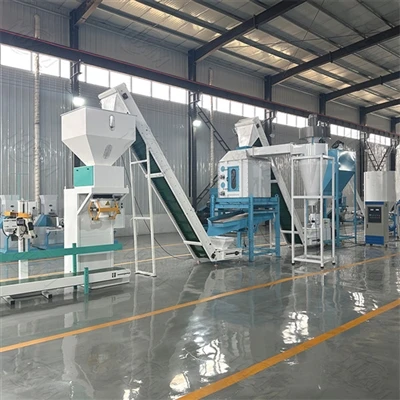
| Capacity | 15-20t/h |
| Range of application | large commerical feed factory,could make chicken,sheep,cow,shrimp feed |
| Workers requirments | 4-5 people |
| Shipment requirments | 6*40ft container |
| Product advantages | Fully automatic intelligent batching, computer control system with stable output, efficient and continuous operation, labor saving, direct packaging, particle size can be selected from 1-12mm. |
| size for whole line | According to land size and layout |
Selection recommendations
Raw material matching: If straw or silage is the primary feedstock, prioritize models with strong crushing power and anti-clogging features.
Capacity verification: Verify whether the stated capacity includes cooling and screening.
Scalability: Ports for fermentation or puffing modules are reserved for future upgrades.
The final plan requires a comprehensive evaluation based on plant layout, raw material characteristics, and budget. It is recommended to refer to the manufacturer's trial reports and success cases.


Why choose MIKIM?
Whether it is a new construction or expansion project, or an upgrade and renovation of an existing facility, MIKIM can use its extensive processing expertise and experience to meet your specific requirements at the lowest total cost of ownership.
We will customize according to your feed type, raw materials, formulation, plant area, production capacity, etc.
No matter how special your raw materials are, no matter how limited your plant space is, our engineers can realize the most suitable design to meet your feed processing needs.
For more information on process design, equipment layout, plant construction plan, single machine equipment quotation, turnkey quotation, etc., please feel free to contact us.
Equipment Photos


Certificate of Honor


