Is It Complicated To Assemble The Single Screw Fish Feed Fxiruder Machine For Fish And Pet Feed Pellets?
Leave a message
Preparatory work before assembly is fundamental to reducing difficulty. First, verify the fish feed making machine parts list, ensuring that core components such as the 316 stainless steel screw, barrel, and ring die are complete. These components are crucial for resisting the high salt corrosion of fish and shrimp feed and must be individually inspected for scratches or rust. For tools, prepare a torque wrench, Allen screwdriver, and sealant. The torque wrench is used to precisely tighten bolts, preventing uneven force that could deform components. Simultaneously, clean the assembly area and lay down anti-slip mats and moisture-proof cloths to prevent components from getting damp or bumped.
Assembling core components requires precise operation, but the process is clear. Fixing the base is the first step. Secure the base to the concrete foundation using expansion bolts, controlling the horizontal error to within 0.2mm/m. This serves as the benchmark for subsequent component installation and can be repeatedly calibrated using a level. Next, install the transmission system. Ensure the pulleys of the motor and reducer are aligned, with a deviation not exceeding 1mm; otherwise, abnormal noise or belt wear may occur during operation. After installation, manually rotate the pulleys to ensure smooth, unobstructed rotation.
The most crucial aspects are the assembly and sealing of the screw and barrel of the fish feed extruder machine. When slowly pushing the screw into the barrel, apply food-grade lubricant to prevent metal-to-metal friction from scratching the surface. The gap between the screw and barrel should be adjusted to 0.1-0.3mm, which can be measured with a feeler gauge. Sealing is paramount for fish and shrimp feed pellet mills. The connections between the barrel and the inlet and outlet must be wrapped with PTFE sealing tape, followed by application of special sealant to prevent raw material leakage or salt spray penetration and corrosion during production. Finally, install the ring die and tighten the fixing bolts diagonally with a torque wrench to ensure the ring die is flat and free of movement. After overall assembly, conduct a no-load test to observe whether the operation is stable and whether there are any abnormal noises. If there are no problems, trial production can begin.
Why choose us?
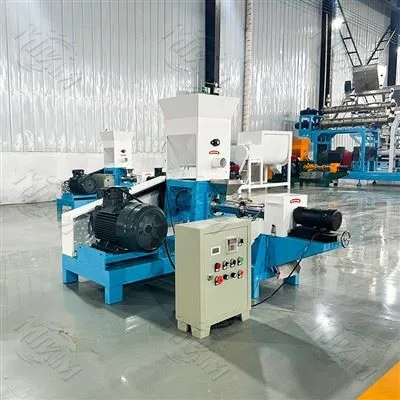
The MIKIM's floating fish feed extruder machine is constructed entirely of food-grade 304 stainless steel, fully complying with food processing hygiene standards. It is corrosion-resistant, easy to clean, and eliminates potential contamination at the source. The core screw is made of high-quality alloy steel through special heat treatment, offering outstanding wear resistance and corrosion resistance. Combined with its integrated structural design, this significantly extends its service life. The entire machine has passed CE and ISO international authoritative certifications, aligning with global quality standards and ensuring safer and more reliable processing.
Our equipment



Our Services
We offer:
One-Year Whole Machine Warranty Service
On-site Installation, Commissioning, and Technical Guidance
24/7 Online Technical Support
Qualifications and Honors

Customer visit

FAQ
1. What is the price of the small fish food making machine?
The price ranges from approximately $1,500-$50,000
2. How do you deliver to customers?
MIKIM Machinery's machinery delivery follows a complete process of "customized preparation - safe and fast delivery - precise handover - after-sales extension", with 3-day fast delivery, multi-layer protective packaging, global logistics tracking and 1-year warranty + on-site technical service to ensure that the equipment is delivered efficiently and in good condition and put into use smoothly.