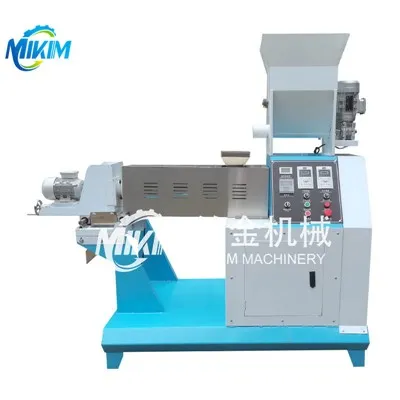
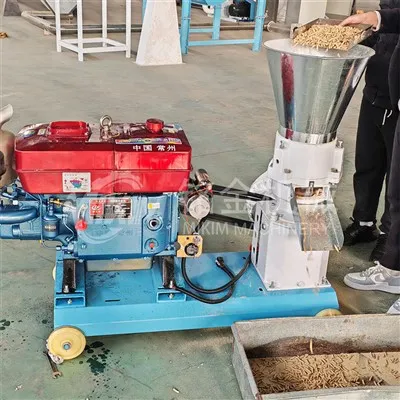
The Difference Between A Floating Fish Food Extruder Machine And A Poultry Feed Making Machine in Controlling The Buoyancy Of Feed Particles.
Leave a message
content
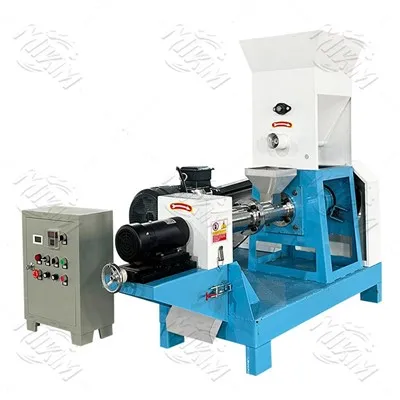
The key feature of aquatic fish feed extruders is their built-in controllable puffing function, which allows them to "customize" the particle density according to the water depth in which the fish inhabit. For example, when raising grass carp, floating feed is needed to allow the fish to feed at the surface, making it easier to observe their feeding and assess their health. In this case, the extruder raises the internal temperature to 110-130℃ and adjusts the pressure to 8-10MPa. Under high temperature and pressure, the starch in the raw material is fully gelatinized. When the material is extruded from the die, the pressure drops sharply, creating countless tiny pores inside the material, much like a well-fermented bun. The particle density drops to below 0.9g/cm³, lighter than water, allowing it to float steadily on the surface and preventing it from sinking easily, even in windy conditions.
When raising bottom-dwelling fish like carp and grass carp, the extrusion temperature is lowered to 90-100℃ and the pressure reduced to 6-8MPa. This reduces the degree of extrusion, resulting in fewer and smaller internal pores and a particle density exceeding 1.1g/cm³. This causes the pellets to sink quickly to the bottom, perfectly matching the feeding habits of bottom-dwelling fish. Even more conveniently, modern extruders allow for quick changes to ring dies with different apertures, and with an intelligent control system adjusting pressure parameters, such as switching from 1mm floating feed for silver carp to 3mm sinking feed for carp, the entire process takes less than 20 minutes, fully meeting the diverse needs of mixed-species ponds.

The design logic for pellet mills in poultry farms is much simpler. Since chickens, ducks, and geese feed on the ground or in feed troughs, whether the pellets sink or not is irrelevant. The core requirement is simply to ensure uniform pellet size and prevent them from crumbling into powder. Unlike extruders, pellet mills lack the high-pressure screws and extrusion chambers of traditional extruders. After simple steam conditioning, the raw materials are directly pressed into the ring die by pressure rollers, resulting in pellets with a density generally above 1.2 g/cm³. These pellets will sink in water, but this has no impact on poultry.
However, pellet mills are very flexible in adjusting pellet size. For chicks 1-2 weeks old, a 1 mm diameter ring die is used to make fine pellets to prevent choking. For laying hens, a 3 mm ring die is used, resulting in slightly larger pellets that are easier to peck at without waste. For meat ducks, even 5 mm coarse pellets can be used. Changing the ring die doesn't require adjusting complex extrusion parameters; simply remove the old ring die, align the new one with the positioning pins, and tighten the fixing screws. A worker can complete this in half an hour. A farmer raising 2000 laying hens said that he changes the ring die on his pellet mill four times a year and has never experienced feeding delays due to pellet size issues; the operation is much simpler than an extruder.


about Us
We offer a one-year warranty on all machines. MIKIM's feed pellet mills, charcoal briquetting machines, and other equipment all come with a one-year warranty. During the warranty period, if any quality issues arise due to materials, design, or manufacturing defects, we will replace the damaged parts free of charge and perform repairs and adjustments. However, easily damaged parts are unlikely to be covered under the free warranty, thus ensuring stable operation of the equipment throughout its core lifespan.
On-site installation, commissioning, and technical guidance: For complex complete sets of equipment such as feed production lines and extruders, we will dispatch professional technicians to the customer's location to handle on-site installation and commissioning, ensuring the equipment can be smoothly integrated into the customer's production process and meet preset production standards. Our technicians will also visit regularly to resolve various technical malfunctions and provide long-term on-site guidance on equipment operation and routine maintenance.
Qualifications and Honors

Customer visit
FAQ
1. What is the price of the fish feed production machine?
The price ranges from approximately $5,500-$30,000
2. Do you provide maintenance services for your customers?
Yes, we offer comprehensive after-sales maintenance services to our customers.