What Are Some Common Maintenance Issues in Floating Fish Feed Pellet Production Lines?
Leave a message
Wear issues in core components of fish feed extruder machines primarily focus on three main parts: the screw, barrel, and die, each with different causes. Screw wear is often due to hard objects (such as metal impurities or stones) embedded in the raw material, or long-term processing of high-fiber, high-hardness materials (such as alfalfa meal or bone meal), leading to repeated friction and wear on the thread edges. Some manufacturers use inferior screw materials (such as ordinary steel instead of alloy steel) to reduce costs, which also accelerates wear. Barrel wear is related to the screw clearance; excessive clearance causes excessive friction between the raw material and the barrel wall, or uneven feeding speed leads to excessive local pressure, causing scratches on the barrel wall. Die wear is mainly due to long-term extrusion molding, where the edges of the die become dull from repeated friction by the raw material, or inadequate cleaning leads to carbonization of residual raw material, exacerbating wear.
The harm caused by wear problems is both gradual and destructive. Initially, this manifests as poor feed pellet formation (loose, uneven size) and decreased production capacity. In the middle stages, it leads to increased noise and energy consumption in the floating fish feed machine. When the screw and barrel clearance exceeds tolerance, the raw material gelatinization is insufficient, reducing nutrient absorption efficiency. In the later stages, it can cause serious malfunctions such as component jamming and breakage, resulting in equipment downtime of several days and significant production losses.
Targeted solutions and preventative measures must be implemented throughout the entire production process. Daily maintenance requires checking the wear of the fish extruder machine screw and barrel daily, measuring the clearance with a feeler gauge (normally ≤0.3mm), and cleaning residual raw material from the die orifices weekly to prevent carbonized wear. During raw material pretreatment, multi-layer screening and magnetic separation devices must be installed to thoroughly remove hard impurities. Regularly change the lubricating oil to ensure adequate lubrication and reduce friction loss. If wear has already occurred, minor wear can be repaired by welding the screw threads; moderate wear requires replacement of the die or barrel bushing; and severe wear necessitates replacement of the entire component. One feed mill extended the service life of its core components from 800 hours to 1500 hours by implementing these measures.
.
Why choose us?
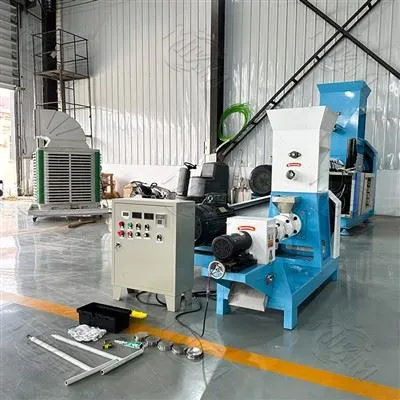
The MIKIM's floating fish feed extruder machine is constructed entirely of food-grade 304 stainless steel, fully complying with food processing hygiene standards. It is corrosion-resistant, easy to clean, and eliminates potential contamination at the source. The core screw is made of high-quality alloy steel through special heat treatment, offering outstanding wear resistance and corrosion resistance. Combined with its integrated structural design, this significantly extends its service life. The entire machine has passed CE and ISO international authoritative certifications, aligning with global quality standards and ensuring safer and more reliable processing.
Our equipment


Our Services
We offer:
One-Year Whole Machine Warranty Service
On-site Installation, Commissioning, and Technical Guidance
24/7 Online Technical Support
Qualifications and Honors

Customer visit