


1000 kg/h Aquaculture Feed Pellet Production Line
Fish feed production line can produce high-nutrition pellet feed.
Description
A 1000 kg/h Aquaculture Feed Pellet Production Line built on a Wet-type single screw fish feed extruder machine sits in the sweet spot between a small farm line and a full industrial plant. It gives you the water stability and digestibility of steam-conditioned feed at roughly half the capital of a twin-screw, while still making reliable floating pellets at about 1 ton per hour. If you supply a cooperative, run a medium fish farm, or want to start a regional feed business without the cost of twin-screw, this line is the practical answer. Dry lines top out on quality and twin-screw costs more than your volume needs, a familiar squeeze. This guide explains how wet single-screw works, how it compares to dry and twin-screw, the full model range, a complete line configuration with powers, and a realistic investment and payback view. We cover tilapia, catfish, and other aquaculture feeds at 1 t/h.
Key Takeaways
- A 1000 kg/h Aquaculture Feed Pellet Production Line with a Wet-type single screw floating fish feed extruder machine delivers steam-conditioned floating feed at about 1 ton per hour, between dry and twin-screw on cost and quality.
- Steam conditioning lifts starch gelatinization and water stability, so pellets float 12–24 hours, while the single screw keeps capital and operating cost below twin-screw.
- The wet single-screw family spans 0.3 t/h to 4 t/h across eight models, with the 100-B (0.6–0.8 t/h) and 135-B (1.2–1.5 t/h) bracketing the 1 t/h target.
- A complete 1 t/h plant adds a boiler, grinder, mixer, dryer, oil sprayer, cooler, screener, and automatic packer, with total power typically 90–140 kW and a footprint near 200–300 m².
- At this scale, on-site production commonly recovers the plant cost in 8 to 15 months, depending on local raw material and feed prices and daily run hours.
1. What Is a 1000 kg/h Aquaculture Feed Pellet Production Line?
An aquaculture extruded pellet feed production line at 1 t/h takes raw ingredients, grinds and mixes them, steam-conditions the mash, extrudes it through a single screw, then dries, coats, cools, screens, and packs the pellets automatically. The "1000 kg/h" names the hourly throughput the wet single-screw extruder is sized for.
At 1 t/h and 8 hours a day for 300 days, the aquaculture farm pellet feed production line makes about 2,400 tons of feed a year. That is enough to support a medium to large fish farm or to run a modest feed business supplying nearby ponds and cages. It is the capacity where steam conditioning starts to clearly pay off over dry extrusion, but twin-screw is still more machine than the volume needs.
The Wet-type single screw floating fish feed extruder machine uses one screw in a steam-heated barrel. It is simpler and cheaper than twin-screw, yet it captures most of the quality gain that steam conditioning provides.
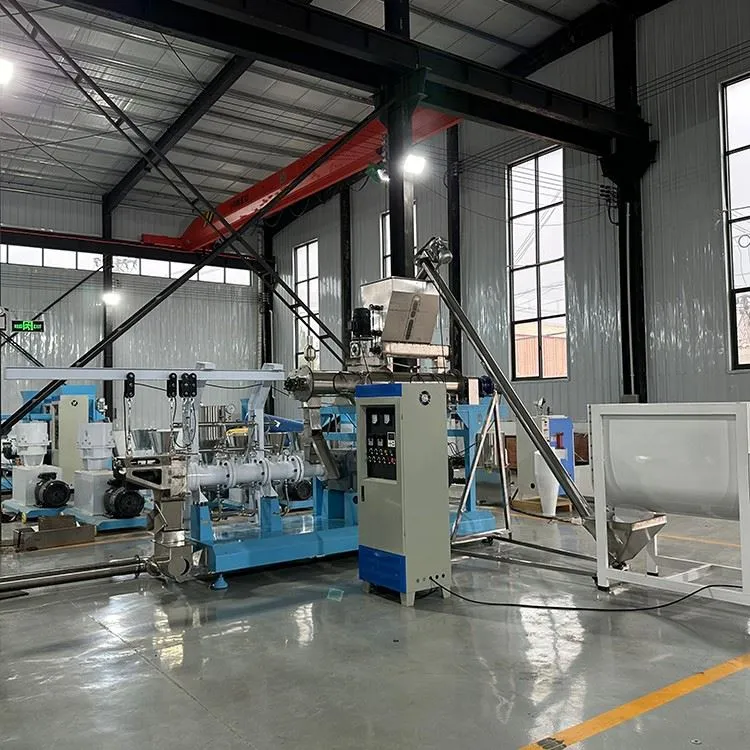
1–2T/H Fish Feed Pellet Production Line Factory Showcase
Start from your numbers. Give us your daily tonnage and target species (tilapia, catfish, carp), and we will size the wet single-screw plus the boiler and every station, then send a configured quote. Request a configured quote
2. Wet-type single-screw floating fish extruder machine Explained (Steam Conditioning)
The MIKIM Wet-type single screw floating fish feed making machine works like a dry machine but adds a steam conditioner upstream. The mash is pre-cooked with live steam (typically 70–90°C at the conditioner) before it enters the barrel, so the extruder itself does less heating work and the starch gelatinizes more completely.
The single screw then compresses and shears the conditioned mash, forcing it through a die. At the die, the pressure drops to atmospheric and trapped steam puffs the pellet, creating the porous, low-density structure that floats for 12–24 hours. Screw speed, steam rate, and die size set pellet diameter (0.8–12 mm) and buoyancy.
Steam conditioning is the key difference from a dry line. It raises water stability and digestibility, which means less wasted feed and faster fish growth, the two levers that decide whether your feed operation makes money.
3. Wet-type single screw floating fish food maker machine vs Dry Type single screw fish feed making machine
The choice between wet and dry single-screw is mostly about quality versus simplicity:
- Water stability. Wet (steam-conditioned) pellets float 12–24 hours with low leaching; dry pellets float well but with slightly lower stability.
- Digestibility. Steam pre-gelatinization lifts starch gelatinization past 85 percent, improving FCR.
- Boiler. Wet needs a boiler; dry needs none. The boiler adds cost, space, and an operator skill.
- Energy. Wet runs about 50–90 kWh per ton including the boiler; dry runs 25–60 kWh per ton.
- Cost. Wet single-screw costs more than dry but less than twin-screw.
If you farm tilapia, catfish, and carp and want the best return with no boiler, the dry single-screw 40–2000 kg/h line is the lean choice. If you sell feed or need top water stability, wet single-screw is worth the step up.
4. Wet Single-Screw Pros & Cons (at ~1 t/h)
Pros at this capacity:
- Quality near twin screw. Steam conditioning gives floating feed that competes with twin-screw output for most species.
- Lower capital than twin-screw. You avoid the cost and complexity of a second screw and its drive.
- Good fat range. Handles standard formulas up to about 12 percent fat comfortably.
- Proven at 1 t/h. This is a mature, well-supported configuration, not an edge case.
Cons to weigh:
- Boiler required. Adds capital, floor space, fuel or electricity, and a skilled hand for steam.
- Fat ceiling. Above about 12 percent fat, single-screw can struggle; that is when a wet twin-screw 1.5–2 t/h line becomes the better tool.
- Throughput cap. Single-screw tops out below the 3–4 t/h that twin-screw reaches.
For a 1 t/h aquaculture extruded pellet feed line serving standard species, the pros clearly outweigh the cons for most buyers.


5. Single-Screw vs Twin-Screw at 1 t/h: Which to Buy?
At exactly 1 t/h, the decision is about product mix and budget. Choose wet single-screw when:
- Your formulas stay at or below about 12 percent fat (tilapia, catfish, carp, standard shrimp).
- Your budget favors lower capital and simpler operation.
- You do not need the absolute tightest density control batch to batch.
Choose wet twin-screw when:
- You add salmon, eel, or grouper feeds above 12 percent fat.
- You resell feed and brand consistency is critical.
- You plan to scale past 2 t/h soon and want one platform.
At 1 t/h, wet single-screw usually wins on value. Twin-screw is the upgrade you buy when the product or volume demands it, not before.
6. Extrusion Process Flow & Steam Conditioning Benefits
The wet single-screw flow at 1 t/h includes steam conditioning, and at this capacity the conditioner is the feature that earns the premium over a dry line while costing far less than twin-screw. Each station below states what it does, why it matters, and the typical equipment.
1–2 T/H Wet-type single screw floating fish feed pellet production line test
1. Raw material receiving and pre-cleaning
- What it does: bulk ingredients pass a magnet and sieve to remove stones, metal, and clumps.
- What it costs you if you skip it: one hard object can damage the grinder or score the extruder screw, stopping a 1 t/h line mid-shift.
- Equipment: magnetic separator and rotary screener, typically 0.25–0.55 kW, one set.
2. Grinding (hammer mill)
- What it does: reduces ingredients to 60–80 mesh for even cooking.
- Why you should care: fine, uniform meal is what lets starch gelatinize fully and keeps fines under 8 percent.
- Equipment: hammer mill, typically 15–30 kW at this scale, one unit.
3. Batching and mixing
- What it does: ingredients are weighed to formula and blended in a double-shaft mixer to ±1 percent.
- Why this matters to you: even mixing means consistent nutrition per pellet, steadier fish growth, and fewer complaints if you resell.
- Equipment: batch weigher plus mixer, typically 5.5–11 kW, one set.
4. Steam conditioning
- What it does: live steam pre-cooks the mash in a conditioner before extrusion.
- Why you should care: this is the quality step that justifies wet over dry at 1 t/h. Steam lifts water stability so pellets float 12–24 hours and resist leaching, and it lowers the energy the extruder must supply. On the 100-B class the conditioner is double-layer (about 7.5 kW), so every ton is pre-cooked uniformly, the real reason steam-conditioned feed holds its premium.
- Equipment: steam conditioner plus boiler, conditioner drive typically 1.5–7.5 kW depending on model.
5. Single-screw extrusion and puffing
- What it does: the screw compresses and shears the conditioned mash, then forces it through a die; pressure release puffs the pellet.
- Why you should care: floating feed is made here, with pellet size set by die (0.8–12 mm) and buoyancy by screw and steam tuning. One machine serves floating and sinking needs.
- Equipment: wet single-screw extruder with main motor, feeder, and cutter. See the model table in Section 7.
6. Drying
- What it does: a multi-layer dryer reduces moisture to 8–10 percent.
- The payoff: correct drying prevents mold in storage and protects your inventory across the year. Because the steam conditioner already did most of the cooking, the dryer load is modest, another reason wet-at-1 t/h beats dry on quality without twin-screw cost.
- Equipment: 3–5 layer dryer with fans and heat, drive typically 0.75–2.2 kW plus heating, one unit.
7. Oil spraying
- What it does: a drum coats pellets with fish oil and attractants after extrusion.
- Why you should care: post-coating raises energy without softening pellets, improving intake and growth.
- Equipment: oil spray drum, typically 0.75 kW, one set.
8. Cooling
- What it does: counter-flow cooler brings pellets to room temperature.
- Why you should care: packing hot pellets causes condensation and cracking; cooling stabilizes bag life.
- Equipment: counter-flow cooler, typically 0.75 kW, one unit.
9. Screening
- What it does: separates fines (target under 8 percent) from whole pellets.
- Why you should care: fines waste nutrition and foul water; returning them recovers value.
- Equipment: vibrating screener, typically 0.12–0.25 kW, one set.
10. Automatic packing
- What it does: electronic weigher fills and seals 5–50 kg bags.
- Why you should care: automatic packing holds ±0.2 percent weight and frees labor versus hand bagging.
- Equipment: automatic weigher-packer, typically 1.5 kW, one unit.
Table 1: Whole-line equipment list (example: 100-B / 135-B class, ~1 t/h)
| Equipment | Function | Typical power | Qty |
|---|---|---|---|
| Pre-cleaner (magnet + sieve) | Remove stones, metal, clumps | 0.25–0.55 kW | 1 |
| Hammer mill | Grind to 60–80 mesh | 15–30 kW | 1 |
| Batching weigher + mixer | Weigh and blend to ±1% | 5.5–11 kW | 1 set |
| Steam boiler + conditioner | Pre-cook mash with steam | 1.5–7.5 kW (cond.) + boiler | 1 set |
| Wet single-screw extruder | Extrude and puff | 55–90 kW (main) + feeder + cutter | 1 |
| Multi-layer dryer | Dry to 8–10% moisture | 0.75–2.2 kW + heat | 1 |
| Oil spray drum | Coat with oil / attractant | 0.75 kW | 1 |
| Counter-flow cooler | Cool to room temperature | 0.75 kW | 1 |
| Vibrating screener | Remove fines (<8%) | 0.12–0.25 kW | 1 |
| Automatic packer | Weigh and seal 5–50 kg | 1.5 kW | 1 |
Table 2: Whole-line typical indicators (example: 100-B / 135-B class, ~1 t/h)
| Indicator | Typical value |
|---|---|
| Total line power | Approx 90–140 kW (incl. conditioning) |
| Footprint | Approx 200–300 m² |
| Operators | 3–4 workers |
| Installation period | 15–30 days |
| Final product moisture | 8–10% |
| Fines rate after screening | < 8% |
The ~1 t/h (100-B / 135-B class) figures are a reference build; your quotation confirms layout, power, boiler size, and footprint for your site.

7. Complete Wet Single-Screw Model Range (~1 t/h)
The wet single-screw family runs from 0.3 t/h to 4 t/h across eight models. For a 1000 kg/h Aquaculture Extruded Pellet Feed Production Line, the 100-B (0.6–0.8 t/h) and 135-B (1.2–1.5 t/h) bracket the 1 t/h target, so you pick based on whether you want headroom or a lighter footprint.
| Model | Capacity (t/h) | Main motor (kW) | Feeder (kW) | Cutter (kW) | Conditioner (kW) | Barrel sections |
|---|---|---|---|---|---|---|
| 75-B | Contact factory | Contact factory | Contact factory | Contact factory | Contact factory | Contact factory |
| 85-B | 0.3–0.5 | 30 | 0.75 | 0.75 | 1.5+1.5 (double layer) | 5 sections |
| 90-B | 0.5–0.6 | 37 | 1.5 | 2.2 | 5.5 | 5 sections |
| 100-B | 0.6–0.8 | 55 | 1.5 | 2.2 | 7.5 | 6 sections |
| 135-B | 1.2–1.5 | 90 | 2.2 | 3 | 11 | 6 sections |
| 145-B | 2.0–2.5 | 110 | 2.2 | 3 | 15 | 6 sections |
| 160-B | 3.0–4.0 | 160 | 3 | 5.5 | 18 | 6 sections |
| 175-B | Contact factory (large-capacity model) | 200 | 3 | 7.5 | 22 | 6 sections |
Note the double-layer conditioner on the 85-B (1.5+1.5 kW) for two-stage pre-cooking, and that barrel sections increase from 5 to 6 as capacity grows to lengthen residence time. The 75-B and 175-B specs are confirmed per order, so contact the factory for those models.

Match your model and price: send your target output and species, and we will pick the wet single-screw size, size the boiler, and quote the full line with lead time. Size my wet single-screw line
8. Tilapia, Catfish & Aquaculture Feed at 1 t/h
At 1 t/h on a steam-conditioned wet single-screw, you are producing premium floating feed for standard species, and the steam is what lets you use more local plant protein than a dry line can. Starting points:
- Tilapia (steam-conditioned floating feed): fry 0.8–1.2 mm, grower 2–4 mm, market 4–6 mm, protein 28–36 percent. A typical grow-out blend runs about 30 percent crude protein. It uses fish meal 12%, soybean meal 28%, maize or rice bran 22%, wheat flour 18%, fish oil 4%, and a 2% vitamin-mineral premix. Because the conditioner gelatinizes starch past 85 percent, this higher-plant mix digests as well as a dry line's lower-plant blend.
- Catfish (slow-sinking or sinking): juvenile 1.5–2.5 mm, adult 4–6 mm, protein 32–36 percent. The steam pre-cook lets you raise wheat flour slightly for binder without hurting the cook, so catfish accept more plant protein and you lower formula cost.
- Carp and other omnivores: 3–5 mm, protein 28–35 percent. Carp tolerate higher fibre, which the steam treatment also softens.
On a 1 t/h wet single-screw the conditioner is double-layer on the 100-B class (about 7.5 kW), so every ton is pre-cooked uniformly and your tilapia and catfish diets stay consistent batch to batch. That batch consistency is the real reason steam-conditioned feed holds a premium over dry output. The same machine still makes both floating and sinking pellets by adjusting screw, steam, and die, so one line covers surface and bottom feeders.
If you need only the extruder rather than a full line, see our floating fish feed machine range.
9. Price, Investment & Payback for a 1 t/h Aquafeed Plant
A 1 t/h aquaculture extruded pellet feed line with a wet single-screw extruder typically costs in the USD 40,000–120,000 range, depending on automation, steel grade, dryer, and boiler. This is mid-band: more than a dry line, less than twin-screw, and it captures most of the steam-conditioning quality gain.
At 1 t/h, 8 hours a day, 300 days, the plant makes about 2,400 tons a year. If commercial feed costs USD 400–700 per ton and you make equivalent quality on-site for USD 300–500 per ton, the saved or margin per ton is roughly USD 50–200. Across 2,400 tons, that is USD 120,000–480,000 a year in value, before freshness and supply-security gains.
For illustration only (not a real customer): a fishing cooperative running a 100-B line at about 0.7 t/h for member ponds, buying commercial feed at USD 500 per ton and making equivalent quality at USD 360 per ton, saves about USD 140 per ton across the roughly 1,700 tons a year the line produces, about USD 240,000 a year before freshness gains.
Payback commonly lands at 8 to 15 months for plants running at 70 percent or higher utilization. Energy runs about 50–90 kWh per ton including the boiler, a small slice next to raw materials at 60–70 percent of cost. As with any plant, secure off-take or your own farm demand before investing, because below 50 percent utilization fixed costs can erase the margin.
10. How to Start an Aquaculture Feed Production Business
Starting a 1 t/h aquafeed business follows a clear path:
- Set daily tonnage. Multiply biomass by daily feeding rate (2–5 percent of body weight) and divide by operating hours to get kg/h.
- Choose species and float/sink mix. This sets your die sizes and confirms wet single-screw is the right tier.
- Pick the model from the table in Section 7 that covers your t/h with headroom (100-B or 135-B for ~1 t/h).
- Plan the boiler. Wet lines need steam, so budget boiler size, fuel, and a small boiler room.
- Confirm utilities. Lines run on 3-phase power (commonly 380V/50Hz or 220V/60Hz by region).
- Request layout and quote. MIKIM returns a plant drawing, equipment list with powers, lead time, and price.
- Install, train, and start. MIKIM engineers guide installation and train your team on grinding, extrusion tuning, and die changes (typically 30–45 minutes).
Get your configured quote now: tell us your daily feed tonnage, target species, and floating-or-sinking ratio, and we will size the wet single-screw extruder, boiler, and every station, then send a configured quote. Get a configured quote
Explore more Fish Feed Production Line options from MIKIM for tilapia, catfish, and shrimp feed.
Authoritative references: For background on feed extrusion and processing, see the FAO manual on extruded aquafeed, the WorldFish: feed is 30–70% of operating cost, and the Aquatic feed manufacturing technical guide.
FAQ
Q1: Does a wet single-screw line need a steam boiler?
A: Yes. Wet single-screw extrusion requires steam conditioning before the barrel, so a boiler is part of the plant. It adds capital and operating cost versus a dry line but delivers the higher water stability and digestibility that steam-conditioned feed provides.
Q2: Can the Wet-type Single-Screw floating fish feed pellet maker machine make both floating and sinking feed?
A: Yes. By adjusting screw speed, steam rate, and die, the wet single-screw produces floating, slow-sinking, or sinking pellets. One machine serves tilapia, catfish, carp, and standard shrimp diets.
Q3: What capacity should I choose for about 1 t/h?
A: The 100-B (0.6–0.8 t/h) and 135-B (1.2–1.5 t/h) bracket the 1 t/h target. Choose 100-B if you want a lighter footprint or 135-B if you want headroom above 1 t/h. Leave 20–30 percent headroom so the line is not at its limit all day.
Q4: How much space and how many workers does the line need?
A: A ~1 t/h wet single-screw plant typically needs about 200–300 m² (including a boiler room) and 3–4 operators. Final footprint depends on your layout, dryer length, and bulk storage.
Q5: How long until the plant pays for itself?
A: With 70 percent or higher utilization, payback commonly falls between 8 and 15 months, driven by local raw material and feed prices and daily run hours. Below 50 percent utilization the economics weaken, so confirm off-take before investing. Send your numbers for a tailored estimate.
Hot Tags: 1000 kg/h Aquaculture Feed Pellet Production Line, China 1000 kg/h Aquaculture Feed Pellet Production Line manufacturers, suppliers, factory, fish food extruder machines, floating fish food production line, screw feed extruder machine, Fish Feed Production Line, extruder line for floating fish feed, dry type fish feed extruder line
Send Inquiry
You Might Also Like


