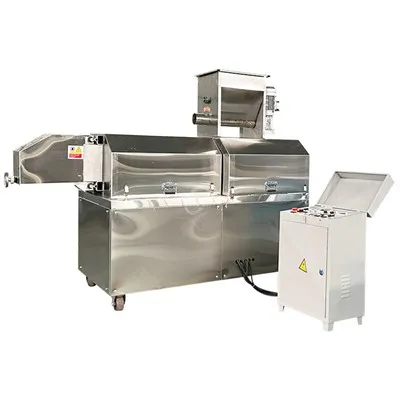
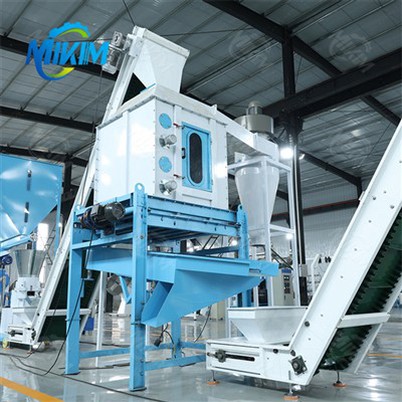
Twin Screw Extruder Floating Fish Feed Production Line for 3-8 mm Pellets
Leave a message
What a Twin Screw Extruder Floating Fish Feed Line Does
A twin screw extruder floating fish feed production line is an integrated processing system that turns blended feed ingredients into expanded, buoyant pellets. Two intermeshing screws convey, compress, cook, and expand the mash under controlled temperature and pressure. As the dough leaves the die, the sudden pressure drop makes the pellet puff and float. Finished pellets are normally 3-8 mm in diameter, which covers most commercial fish and shrimp species.
The complete line usually links a grinder, a mixer, a twin screw extruder with a preconditioner, a dryer, a coater, and a cooler through screw conveyors and bucket elevators. Because the extruder carries out both the cooking and the shaping duty, upstream particle size control and downstream drying decide how buoyant and water stable the finished pellet becomes.
Technical Parameters by Model
Several frame sizes are offered so that capacity can be matched to the production target. The table below summarises three typical configurations of this line.
| Model | Installed Power | Running Power | Capacity | Line Dimension |
|---|---|---|---|---|
| MK65-III | 76 kW | 54 kW | 140-160 kg/h | 17 x 2 x 2.5 m |
| MK70 | 95 kW | 66 kW | 240-260 kg/h | 22 x 2 x 2.5 m |
| MK85 | 178 kW | 125 kW | 500 kg/h | 26 x 2 x 3.5 m |
Installed power is the total rated load of every motor on the line, while running power is the typical load during steady operation. The dimension figures cover the whole production line, so workshop planning should also reserve space for raw material storage, packing, and a maintenance aisle.
Raw Materials and Finished Pellets
The line accepts the usual aquafeed ingredients and a small number of functional additives:
Starch base: wheat flour, corn flour, or cassava flour, normally 20-30% of the blend
Protein source: fish meal, soybean meal, or blood meal, normally 30-45% of the blend
Energy and nutrition: fish oil, soybean oil, vitamin and mineral premix
Functional additives: wheat gluten as a binder, calcium phosphate, mould inhibitor
Starch is essential because gelatinisation inside the extruder barrel is what gives the pellet its expansion and its water stability. Die hole diameter and cutter speed set the pellet size, while the screw profile and the barrel temperature zones control the degree of expansion. Floating pellets for surface feeders, slow sinking pellets for mid water species, and sinking pellets for bottom feeders can all be produced on the same extruder by changing the die, the screw configuration, and the processing conditions.
Main Applications
Although the machine is designed mainly for fish feed, the same extrusion principle also produces feed for shrimp, catfish, and tilapia, and for cats, dogs, and birds. Typical end users include commercial aquafeed plants, fish hatcheries, shrimp farms, and pet food producers that need a medium capacity line.
How to Select the Right Configuration
Start from the target annual output and the shift pattern, then convert both into an hourly capacity requirement. A 140-160 kg/h line suits small farms and pilot production, while a 500 kg/h line fits a commercial aquafeed plant. Compare installed power with the electrical supply of the site, and check that the line dimensions fit the workshop layout, including the height needed for the dryer and the cooler.
Before ordering, obtain a process flow diagram, an equipment layout drawing, and a factory construction plan, and agree the maintenance policy and the spare parts list. These steps reduce the risk of downtime during commissioning and avoid hidden installation costs.
Frequently Asked Questions
Q: What pellet size can the line produce?
The standard range is 3-8 mm in diameter. Dies can be changed to move within this range, and finer dies down to about 1 mm are available for fry feed.
Q: How much workshop space is needed?
The MK85 line occupies about 26 x 2 x 3.5 m. Add space for raw material storage, packing, and a maintenance aisle when planning the layout.
Q: Which raw materials work best?
Wheat or corn flour as the starch base, fish meal or soybean meal as the protein source, plus oil and a vitamin mineral premix. A starch content of 20-30% supports good expansion.
Q: Can the same extruder make sinking pellets?
Yes. Changing the die, the screw configuration, and the barrel temperature profile switches the output between floating, slow sinking, and sinking pellets.
Q: What sets the hourly capacity?
Capacity is set by the extruder frame size, the die open area, and the screw speed. The three models above cover 140-160 kg/h, 240-260 kg/h, and 500 kg/h.
Q: How is the power supply matched to the line?
Use the installed power figure for the incoming supply and cabling, and the running power figure for the average load and the energy cost estimate. The MK85 line needs 178 kW of installed capacity.