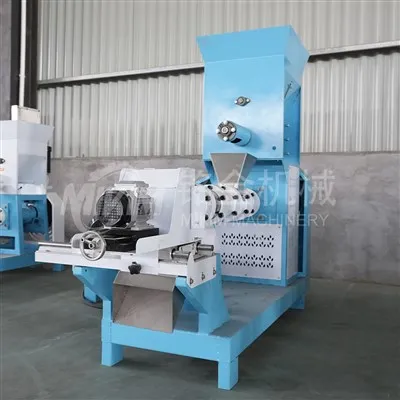
Floating Fish Feed Extruder: Models and Process Guide
Leave a message
What Is a Floating Fish Feed Extruder?
A floating fish feed extruder is a cooking extruder that produces pellets with a porous structure light enough to stay on the water surface. The machine cooks and gelatinizes starch inside a heated barrel, then expands the dough through a die, trapping air in the pellet. Floating pellets are valuable to fish farmers because they let the farmer see feeding in real time, stop feeding when fish are full, and avoid the feed that sinks and rots on the pond bottom. This makes the extruder a core investment in commercial aquaculture.
Model Range and Output
Extruders are classified by screw diameter, and the model number indicates the class:
| Model | Main motor | Capacity |
|---|---|---|
| 65 | 22 kW | 250-300 kg/h |
| 70 | 37 kW | 400-500 kg/h |
| 75 | 45-55 kW | 600-800 kg/h |
| 85 | 75-90 kW | 1,000-1,500 kg/h |
| 95 | 110-132 kW | 2,000-3,000 kg/h |
| 120 | 160-185 kW | 3,500-4,500 kg/h |
| 136 | 200 kW | 5,000-6,000 kg/h |
Output depends on formula, moisture, and die size, so the figures are practical reference ranges rather than guarantees.
How Floating Pellets Are Made
The process starts with grinding, which reduces grains and meals to a uniform particle size, and mixing, which blends the formula with vitamins and minerals. Steam conditioning adds moisture and heat so the starch softens before the barrel. Inside the barrel, temperature and pressure cook the dough while the screws knead it. At the die, the sudden pressure drop expands the dough and the rotary cutter slices it into pellets. Drying removes surface moisture so the pellets are stable, and cooling brings them to ambient temperature before packing.
Water Stability and Feed Quality
Two quality indicators matter most to farmers. Floating time describes how long pellets stay on the surface; it depends on starch content, expansion, and drying. Water stability describes how long a pellet keeps its shape while being nibbled; better gelatinization and die compression give pellets that survive handling and feeding without turning into powder. Both qualities reduce nutrient loss into the water and are the measurable reason floating extruded feed outperforms simple pressed pellets.
Selecting an Extruder for Your Fish Farm
Calculate the daily feed demand of the ponds, then choose a model whose eight-hour output covers it with a margin. A small farm producing a few hundred kilograms per day can start with a Model 65-70 machine. A medium fish farm or small feed mill needs a Model 75-85 machine. A large commercial mill should evaluate Model 95-136 equipment and plan the dryer, cooler, and silo capacity together with the extruder. Also verify that the screw and barrel are wear-resistant, because fish meal and other abrasive ingredients shorten the life of soft components.
FAQ
What temperature is used inside the extruder barrel?
The barrel is typically held at 110-130 degrees Celsius so starch gelatinizes fully, which is the basis of buoyancy and digestibility.
How long do extruded floating pellets stay afloat?
Under suitable formulation, moisture, and drying conditions, floating time can exceed 12 hours, although water temperature and pellet size affect the real result.
Which extruder model suits a 5-ton-per-day feed demand?
A Model 95 machine rated at 2,000-3,000 kg/h produces 5 tons in about two hours of extrusion, leaving time for drying and packing.
Why do extruded pellets pollute the pond less than pressed pellets?
Floating pellets are eaten completely before nutrients can dissolve, and better starch gelatinization improves digestibility, so less nitrogen and phosphorus enter the water.
Is a dryer mandatory after extrusion?
Yes. Pellets leave the die with high moisture and must be dried and cooled to a stable moisture level, otherwise they soften, mold, or collapse in storage.