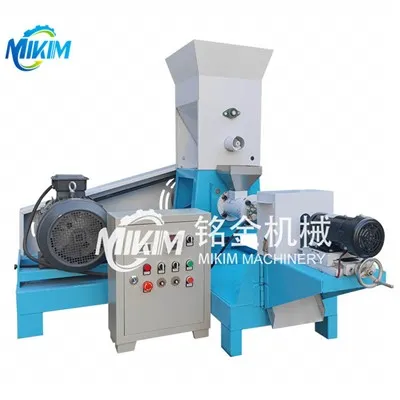
Commercial Pet Food Processing Machinery: Floating Feed Extruder
Leave a message
What a Commercial Floating Feed Extruder Can Process
A floating fish feed pellet machine can make many kinds of feed for different animals. It produces poultry and pet feed as well as aquaculture and fishery feed, which is also called floating feed. The machine is applied to the pretreatment of animal feed, reducing the loss of nutrition, advancing the protein content, and making the feed easier for animals to digest. Poultry feed produced on the machine can feed chickens, rabbits, sheep, pigs, horses, and cattle; pet feed can feed dogs, cats, and goldfish; fishery feed can feed fish, shrimp, crab, eel, catfish, and amphibians.
The Production Flow
The fish feed pellet production line follows a defined sequence. The raw materials are first cleaned and crushed, then the ingredients are mixed, conditioned, and pelletized. The pellets are then cooled and screened to remove unqualified pellets before packaging and storage. Each step contributes to final quality: cleaning removes contaminants, crushing creates a uniform particle size, mixing distributes nutrients evenly, conditioning improves starch gelatinization, and cooling hardens the pellets for storage.
Model Specifications
The DGP series covers small commercial outputs from 30 to 600 kg per hour. The table below lists the published specifications for each model.
| Model | Output | Main Power (kW) | Feeding Power (kW) | Cutting Power (kW) | Dimension (mm) | Weight (kg) |
|---|---|---|---|---|---|---|
| DGP 40 | 30-40 kg/h | 5.5 | 0.4 | 0.4 | 1400*1030*730 | 240 |
| DGP 50 | 60-80 kg/h | 11 | 0.4 | 0.4 | 1470*1100*1250 | 320 |
| DGP 60 | 100-150 kg/h | 15 | 0.4 | 0.4 | 1470*1120*1250 | 350 |
| DGP 70 | 180-200 kg/h | 18.5 | 0.4 | 0.4 | 1650*1400*1300 | 580 |
| DGP 80 | 200-300 kg/h | 22 | 0.6 | 0.6 | 1800*1450*1300 | 695 |
| DGP 90 | 300-400 kg/h | 37 | 0.6 | 0.8 | 2100*1450*1350 | 950 |
| DGP 120 | 500-600 kg/h | 55 | 1.1 | 1.5 | 2400*1950*1600 | 1700 |
Key Advantages of Extrusion Processing
Extrusion improves feed quality in several measurable ways. High-temperature puffing kills over 80% of harmful microorganisms and destroys anti-nutritional factors, while creating a looser texture that increases animal digestibility by 10-15%. The process is flexible and versatile: by changing molds and adjusting temperature and pressure, products of varying shapes and particle sizes from 1 to 20 mm can be produced to suit the feeding needs of different animals. For scaled production, twin-screw machines offer capacities of 1-10 tons per hour with continuous operation and a high degree of automation, reducing labor input.
Choosing the Right Model
Match the model to the daily output and the animals being fed. A small fish farm producing a few hundred kilograms per day can start with the DGP 40 or DGP 50. A commercial pet food workshop serving dogs and cats may choose the DGP 80 or DGP 90 for outputs around 200-400 kg/h. Larger aquaculture operations with continuous schedules should consider the DGP 120 at 500-600 kg/h, or twin-screw lines with higher capacities. Verify the available power supply against the main motor rating and plan the layout using the dimensions in the table.
FAQ
What animals can be fed with extruded feed from this machine?
Poultry feed can feed chickens, rabbits, sheep, pigs, horses, and cattle; pet feed can feed dogs, cats, and goldfish; fishery feed can feed fish, shrimp, crab, eel, catfish, and amphibians.
What is the production flow of a fish feed pellet line?
Raw materials are cleaned and crushed, then mixed, conditioned, and pelletized, followed by cooling and screening to remove unqualified pellets before packaging and storage.
What capacity does the DGP series offer?
The DGP 40 produces 30-40 kg/h and the series scales up to the DGP 120 at 500-600 kg/h. Twin-screw machines cover 1-10 tons per hour for larger lines.
How does extrusion improve feed quality?
High-temperature puffing kills over 80% of harmful microorganisms, destroys anti-nutritional factors, creates a looser texture, and increases digestibility by 10-15%.
What pellet sizes can be produced?
By changing molds and adjusting temperature and pressure, product shapes and particle sizes from 1 to 20 mm can be produced for different animals.
Is the machine suitable for continuous production?
Yes. Twin-screw machines support continuous operation with capacities of 1-10 tons per hour and a high degree of automation, reducing labor input.