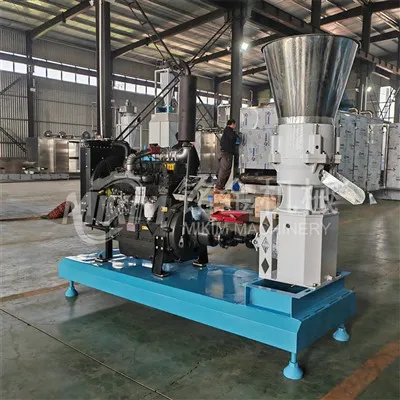
Feed Pellet Making Line: Poultry and Pig Feed Processing
Leave a message
What Is a Feed Pellet Making Line?
A feed pellet making line is a comprehensive system of machinery and procedures that transforms loose powders or granular ingredients, such as corn, soybean meal, vitamins, and minerals, into high-density pellet feed. The process runs continuously through raw material cleaning, crushing, batching, mixing, conditioning, pelleting, cooling, and grading. The line combines a hammer mill, feed mixer, feed pellet machine, counter-flow cooler with screen, and packing machine in one integrated system, with an advanced design, simple structure, wide applicability, small footprint, and low noise.
The Complete Process Flow
The line follows a standardized sequence. Raw materials are first cleaned to remove stones and impurities, then crushed to the particle size required by the formula. The crushed ingredients are weighed and batched according to the recipe and mixed uniformly in the ribbon mixer, with liquid oils added through a dedicated pipe when needed. The conditioned mash is then compressed into pellets by the pellet machine, and the hot pellets pass through a counter-flow cooler and screen to remove fines before packing. Each stage is sized to the target capacity so the line operates without bottlenecks.
Technical Specifications
| Model | Capacity (kg/h) | Power (kW) | Weight (kg) | Dimension (cm) |
|---|---|---|---|---|
| 125 | 80-100 | 3 | 95 | 110 x 35 x 70 |
| 150 | 110-150 | 4 | 98 | 115 x 35 x 80 |
| 210 | 200-300 | 7.5 | 280 | 115 x 45 x 95 |
| 230 | 350-450 | 11 | 300 | 138 x 46 x 100 |
| 260 | 500-600 | 15 | 315 | 130 x 53 x 105 |
| 300 | 700-800 | 22 | 600 | 145 x 62 x 120 |
| 360 | 800-900 | 22 | 795 | 160 x 67 x 145 |
| 400 | 1000-1200 | 30 | 1000 | 160 x 67 x 145 |
Capacities range from 80-100 kg/h on model 125 to 1000-1200 kg/h on model 400, with power from 3 kW to 30 kW. Larger models add weight and power to maintain stable pelleting under higher throughput.
Key Components and Their Functions
The hammer mill provides good cleaning effect with more than 98% efficiency, clears the screen automatically to keep the effective screen area, and uses two 180-degree semicircle sieve plates that are easy to disassemble. The gap between the screen cylinder and the plate can be adjusted to maintain screening performance. The rotor passes a high-precision balance test, so vibration is low and service life is long. The horizontal ribbon mixer is suitable for concentrated feed and powdered feed mixing, with a specially designed discharge mechanism for rapid, low-residue emptying. Its double helix ribbon mixes without dead ends in a short cycle, and a liquid oil addition pipe allows oils to be blended into the formula.
Application Scenarios and Selection Tips
The line is widely used in feed mills, food factories, livestock farms, and related facilities, and it crushes various kinds of pellet raw materials such as corn, sorghum, wheat, beans, and wood chips. When selecting a line, match the model capacity to the daily feed tonnage: models 125-210 suit small farms, models 260-300 suit medium operations, and models 360-400 serve larger feed plants. Verify the available power supply, plan space for the cooler and screen, and confirm that the pellet die aperture matches the target animal before purchase.
FAQ
What process does a feed pellet making line follow?
The line runs through raw material cleaning, crushing, batching, mixing, conditioning, pelleting, cooling, and grading, turning powder into dense pellet feed in one continuous flow.
What equipment is included in the line?
The line includes a hammer mill, feed mixer, feed pellet machine, counter-flow cooler with screen, and packing machine, integrated as one system.
What capacity range is available?
Eight models cover capacities from 80-100 kg/h to 1000-1200 kg/h, with motor power from 3 kW to 30 kW.
Which raw materials can the line process?
It processes corn, sorghum, wheat, soybeans, and other grains, as well as pellet raw materials, and the mixer handles concentrated feed and powdered feed with liquid oil addition.
How does the mixer improve mixing quality?
The double helix ribbon mixes without dead ends in a short cycle, and the rapid discharge mechanism leaves small residues, so formulas stay consistent between batches.
Where is the line typically used?
It is used in feed mills, food factories, and livestock farms, and suits poultry and pig feed production from small farms to medium-scale feed plants.