Poultry Feed Pellet Production Line: Machines and Key Parameters
Leave a message
What a Poultry Feed Pellet Production Line Includes
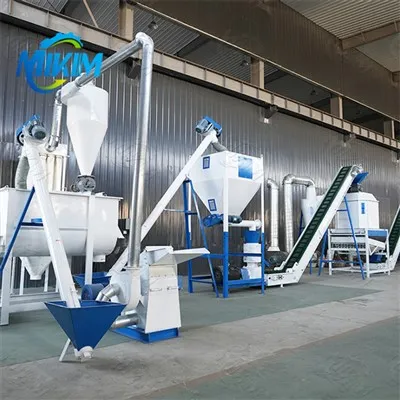
A poultry feed pellet production line is an integrated set of machines and procedures that turns loose powders such as corn, soybean meal, vitamins and minerals into dense, uniformly shaped pellet feed for poultry. The material moves through a fixed sequence: raw material cleaning, crushing, batching, mixing, conditioning, pelleting, cooling and grading. Every stage prepares the material for the next one, so final pellet quality depends on the whole line rather than on any single unit.
Core Machines and Their Roles
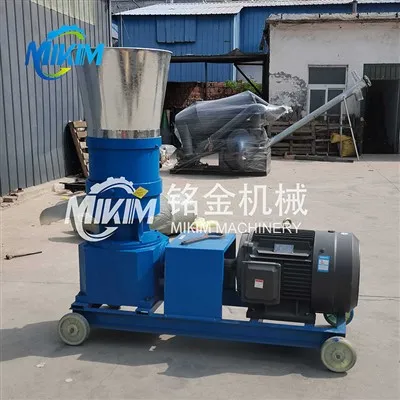
The line combines a hammer mill, a feed mixer, a feed pellet machine, a counterflow cooler with screen and a packing machine in one compact, low-noise unit with a broad application range.
Hammer mill - grinds grains and other ingredients to a consistent particle size, which governs pellet binding and die life.
Feed mixer - blends the ground ingredients in the correct ratio so that every pellet carries the same nutrient profile.
Pellet machine - compresses the conditioned mash into pellets of the required diameter and hardness.
Counterflow cooler and screen - lowers pellet temperature and moisture so the pellets become durable and stable in storage.
Packing machine - weighs and bags the finished feed for farm use or sale.
Model Specifications
The MK series spans a wide capacity range so that farms of different sizes can select a matched unit. The figures below are typical for the series, and the exact configuration of a delivered machine follows the model ordered.
| Model | Capacity | Dimension | Weight |
|---|---|---|---|
| MK-125 | 80-100 kg/h | 110*35*70 cm | 95 kg |
| MK-150 | 120-150 kg/h | 115*35*80 cm | 100 kg |
| MK-210 | 200-300 kg/h | 115*45*95 cm | 300 kg |
| MK-260 | 500-600 kg/h | 138*46*100 cm | 350 kg |
| MK-300 | 700-800 kg/h | 130*53*105 cm | 600 kg |
| MK-360 | 900-1000 kg/h | 160*67*150 cm | 800 kg |
| MK-400 | 1200-1500 kg/h | 160*68*145 cm | 1200 kg |
Where an Integrated Line Pays Back
Integration removes manual transfer between processes, which is where most dust, spillage and labour cost sit. The cleaning stage achieves an efficiency above 98%, and the screen is cleared immediately so its full working area stays available. A pair of 180-degree semicircle sieve plates can be opened easily, and the gap between the screen cylinder and the plate is adjustable to safeguard screening efficiency. The rotor runs with minimal vibration and passes a high-accuracy balancing test, which extends service life. Because the hammer mill handles corn, sorghum, wheat, beans and wood chips, the same line also serves livestock farms, food factories and commercial feed mills.
Matching a Line to Farm Size
Start from the required output per hour and work back to capacity. A small farm producing a few hundred kilograms per hour can begin with the MK-125 or MK-150. Medium farms with a regular flock number usually choose the MK-210 or MK-260, while large feed mills running a continuous schedule benefit from the MK-360 or MK-400. Check floor space against the dimensions in the table and confirm total weight for transport and foundation design. Automating feeding, mixing and discharging keeps labour low and product consistency high from batch to batch.
Frequently Asked Questions
Q: Which stages make up a poultry feed pellet production line?
Raw material cleaning, crushing, batching, mixing, conditioning, pelleting, cooling and grading, carried out as one continuous sequence.
Q: Which model suits a small poultry farm?
The MK-125 at 80-100 kg/h or the MK-150 at 120-150 kg/h, both of which fit modest floor space and single-phase or light three-phase supplies.
Q: What capacity is available for a medium or large operation?
The MK-210 and MK-260 cover 200-600 kg/h, while the MK-300, MK-360 and MK-400 reach 700-1500 kg/h for continuous schedules.
Q: How efficient is the cleaning stage?
Cleaning efficiency is above 98%, and the screen is cleared immediately afterwards so that its full working area remains effective.
Q: Which raw materials can the hammer mill handle?
Corn, sorghum, wheat, beans and wood chips, among others, which makes the line usable for poultry, livestock and general feed milling.
Q: What should be checked before ordering a line?
Target output per hour, available floor space against the model dimensions, total weight for transport and foundation, and the power supply available on site.