Floating Fish Feed Production Equipment: A Complete Line Guide
Leave a message
What Is a Floating Fish Feed Production Line?
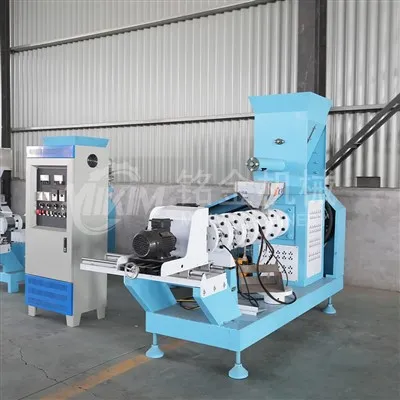
A floating fish feed production line is an integrated processing system that converts grain powders, fish meal and protein concentrates into extruded aqua feed pellets that stay buoyant on the water surface. The centre of the line is a twin-screw extruder fitted with segmented combination screws, which allows a single machine to run several formulations and nutrient profiles while the operating parameters remain under precise control. During extrusion the material is cooked under moisture, heat and mechanical shear, so degraded protein and gelatinised starch become easier for fish to absorb and the nutritional value of the finished pellet rises.
The line is not restricted to one species or one pellet shape. By changing the die plate and adjusting the formulation, the same equipment can produce floating pellets for tilapia and grass carp, slow-sinking pellets for shrimp and crab, and shaped kibble for dogs, cats, birds and rabbits.
Core Equipment Stages of the Line
A complete line is assembled from a fixed sequence of units, each sized to match the capacity of the next so material flows continuously without intermediate buffering.
| Stage | Main equipment | Function |
|---|---|---|
| Raw material preparation | Grinder, blender, vacuum conveyor | Reduces grain and meal to a uniform particle size and blends additives into a homogeneous base. |
| Conditioning | Double-shaft preconditioner | Adds steam and water so starch gelatinises and the extrudate develops a stable, uniform texture. |
| Extrusion | Twin-screw extruder | Cooks, expands and shapes the feed; the screw profile and die set pellet density and floating behaviour. |
| Drying | Air conveyor and multi-layer oven | Moves pellets gently into a multi-layer dryer that removes moisture evenly across the bed. |
| Coating | Roller, oil sprayer, flavour roller | Applies fat, oil and flavour so the pellet carries enough energy and palatability. |
| Cooling and packing | Cooling conveyor, packing machine | Brings the product to ambient temperature and loads it into bags at a stable weight. |
Main Accessories and Their Functions
Line reliability depends heavily on the quality of the main accessories, summarised in the table below.
| Accessory | Function |
|---|---|
| Anti-blocking feeder | Ensures even feeding and a stable discharge of raw material. |
| Double-shaft preconditioner | Keeps material longer inside the conditioner for even pre-curing, raises the degree of pre-gelatinisation and increases capacity. |
| Gearbox | Machined with advanced process technology so the drive runs for long periods without malfunction. |
| Lubrication and cooling system | Uses refined filtration and forced cooling to create stable working conditions for the bearings. |
| Feeding system | Double-spiral forced feeding gives a uniform, wide feed band to the extruder. |
| Screw | Segmented combination screw suits a wide range of raw materials and provides a self-cleaning effect. |
| Rotary cutting device | A suspended die and knife assembly with a linear-bearing tool adjuster allows safe, accurate and quick blade changes. |
Raw Materials and Formulation Flexibility
Typical raw materials are corn flour, wheat flour, soybean meal, rice bran, wheat bran, fish meal, bone meal and meat meal. Because both the die and the formulation can be changed, one line can serve several product families, from a plain floating fish pellet to a flavoured pet kibble shape, without adding equipment. This flexibility matters to plants that sell into more than one market and need to switch products within a season.
Starch sources: corn flour, wheat flour, rice bran, wheat bran
Protein sources: fish meal, soybean meal, bone meal, meat meal
Additives: vitamins, minerals, amino acids, oils and flavours
Why Plants Choose a Continuous Floating Feed Line
All contact parts are made of stainless steel, and the whole line runs continuously and automatically from feeding to packing. A basic formulation can be supplied according to the buyer's requirements as a starting point for trials, and final product shapes and sizes can be varied by changing the mould, with different mould sizes supplied free of charge. A packing machine can be matched to the line on request. Together these features cut the engineering work needed to bring a new feed product into production and shorten the time from trial to full output.
Quality Control and Operating Notes
Consistency in the finished pellet depends on three variables that operators should record every shift: moisture of the raw material blend, barrel temperature profile and cutter speed. Water addition and mixing time are the two factors that most affect pellet uniformity. After drying, moisture content should be measured before coating, because residual moisture shortens shelf life and softens the pellet in water. Finally, floating time should be tested on a sample from each batch at the culture water temperature expected on the farm.
Frequently Asked Questions
Q: What raw materials can the floating fish feed production line process?
Corn flour, wheat flour, soybean meal, rice bran, wheat bran, fish meal, bone meal and meat meal are the usual inputs, blended with vitamins, minerals and oils.
Q: Can one line produce both fish feed and pet food?
Yes. Changing the die plate and the formulation lets the same line run floating aqua pellets and shaped pet kibble in turn.
Q: How is pellet length controlled?
Pellet length is set by the rotary cutting device at the extruder outlet; blade speed is adjusted with frequency conversion to give short crumble or longer pellets.
Q: Why does the extruder improve digestibility?
Moisture, heat and shear gelatinise the starch and open the protein structure, so nutrients are more accessible to fish than in raw ground feed.
Q: What moisture should be reached after drying?
Pellets should be dried to a low, stable moisture before coating; the exact target depends on the formulation and the storage climate, and it should be verified per batch.
Q: Are different mould sizes available?
Different mould sizes are supplied so a single extruder can cover several pellet diameters and shapes without additional equipment.