How do pelleted and extruded feeds differ in their quality attributes?
Leave a message
When buying feed, some farmers may find that some feeds feel hard in their hands and don't easily crumble when dropped, while others crumble easily with a gentle squeeze and have a stronger aroma. This is actually the difference in quality characteristics between pelleted feed and extruded feed. These differences not only affect the user experience but also relate to storage and transportation. Let's analyze this in detail below.
Quality differences caused by manufacturing process
The quality characteristics of pelleted feed: Because it is "pressed," the pellets have a compact structure, high hardness, and good wear resistance. They are not easily broken when dropped or during transportation, reducing waste. Furthermore, the smooth surface of the pellets has low water absorption, making them less prone to moisture absorption and clumping, suitable for long-term storage. Even in warehouses with slightly higher humidity, they are not prone to mold. However, the palatability of pelleted feed is relatively average because the raw materials are not subjected to high-temperature extrusion, and the aroma is not fully released, which may not appeal to some picky eaters. Also, the high pellet density makes it easier for animals to feel full after eating a lot, making it suitable for animals whose feed intake needs to be controlled.


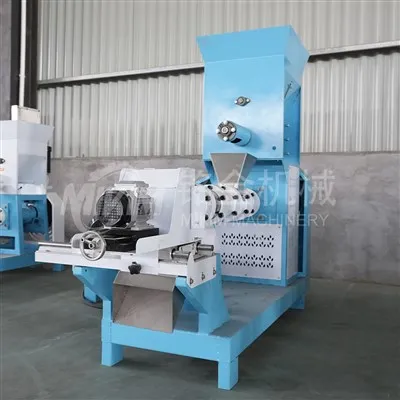
The production process of extruded feed is more like "making popcorn," with the addition of a high-temperature, high-pressure "expansion" step. After the raw materials are crushed and mixed, they first enter a conditioner for thorough heating and humidification, and then are fed into a fish feed machine. The screw of the feed extruder rotates rapidly, pushing the raw materials forward. During this process, pressure is continuously increased, and the temperature rises to 110-130℃. Under high temperature and pressure, the starch in the raw materials is fully gelatinized, and gas is also produced. When the raw materials are pushed to the die at the extruder outlet, the pressure is suddenly released, and the gas in the raw materials expands, making the feed larger in volume and more fluffy in texture. After exiting the die, it is quickly cooled and shaped, which is extruded feed (expanded feed). The entire process adds a "high-temperature, high-pressure extrusion" step, making it a typical "extrusion-expansion" integrated molding process.


Other differences
The differences in quality characteristics lead to different storage and transportation requirements for the two: pelleted feed can be packaged in ordinary woven bags and stacked in a warehouse, without needing special attention to prevent breakage during transportation; extruded feed requires well-sealed packaging bags (such as woven bags with an inner lining), should be stored away from humid environments, and should be transported with minimal impact to reduce breakage. Additionally, extruded feed has a lower bulk density; for the same weight, extruded feed has a larger volume than pelleted feed, requiring more storage space.
about Us
Customer visit

FAQ
1. What is the price of the fish pellet machine?
The price ranges from approximately $9,000-$42,000
2. Do you provide maintenance services for your customers?
Yes, we offer comprehensive after-sales maintenance services to our customers.