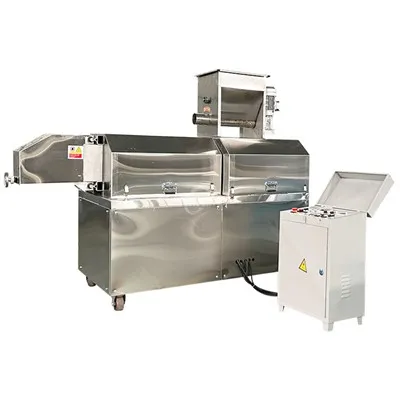
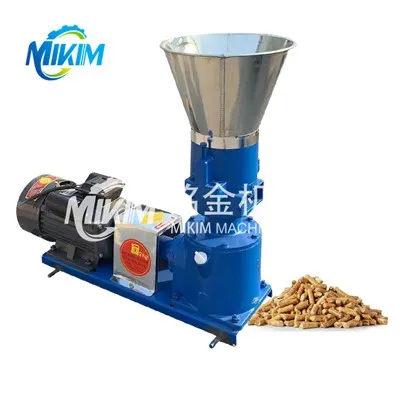
How to adjust the Best dog food Maker machine tension?
Leave a message
content
Key Point 1: Accurately Identify Tension Anomalies to Avoid Blind Adjustments
Tension anomalies are mainly categorized into two types: "too loose" and "too tight." Combining the operating status of the Best Pet food Maker machine with product quality allows for quick and accurate identification, without the need for specialized testing tools. Typical symptoms of too loose tension include: material shifting or slipping during conveying; uneven feeding in the extruder leading to uneven cooking; loose connection between the pellet mill's pressure roller and die head, resulting in skewed and unevenly sized pellets; and loose or vibrating conveyor belts or chains. Typical symptoms of too tight tension include: increased equipment noise and vibration; severe motor overheating and increased energy consumption; accelerated wear of conveyor belts or chains, even component deformation; increased screw resistance in the Homemade dog food Maker machine; and abnormally high discharge pressure (exceeding 6 MPa). In practice, combining these symptoms can quickly pinpoint the type of tension anomaly, providing direction for subsequent adjustments.
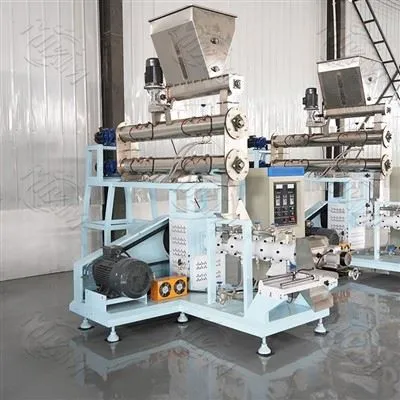
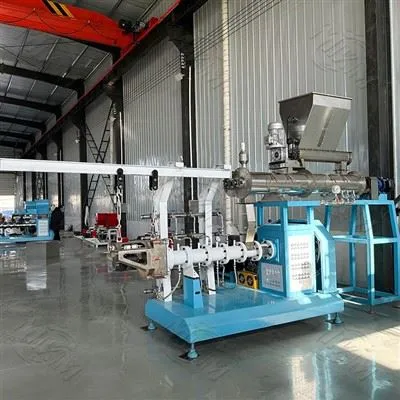
Key Point 2: Basic Principles of Tension Adjustment, Aligning with Equipment Operating Logic
First, the "gradual" principle: Adjustments should be made slowly and finely, with each adjustment controlled within 5%-10%. Avoid large, sudden adjustments that could damage equipment components or affect pellet quality.
Second, the "synchronized adaptation" principle: Tension adjustments must be compatible with the operating parameters (speed, pressure, temperature) of the homemade dog food pellet machine. For example, when adjusting the feed tension of the extruder, the extruder speed should be adjusted simultaneously to ensure uniform feeding.
Third, the "real-time monitoring" principle: During adjustment, observe the equipment's operating status, material conveying, and pellet forming effect in real time, and promptly correct the adjustment range to ensure the tension remains stable within the standard range.

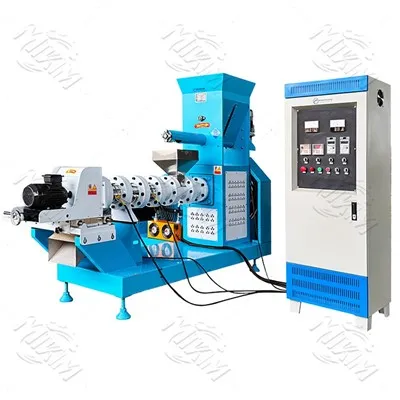
Key Point 3: Universal Adjustment Steps, Easy for Beginners
A universal tension adjustment process for all Automatic Dog Food machines is provided. No complicated operations are required; it can be completed in just four steps, suitable for various small and medium-sized dog food factories.
Step 1: Safe Shutdown: Turn off the main power to the fish food making machine, unplug the power cord, hang a warning sign that reads "Tension Adjustment in Progress, Do Not Start," and wait for the equipment to cool completely (below 50℃). Clean up any remaining material and dust around the equipment.
Step 2: Locate the Adjustment Point: Locate the tension adjustment mechanism of the equipment (usually an adjusting bolt, tension wheel, or adjusting knob). The adjustment points may vary slightly depending on the equipment; in fish feed processing machines, they are often located at the linkage points, while in conveyor systems, they are often at the belt or chain connections.
Step 3: Precise Fine-Tuning: Depending on the type of tension abnormality, slowly adjust the tension mechanism. If the tension is too loose, tighten the adjusting bolt clockwise; if the tension is too tight, loosen it counterclockwise. After each fine-tuning, gently shake the linkage components or belt to feel the tension change.
Step 4: Testing and Verification: Turn on the power, start the fish food extruder machine, and run it idle for 3-5 minutes. Observe the operating status, then add a small amount of raw materials for trial production to test the material conveying and pellet forming effects. Once the tension is confirmed to be stable, normal production can be resumed.
Finished Product Display

about Us
MIKIM's fish feed pellet production lines and supporting machinery offer excellent value for money. Not only are they affordable, eliminating middlemen markups and allowing small and medium-sized enterprises (SMEs) and fish farmers to purchase complete sets of equipment at reasonable costs, but they also boast exceptional efficiency. The fully automated process, from raw material crushing and precise ingredient mixing to extrusion pelleting and maturation, is completed in one continuous flow. This results in high starch gelatinization rates and uniform pellet formation, significantly improving production efficiency and feed quality, truly achieving "low cost, high output." Choosing a MIKIM fish feed pellet production line means enjoying comprehensive pre-sales and after-sales service, including 24-hour online customer support, a one-year warranty on the entire machine, professional on-site installation, commissioning, and maintenance, and a stable supply of spare parts. Customers can buy with confidence and use with peace of mind, with both excellent value and service quality!!!
Customer visit

Certificate of Honor

FAQ
1. What is the price of the fish meal processing machine?
The price ranges from approximately $1,500-$55,000
2. Do you provide maintenance services for your customers?
Yes, we offer comprehensive after-sales maintenance services to our customers.
To explore which twin screw pet food machine model is suitable for your product line, view our full range of equipment or contact our team for a customized production plan.