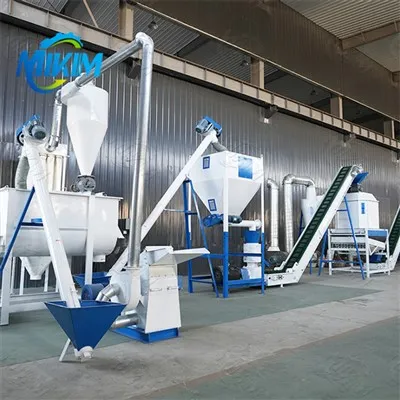
How to control costs for a small fish feed pellet making machine?
Leave a message
Production process optimization reduces ineffective consumption. Implementing an "order-based production" model, production plans are rationally arranged according to customer order volumes to avoid blind production leading to finished product backlogs (feed shelf life is typically 3-6 months). Standardized production processes are established, clearly defining the operation time and quality standards for each stage of raw material receiving, crushing, mixing, extrusion, cooling, and packaging. For example, raw material crushing time is controlled at 10 minutes per batch, and mixing time at 5 minutes per batch, ensuring smooth transitions between stages and reducing waiting time for small fish feed pellet making machines. One feed mill, through process optimization, reduced equipment idle time from 2 hours per day to 30 minutes, saving over 2000 kWh of electricity per month. Simultaneously, production shifts are rationally arranged; during periods of high order volume, a two-shift system is adopted to improve equipment utilization (from 8 hours to 16 hours per day), reducing the fixed cost per unit product.
Personnel optimization reduces labor costs. Small feed mills do not need dedicated electricians or repairmen. They can sign long-term cooperation agreements with local agricultural machinery repair shops, paying on a per-use basis (200-300 yuan per use), saving 4,000-5,000 yuan per month in wages compared to hiring dedicated personnel. Production staff should undergo "one person, multiple roles" training, enabling operators to master multiple skills such as raw material handling, operating the floating fish feed extruder process, and finished product packaging, reducing the number of personnel required.
Quality control reduces rework costs. If the feed produced by the floating fish extruder machine does not meet quality standards (e.g., loose pellets, poor water resistance), it will lead to customer returns, increasing rework costs. A "three-level quality inspection system" needs to be established: moisture and purity are tested before raw materials enter the warehouse, and only qualified raw materials can be used; pellet hardness and temperature are sampled every 30 minutes during extrusion; nutritional components and microbial indicators are tested before finished products leave the warehouse.
Related equipment


about Us
MIKIM's fish feed pellet production lines and supporting machinery offer excellent value for money. Not only are they affordable, eliminating middlemen markups and allowing small and medium-sized enterprises (SMEs) and fish farmers to purchase complete sets of equipment at reasonable costs, but they also boast exceptional efficiency. The fully automated process, from raw material crushing and precise ingredient mixing to extrusion pelleting and maturation, is completed in one continuous flow. This results in high starch gelatinization rates and uniform pellet formation, significantly improving production efficiency and feed quality, truly achieving "low cost, high output." Choosing a MIKIM fish feed pellet production line means enjoying comprehensive pre-sales and after-sales service, including 24-hour online customer support, a one-year warranty on the entire machine, professional on-site installation, commissioning, and maintenance, and a stable supply of spare parts. Customers can buy with confidence and use with peace of mind, with both excellent value and service quality!
Customer visit

Certificate of Honor

FAQ
1. What is the price of the fish feed pellet extruder?
The price ranges from approximately $3,500-$55,000
2. Do you provide maintenance services for your customers?
Yes, we offer comprehensive after-sales maintenance services to our customers.
If you would like to learn more about MIKIM machinery, please contact us. We offer one-stop service and welcome your inquiries!!!